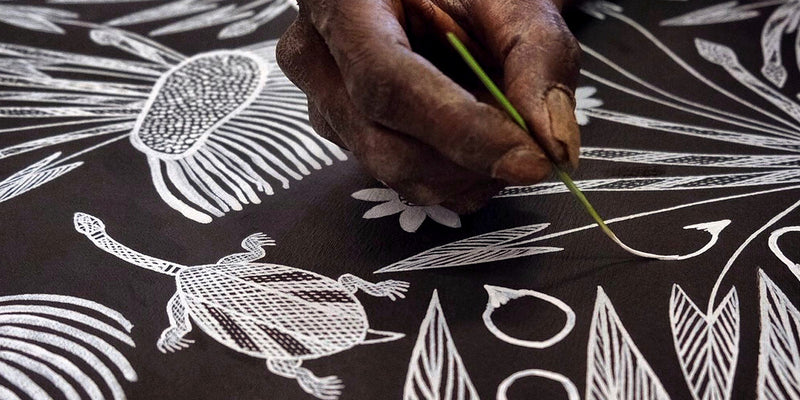
Ngukurr Arts: Yugul Mangi Art from the Roper River
Ngukurr Arts Aboriginal Corporation sits on the banks of the Roper River in south-east Arnhem Land, around 330 kilometres south-east of Katherine in the Northern Territory. The art centre brings together artists from nine distinct clans and language groups: Ngalakgan, Alawa, Mangarrayi, Ngandi, Marra, Warndarrang, Nunggubuyu, Ritharrngu-Wagilak, and Rembarrnga. Together these groups are known as Yugul Mangi, meaning "all together as one."
The community of Ngukurr grew out of the Roper River Mission, established in 1908 by the Church Missionary Society as a refuge for Aboriginal people displaced by the frontier wars. The government took over the mission in 1968, and in 1988 control was handed to the community, which was renamed Ngukurr at that time.
The Ngukurr painting movement has its origins in 1986, when the Northern Territory Open College of TAFE established a printmaking workshop in the community. In 1987, at the artists' own request, painting and printing workshops were organised through the NT Education Department, and Sydney artist John Nelson introduced a course working with large canvases. From that beginning, Ngukurr rapidly developed a distinctive art style recognised for its bold use of colour, dynamic energy, and the synthesis of traditions from nine different language groups. The art centre has been operating as a corporation since 1988.
What makes Ngukurr art immediately recognisable is the combination of bold, vivid colour with imagery drawn from the Roper River environment: the river itself, its wildlife, ceremonial stories, and the landscapes of south-east Arnhem Land. Because artists come from such a wide range of cultural backgrounds, the work at Ngukurr is unusually diverse, with no single dominant style. Some artists work with traditional iconography and cross-hatching. Others paint figurative and narrative works that reflect community life, country, and personal history.
The most celebrated artist to have worked through the centre is Ginger Riley Munduwalawala (c.1937-2002), whose luminous landscape paintings of his mother's country on the Limmen Bight River brought him national and international recognition. His works are held in major collections including the National Gallery of Victoria. Other significant artists associated with the centre include Djambu Barra Barra (c.1946-2005), Amy Jirwulurr Johnson, Willie Gudapi, Gertie Huddleston, and Angelina George. Current artists include Wally Wilfred, Gwenneth Blitner, Karen Rogers, Jill Daniels, and Alan Joshua.
The centre produces paintings, prints, sculpture, jewellery, and textiles. Artists work across a range of mediums and the centre is known for embracing innovation alongside cultural tradition. The Ngukurr Story Project, an ongoing oral history and digital archive initiative, documents the cultural heritage and community history of Ngukurr residents.
Ngukurr is one of the few communities in Arnhem Land that can be visited without a permit. The art centre is open to the public Monday to Friday, 10am to 4pm, and welcomes visitors to the studio space where artists work.
Ngukurr Arts at a glance
-
Established
Painting workshops began 1987. Art centre corporation registered 1988. -
Location
Ngukurr, south-east Arnhem Land, Northern Territory, 330km south-east of Katherine on the Roper River. -
Language and Culture
Nine clans and language groups: Ngalakgan, Alawa, Mangarrayi, Ngandi, Marra, Warndarrang, Nunggubuyu, Ritharrngu-Wagilak, and Rembarrnga. Collectively known as Yugul Mangi. -
Art Style
Bold colour, figurative and narrative painting, printmaking, sculpture, and jewellery. Diverse styles reflecting the nine distinct cultural traditions of the community. -
Notable Artists
Ginger Riley Munduwalawala, Djambu Barra Barra, Amy Jirwulurr Johnson, Willie Gudapi, Wally Wilfred, Gwenneth Blitner, Jill Daniels, and Karen Rogers.