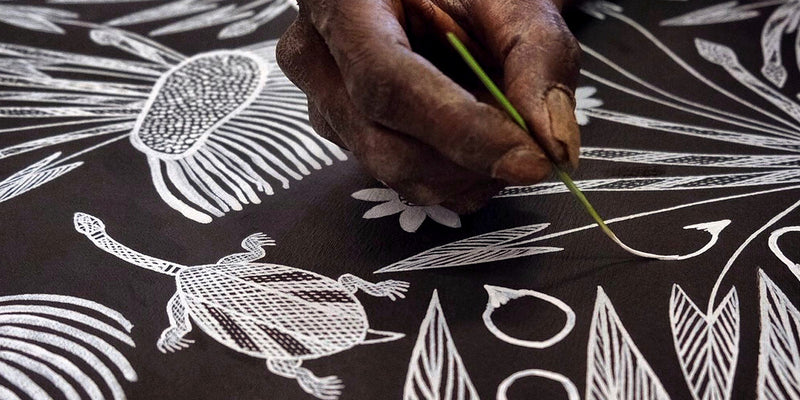
Aboriginal art is one of the oldest living art traditions in the world. It reflects deep connections to Country, culture, and knowledge that continue today. These ten facts outline how Aboriginal art works, why stories and styles repeat, and how art remains connected to place, responsibility, and community.
1. Aboriginal art is one of the world’s oldest living art traditions
Aboriginal people have created art in Australia for at least 65,000 years. This makes Aboriginal art one of the oldest continuous art traditions still practised today.
2. Aboriginal art is connected to Country
Many artworks map Country, showing waterholes, tracks, and important sites, rather than landscapes as seen from a single viewpoint.
3. Dreaming stories are central to Aboriginal art
Many Aboriginal artworks are connected to Dreaming narratives. These stories explain the creation of the land, plants, animals, and people, and set out rules for living and caring for Country.
4. Not everyone can paint every story
Artists do not choose their subjects freely. Rights to paint particular Dreaming stories are inherited through family and governed by cultural law.
5. Repetition is important in Aboriginal art
Many artists paint the same Dreaming throughout their lives. This repetition reflects responsibility and continuity, not copying or lack of creativity.
6. Aboriginal art varies greatly between regions
There is no single Aboriginal art style. Art from Arnhem Land, the Central Desert, the Kimberley, coastal regions, and Tasmania reflects different environments, histories, and cultural practices.
7. Aboriginal art existed long before canvas painting
Before painting on canvas, Aboriginal people created art on rock surfaces, on the body, in sand, and on ceremonial objects. Canvas and acrylic paint became common only in the twentieth century.
8. Symbols in Aboriginal art are part of visual languages
Many Aboriginal artworks use symbols to represent people, places, and movement. These symbols work alongside storytelling, song, and ceremony rather than replacing written language.
9. Aboriginal art has cultural and economic importance
Aboriginal art supports cultural continuity and provides income for many communities. Community-run Aboriginal art centres play an important role in protecting artists and ensuring fair payment.
10. Aboriginal art is a living practice
Aboriginal art is not frozen in the past. Artists continue to paint inherited stories today while adapting to new materials, audiences, and contexts.