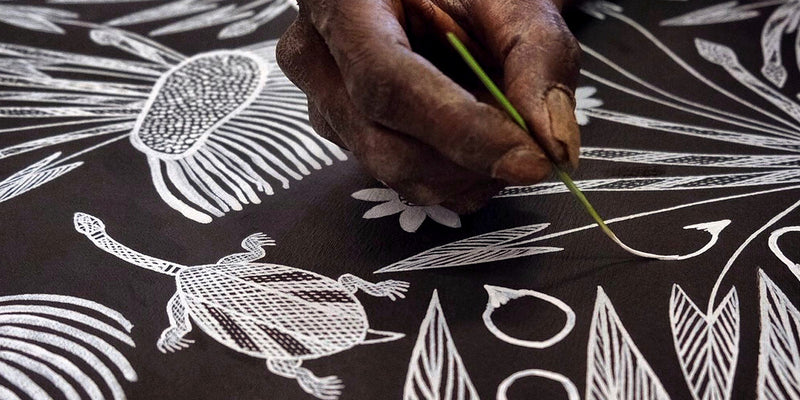
Aboriginal Bark Painting
One Instantly Recognisable Type of Aboriginal Art Today is Bark Painting
Bark paintings were traditionally used to decorate shelters and as part of burial rites. The use of bark painting was first described by Europeans in 1802 when the French disembarked on Maria Island in Tasmania where they found and desecrated a local burial tomb. The tomb was described as a ‘conical structure roughly made of pieces of bark’ which were decorated with painted designs.
Fascinating, given Maria Island is about as far from Arnhem Land as you can get, and Tasmania had been cut off from the mainland for well over ten thousand years by then.

Marie-Alexandre Duparc and Victor Pillement (engravers), after Charles-Alexandre Lesueur. Native tombs on Maria Island. A View of a part of Maria Island and of Marion Bay, Van Diemen's Land (Tombeaux des naturels de l'ile Maria. Vue d'une partie de l'ile Maria, et de la baie Marion, sur la terre de Diémen), 1824. Plate 12 in the Voyage de Découvertes aux Terres Australes atlas, Arthus Bertrand, Paris, 1824, 2nd edition. Published twenty-two years after the encounter it depicts.
The first collections of bark paintings made based on artistic and aesthetic merit, as opposed to ethnographic interest, were put together in 1912 by Walter Baldwin Spencer (1860-1929) when he visited the buffalo hunting camp of pastoralist Paddy Cahill (c. 1863-1923) at Oenpelli (now Gunbalanya) in western Arnhem Land.
Artist Paddy Compass Namadbara (c. 1892-1978) recollected in a 1967 interview with researcher Lance Bennett that Spencer asked chosen artists to create bark paintings on small, transport-friendly bark sheets, which they had never done before. This transformed the traditional bark-hut paintings into a new medium: bark paintings.
Bark Painting Process
The material comes from the country the painting is about. The tree is cut on that country, the ochre is dug from it, and the work is made there. The bark is not a support the story was put onto. It is part of the story.

Collecting Barks for Painting. Image courtesy of Buku-Larrŋgay Mulka Centre, Yirrkala. © the artists and Buku-Larrŋgay Mulka Centre.
Preparing the bark takes longer than painting it.
- Eucalyptus stringybark is cut in the wet season, when the sap is up and the bark lifts. Two horizontal incisions and one vertical, then the sheet is prised off whole.
- The inner surface, the smooth side, is put over a fire. This hardens it.
- The sheet is then pressed flat under weights. This can take months.
- Dry, it holds rigid. Stringybark is the name, but the works are solid and durable. A metal support frame holds the sheet and doubles as the hanging point.
Bark sheets are rarely uniform. Some dry almost flat, others keep a curve or a ridge from the tree. Artists work with the sheet they have, and the composition follows its shape and edges.
Rarrk: The Essence of Arnhem Land Paintings

Buku-Larrŋgay Mulka artists painting bark paintings. Image courtesy of Buku-Larrŋgay Mulka Centre, Yirrkala. © the artists and Buku-Larrŋgay Mulka Centre.
- The crosshatching is clan design. It is called rarrk in the west of Arnhem Land and miny’tji in the east, and it is owned. An artist paints the designs they have the right to paint.
- The lines go on in layers, drawn with a brush made from human hair. Up close the surface shimmers. That optical effect is the point: it is ancestral power made visible.
- The palette is red and yellow ochre, charcoal and white clay. Nothing else.
- Binder was egg yolk. Since the 1960s it has usually been water-soluble wood glue.
The Same Designs, Different Surfaces
 Mardayin ceremony body designs from eastern Arnhem Land, NT. Photo: Donald Thomson
 Early bark catalogue from the Milingimbi Education and Cultural Association collection
Compare the Mardayin body designs with the barks beside them. They are the same designs. The bark is another surface, not another subject, and it is partly why barks hang vertically. They follow the body.
 Aboriginal Wandjina rock art in Wunnumurra Gorge, Barnett River
 L ©Wattie Karruwara, c.1962 - R ©Alec Mingelmangan, 1975
The same holds in the Kimberley. Wandjina on rock at Wunnumurra Gorge. Wandjina on bark by Wattie Karruwara in about 1962 and Alec Mingelmangan in 1975. Rock art gets talked about in the past tense. The barks are the argument against that.
About Aboriginal Art
Aboriginal Art History Aboriginal Art Symbols What is The Dreaming? Origins of Dot Painting Aboriginal Art Regions