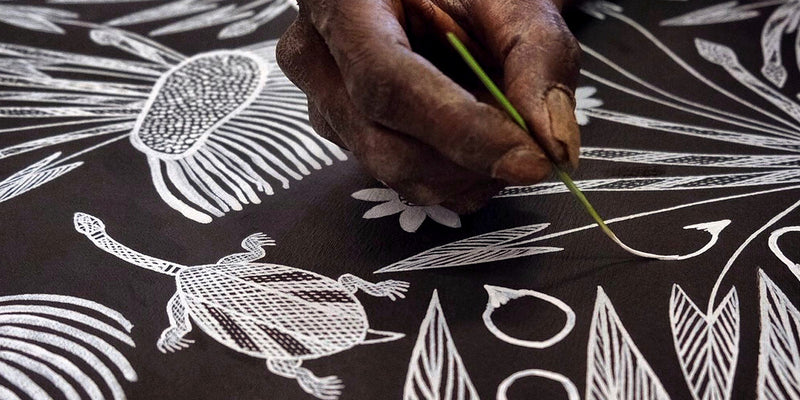
Bark painting from Buku Larrŋgay Mulka Aboriginal Art Centre, Arnhem Land © Buku Larrŋgay Mulka
Buku Larrŋgay Mulka: Aboriginal Art from Yirrkala, North-east Arnhem Land
The name holds its meaning precisely. Buku-Larrŋgay describes the feeling of the first rays of sun striking the face at dawn. Mulka refers to a ceremony that is sacred yet publicly shared, and to hold something without spoiling it. Together they frame what the centre is: a place of cultural authority, visibility, and responsibility.
Buku Larrŋgay Mulka was established in 1976 in the old Mission health centre at Yirrkala, an act of self-determination coinciding with the withdrawal of the Methodist Overseas Mission and the Land Rights and Homeland movements. It was not the beginning of Yolŋu art at Yirrkala, but the beginning of Yolŋu ownership over its sale and representation. Among its main inspirations was Narritjin Maymuru, who had set up his own beachfront gallery in the 1960s to sell work that now graces major museums and private collections worldwide. His vision of Yolŋu-owned business selling Yolŋu art, begun with a shelter on a beach, laid the groundwork for what followed.
The Yirrkala Church Panels and the 1963 Bark Petition had already established that Yolŋu artists used their practice to assert sovereignty, presenting law, history, and land ownership through visual form as direct political statements to the Australian government. The art centre that emerged from this tradition has never departed from it. Miny'tji, sacred clan designs rendered in rarrk cross-hatching, carry ancestral knowledge tied to land, sea, and kinship. These are not decorative traditions. They are living systems of law made visible.
Today the centre comprises two divisions: the Yirrkala Art Centre, which represents Yolŋu artists exhibiting and selling contemporary work, and the Mulka Project, a digital production studio and archiving centre incorporating the museum. The Mulka Museum was opened in 1988 by Gough Whitlam, curated by Yolŋu Elders who designed bark paintings and sculptures for the space throughout the 1980s. A staff of around twenty services Yirrkala and approximately 25 homeland centres within a 200km radius.
Works from the centre are held in the collections of the National Gallery of Australia, the Art Gallery of New South Wales, the National Gallery of Victoria, and the Kluge-Ruhe Aboriginal Art Collection at the University of Virginia, among other major Australian and international institutions.
Buku Larrŋgay Mulka at a glance
- Established: 1976 in Yirrkala, north-east Arnhem Land, as a Yolŋu-controlled enterprise.
- Location: 138 Tuffin Road, Yirrkala, Northern Territory. Approximately 700km east of Darwin on the northeastern tip of Arnhem Land.
- Language and Culture: Yolŋu Matha speaking communities of north-east Arnhem Land. Services Yirrkala and approximately 25 homeland centres within a 200km radius.
- Art Style and Media: Bark painting, rarrk cross-hatching, larrakitj (memorial poles), yidaki, sculpture, fibre art, and printmaking using ochre and natural materials.
- Cultural Significance: The Yirrkala Bark Petition of 1963 is among the most significant works in Australian legal and political history. Artworks function as expressions of Yolŋu law, land ownership, ceremony, and history.
- Divisions: Yirrkala Art Centre (contemporary art sales) and the Mulka Project (digital production studio and cultural archive).
- Public Collections: National Gallery of Australia, Art Gallery of New South Wales, National Gallery of Victoria, and the Kluge-Ruhe Aboriginal Art Collection at the University of Virginia.
View Aboriginal Art from Buku Larrŋgay Mulka
Buku Larrŋgay Mulka Aboriginal Art Centre website