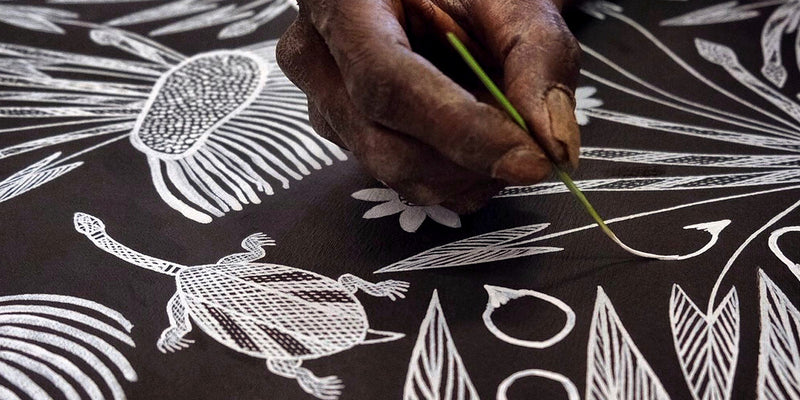
John Mawurndjul, 2005. Photograph: R Ian Lloyd
John Mawurndjul: the Kuninjku bark painter from Mumeka whose rarrk ended up in the Tinguely Museum in Basel
In 1963 John Mawurndjul was brought to Maningrida for leprosy treatment. The disease had affected his hands, a fact that would later seem remarkable given the extreme precision his painting demanded. He had been born in 1952 at Mumeka, a traditional camping ground of the Kurulk clan on the Mann River about 50 kilometres south of Maningrida in West Arnhem Land, and had grown up moving between seasonal camps with his family, with only occasional contact with non-Indigenous people. He learned to paint in the late 1970s with his older brother Jimmy Njiminjuma and uncle Peter Marralwanga under the newly established Maningrida Arts and Culture centre, beginning with small barks depicting Ngalyod the rainbow serpent, Namarrkon the lightning spirit, and local species such as barramundi and bandicoot.
Rarrk is a cross-hatching technique drawn from the body-painting designs of the Mardayin ceremony, a sacred Kuninjku rite. Its lines are applied with a brush sometimes made from a single hair, in a mixture of ochre, water and glue, and can take weeks to complete. The visual effect, described in Kuninjku as kabimbebme ("colour pop" or "paint jumping out"), is understood not as decoration but as an expression of ancestral power. In the 1980s Mawurndjul began working on larger bark surfaces, and around 1988 he made a decisive shift: abandoning figurative iconography almost entirely and allowing rarrk to dominate the whole surface of the painting, filling both the interior and background of his compositions. Earlier artists including Yirawala and Peter Marralwanga had used rarrk within figures, but Mawurndjul extended it outward until the entire bark became a shimmering, undulating field of ancestral energy. It was a development other Kuninjku artists sought to emulate.
He won the bark painting prize at the Telstra National Aboriginal and Torres Strait Islander Art Award in 1999, 2002 and 2016. In 2003 he became the first Indigenous artist to win the Clemenger Contemporary Art Award at the National Gallery of Victoria, a national prize open to all Australian artists, which he described as demonstrating that Aboriginal and non-Aboriginal art were now considered "level." He was appointed a Member of the Order of Australia in 2010 and received the Red Ochre Award for lifetime achievement in First Nations arts in 2018. In 2005 and 2006 he became the first Australian artist to be given retrospectives at two major European museums, at the Museum Tinguely in Basel and the Sprengel Museum in Hannover. In 2018 the Museum of Contemporary Art Australia and the Art Gallery of South Australia jointly mounted the retrospective John Mawurndjul: I Am the Old and the New, a survey of 160 works that toured nationally until 2021.
In the early 1990s Mawurndjul established an outstation at Milmilngkan, on a billabong that is a sacred site of Ngalyod, the rainbow serpent central to his work. He lived between Milmilngkan and Maningrida for the rest of his life, maintaining his ceremonial responsibilities as Djunkay (cultural manager and knowledge-keeper) for the Kurulk clan while sending bark paintings to collections in Australia, Europe and North America. His wife, the celebrated artist Kay Lindjuwanga (Bulanjdjan Ngalkardbam), died in October 2024 after a prolonged illness. John Mawurndjul died peacefully in Maningrida on 21 December 2024. In accordance with Kuninjku cultural protocols, he is to be known as Balang Nakurulk during the period of mourning.
25 Famous Aboriginal Artists You Should Know