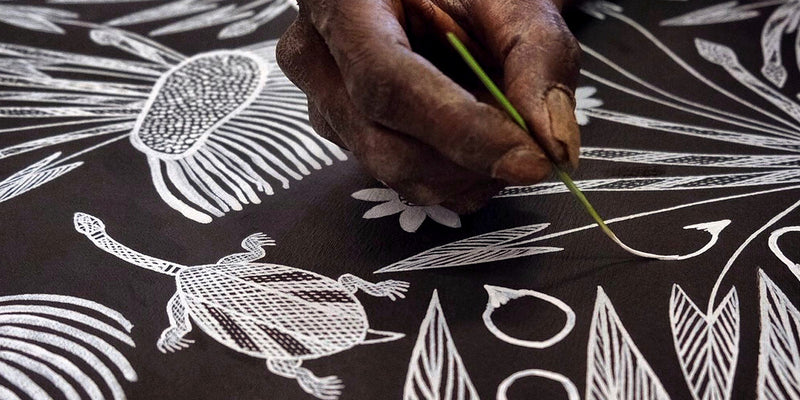
Larrakia Nation Arts, Darwin, Northern Territory
In 1888, a Larrakia man named Billamook was among three Aboriginal prisoners held in Fannie Bay Gaol in Palmerston, the settlement that would become Darwin. The Deputy Sheriff, John George Knight, recognised their artistic abilities and had them produce drawings for Australia's contribution to the Intercolonial Exhibition in Melbourne. The works were listed in the fine arts section of the catalogue: the first time Aboriginal artworks had been exhibited as art rather than as "primitive art". Billamook had been among the Larrakia people who greeted the first British colonists when they arrived by boat in 1869 to establish a permanent settlement on his country. The six drawings that survive, known as The Dawn of Art, are held in the Museums Victoria collection. Larrakia Nation Arts (LNA) carries that long practice of cultural expression forward. Established as part of the Larrakia Nation Aboriginal Corporation, founded in 1997 to represent the traditional owners of Darwin, LNA operates as a meeting place for Larrakia and urban Indigenous artists working across traditional and contemporary practice.
The Larrakia are saltwater people, traditional custodians of Gulumerrgin Country: the Darwin region from the Cox Peninsula in the west to Gunn Point in the north, the Adelaide River in the east and Manton Dam in the south. Nine family groups make up the Larrakia Nation, with around 2,600 people living in and around Darwin today. Artists at LNA work in wood carving, linocut printmaking, acrylic on canvas, silkscreen printing on fabric, silver jewellery, and large-scale public art. Senior artist Daniel 'Roque' (Gullawan) Lee, of the Cubillo family, has spent a working life crafting traditional artefacts including woomeras, spears, message sticks, canoes, didgeridoos and animal carvings, alongside painting on canvas, bone, shell and sawfish bill. Trent 'Bundirrik' Lee worked with Roque Lee on the public sculpture mirragma gunugurr-wa (2023), installed at Bicentennial Park in Darwin, which draws on Larrakia stories of using bamboo rafts to cross Darwin Harbour for ceremony and fishing. Kenny Reid, great-grandson of Larrakia matriarch Granny Ababa, is a carver and muralist whose work includes the first traditional dugout canoe built by Larrakia men in sixty years, commissioned by the Museum and Art Gallery of the Northern Territory. The Larrakia Cultural Centre, a $58.6 million facility designed in the form of an ancestral bird in flight adjacent to the sacred Stokes Hill site overlooking Darwin Harbour, is expected to open in 2026, providing a permanent home for Larrakia culture, language and repatriated artefacts.
Larrakia Nation Arts at a glance
- Location: Darwin (Gulumerrgin Country), Northern Territory
- Language group: Larrakia (Larrakiya/Gulumirrgin); saltwater people of the Darwin region
- Established: Part of Larrakia Nation Aboriginal Corporation, founded 1997
- Art forms: Wood carving, linocut printmaking, acrylic on canvas, silkscreen on fabric, silver jewellery, large-scale public art, traditional artefacts (spears, woomeras, canoes, message sticks)
- Notable artists: Daniel 'Roque' (Gullawan) Lee, Trent 'Bundirrik' Lee, Kenny Reid
- Notable works: mirragma gunugurr-wa public sculpture, Bicentennial Park Darwin (2023); 40 magpie geese installation, Brown's Mart; traditional dugout canoe at Coomali Art Centre
- Forthcoming: Larrakia Cultural Centre at Stokes Hill Waterfront, Darwin, expected to open 2026