Life is better with art!
Image Loading Spinner
  • Aboriginal Artwork by Billy Yunkurra Atkins, Untitled, 76x46cm
  • Aboriginal Artwork by Billy Yunkurra Atkins, Untitled, 76x46cm
  • Aboriginal Artwork by Billy Yunkurra Atkins, Untitled, 76x46cm
  • Aboriginal Artwork by Billy Yunkurra Atkins, Untitled, 76x46cm
Image Loading Spinner
Aboriginal Artwork by Billy Yunkurra Atkins, Untitled, 76x46cm

Billy Yunkurra Atkins, Untitled, 76x46cm

Your support helps the artist and their community art centre.

Free insured post & 120-day returns Ships from Tasmania within 1 business day Arrives in 1–3 days (Aus) · 5–10 days (Int’l*) Guaranteed colour accuracy

Martumili Artists Certificate of Authenticity

Community Certified Artwork

This original artwork is sold on behalf of Martumili Artists, a community-run art centre. It includes their Certificate of Authenticity.

  • Aboriginal Artists - Billy Yunkurra Atkins
  • Community - 
  • Aboriginal Art Centre - Martumili Artists
  • Catalogue number - 20-68
  • Materials - Acrylic paint on canvas
  • Size(cm) - H76 W46 D2
  • Postage variants - Artwork posted un-stretched and rolled for safe shipping
  • Orientation - Painted from all sides and OK to hang as wished

This is Yunkurra’s Country, his ‘ngurra’ (home Country, camp). People identify with their ngurra in terms of specific rights and responsibilities, and the possession of intimate knowledge of the physical and cultural properties of one’s Country. Painting ngurra, and in so doing sharing the Jukurrpa (Dreaming) stories and physical characteristics of that place, has today become an important means of cultural maintenance.

Yunkurra’s ngurra encompasses his birthplace, Palatji (Palarji, Weld Springs, Canning Stock Route Well 9), and the Country that he and his family walked in the pujiman (traditional, desert-dwelling) era. Yunkurra grew up, walked and hunted primarily around the areas surrounding Kumpupirnly (Lake Disappointment), Kupayura (Savory Creek) and Jilukurru (Killagurra Springs, Canning Stock Route Well 17). Eventually, as a ‘young fella’ he, like most other Martu at the time, began working on pastoral stations around the Pilbara, ‘mustering bullock, sheep too.’ In later life Yunkurra relocated to Jigalong Aboriginal community, closer to his home Country.

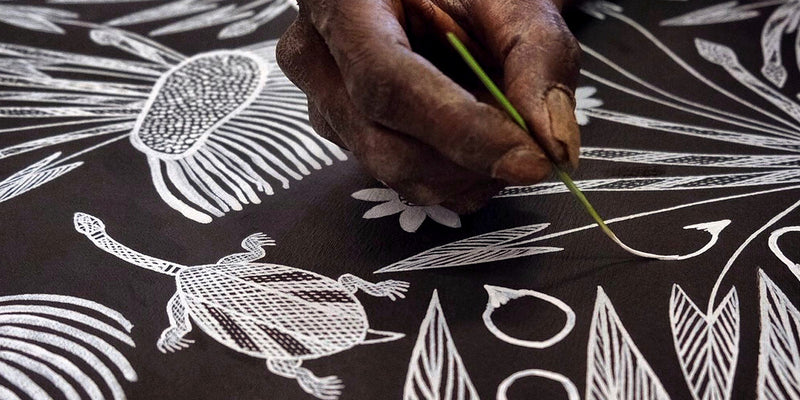
Portrayed in this work are features of Yunkurra’s ngurra, such as the striking salt lakes, dominant permanent red tali (sandhills), warta (trees, vegetation), and the individually named water sources he and his family camped at. Rock holes, waterholes, soaks and springs were all extremely important sites for Martu people during the pujiman period, and are generally depicted with circular forms.

The encyclopaedic knowledge of the location, quality and seasonal availability of the hundreds of water bodies found in one’s Country sustained Martu as they travelled across their Country, hunting and gathering, visiting family, and fulfilling ceremonial obligations. They would traverse very large distances annually, visiting specific areas in the dry and wet season depending on the availability of water and the corresponding cycles of plant and animal life on which hunting and gathering bush tucker was reliant. As they travelled and hunted they would also burn areas of Country, generating a greater diversity of plant and animal life.

"Some people paint a rockhole, only rockhole. Nothing. I got story. Jukurrpa (Dreaming), full up." - Yunkurra Billy Atkins
Yunkurra was a Putijarra man and senior custodian of the area surrounding Kumpupirntily (Lake Disappointment), at the southern end of Martu Country. He was born in the early 1940s at Palatji (Palarji, Weld Springs, Canning Stock Route Well 9), and was the eldest brother of fellow Martumili Artist Miriam Atkins. Yunkurra grew up around Wiluna, and narrowly avoided being taken away by missionaries as a child. Subsequently he grew up with his elders, learning about culture and Country in his traditional lands, including Kumpupirntily, Kupayura (Savory Creek) and Jilukurru (Killagurra Springs, Canning Stock Route Well 17).
Yunkurra lived a pujiman (traditional, desert dwelling) lifestyle on his “Country, good Country... We used to stop there [and] go hunting. No road then, we walking around. No car, only camels” (Yunkurra Billy Atkins). Eventually, as a ‘young fella’ he, like most other Martu at the time, began working on pastoral stations around the Pilbara, ‘mustering bullock, sheep too.’ In later life Yunkurra relocated to Jigalong Aboriginal community, closer to his home Country, where he remained until his passing in 2020.
Yunkurra began painting and carving independently in the early 2000s, earlier than most Martu artists. He played a central role in the development of painting practice in the Martu communities, and as a senior artist and creative innovator he produced works in many mediums. As an individual Yunkurra was instrumental in the establishment of Martumili Artists.
Yunkurra’s Country encompasses some of the most sacred and dangerous sites in the Western Desert; Kumpupirntily and Jilukurru. The Jukurrpa (Dreaming) stories and beings associated with these sites, including the ancestral Ngayurnangalku (cannibal beings) and Wati Kujarra (Two Goanna Men), form the subject for the majority of Yunkurra’s copious body of work. An unashamedly political artist, Yunkurra has used his work as a platform to staunchly oppose the development of mining interests in the Kumpupirntily area, declaring “Ngayurnangalku still there. They’re still alive. Don't go, keep away! I been block him, tell all the miners to keep away. Cannibal gonna come out of the lake, kill you, knock you on the head and have a feed. If they dig him up, anybody, blackfella, whitefella, they’ll get killed! They’ll have a good feed!” (Yunkurra Billy Atkins).
Yunkurra is known for his distinctive imagery, melding a naive Western style with impossibly disorienting multiple perspectives to explore the simultaneous beauty and danger of his Country, rich with Jukurrpa narratives and beings. Yunkurra's work was selected for the 2003 and 2017 Telstra National Aboriginal and Torres Strait Islander Art Awards, and in 2017 he was the recipient of the Hedland Art Award. He held regular solo exhibitions, and his work has been acquired by The National Gallery of Australia, the National Museum of Australia, and the Art Gallery of Western Australia. Yunkurra's collaborative animation, Cannibal Story, also screened in a number of highly celebrated film festivals and screen events around the globe.

Martumili Artists was established in late 2006 and supports Martu artists in Kunawarritji, Punmu, Parnngurr, Jigalong, Warralong, Irrungadji (Nullagine), and Parnpajinya (Newman). Many Martu artists have close relationships with established artists amongst Yulparija, Kukatja, and other Western Desert peoples and are now gaining recognition in their own right for their diverse, energetic, and unmediated painting styles. Their works reflect the dramatic geography and scale of their homelands in the Great Sandy Desert and Rudall River regions of Western Australia. Martumili Artists represents speakers of Manyjilyjarra, Warnman, Kartujarra, Putijarra, and Martu Wangka languages, many of whom experienced first contact with Europeans in the 1960s. The artists include painters working in acrylics and oils, as well as weavers coiling baskets and sculptors working in wood, grass, and wool. Martu artists proudly maintain their creative practices whilst pursuing social and cultural obligations across the Martu.

"Fantastic service. I have now bought several paintings from Art Ark and can highly recommend this gallery" - Lynne, Aus – ART ARK Customer Review

← Previous Page Arnhem Land Weaving Arnhem Land Art Dot Paintings Subscribers Stretched Paintings Desert Weavings Watercolour Paintings