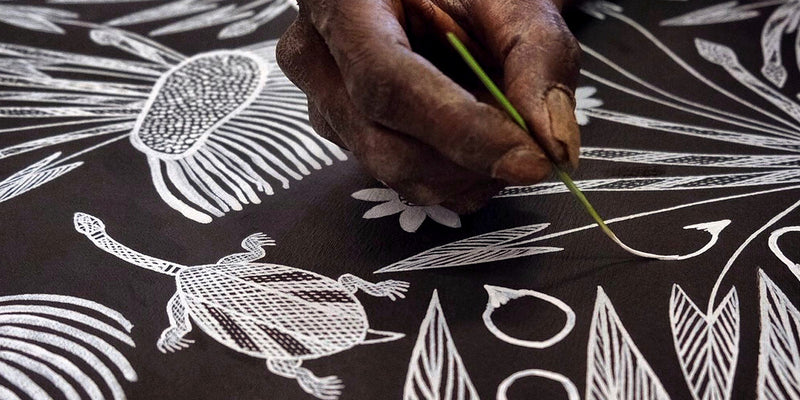
Grace Laradjbi, Kubumi (Waterholes), 165x96cm
Your support helps the artist and their community art centre.
Free insured post & 120-day returns Ships from Tasmania within 1 business day Arrives in 1–3 days (Aus) · 5–10 days (Int’l*) Guaranteed colour accuracy
Community Certified Artwork
This original artwork is sold on behalf of Maningrida Arts and Culture, a community-run art centre. It includes their Certificate of Authenticity.
– Original 1/1
- Details
- Artwork details
- Artist
- Art Centre
- Aboriginal Artist - Grace Laradjbi
- Community - Maningrida
- Aboriginal Art Centre - Maningrida Arts and Culture
- Catalogue number - 912-25
- Materials - Pandanus and Natural Dyes
- Size(cm) - H165 W96 D2
- Postage - Posted flat
- Orientation - Ok to hang in any orientation
Kubumi is a sacred site on the Mann River. This is its story, as told by a ritual manager of the site, Lulu Laradjbi, with the authority of her husband Mick Kubarkku, a land owner of that country.
Ngalyod, the Rainbow Serpent, pierced the rock at a place called Bolerrhlerrh and journeyed downstream from there to Ngalmalanj. The camping place Kubumi is downstream from there, but at Ngalmalanj the serpent was blocked. It pushed down into the riverbed, pushed into the earth, sinking down forever. Now it lives under the rocky riverbed. That site continues downstream. Upstream is the site Molerrhlerrh, which has a waterfall and a big waterhole. There the serpent moved inside, downstream, to the lower region.
During the dry season at Kubumi, the Mann River shrinks to a series of deep waterholes, exposing the tunnels through the rocky outcrop that interconnect the pools.
Grace Laradjbi is the daughter of senior fibre artist Lulu Laradjbi whose partner was the acclaimed bark painter Mick Kubarkku. Grace makes 2D pandanus panels and sculptures often depicting barramundi, stingrays and yawkyawks (female water spirits). Her works are characterised by strong designs, intricate technique and bold use of colour.
Grace uses gun-menama (pandanus spiralis) to create her works. To prepare the pandanus the inner leaves of the plant are collected using a hook. Each V-shaped leaf is first split in half along its spine. After removing the sharp spines, the two surfaces of the leaf are then split away from other. After this preparation, the pandanus is boiled in a billycan with plant materials to dye the fibre. Like her contemporaries, Grace only uses natural dyes and achieves enormous variation. Common colours in her work include:
– barra gu-jirra: the soft, white and fleshy end of the pandanus leaf imparts green to the fibre.
– mun-gumurduk/ gala (Pogonolobus reticulatus): a bright yellow root that is crushed and put in a billycan with the fibre and boiled. It creates yellow when boiled once and deep orange hues when boiled multiple times.
– ngalpur (Haemodorum brevicaule): a bright red root which yields a range of purply red to brown colours.
– Baluk: ashes of certain plants are added to the boiling billycan with the fibre and dye plants to alter the colour that is imparted to the fibre. The fruiting body of gulpiny (Banksia denanta) is burnt and the ashes added to other day plants to make the colour pink.
(Margie West, 1995, Maningrida – the Language of Weaving)
An art movement that is striking, political and enduring: this is what contemporary artists in Maningrida and the surrounding homelands have built, powered by their ancestral connections to country and djang.
Ways of learning and schools of art in Arnhem Land are based around a system of passing knowledge and information on to others. The art here has its genesis in body design, rock art and cultural practices, in concert with more than 50 years of collaborations, travel and political action to retain ownership of country. Values and law are expressed through language, imagery, manikay (song), bunggul (dance), doloppo bim (bark painting), sculptures, and kun-madj (weaving) – the arts.
The artists’ transformation of djang into contemporary artistic expression has intrigued people around the world: art curators and collectors, and stars including Yoko Ono, Jane Campion, David Attenborough and Elton John. Pablo Picasso said of Yirawala’s paintings, ‘This is what I’ve been trying to achieve all my life.’
Yirawala (c.1897–1976) was a legendary Kuninjku leader, artist, land-rights activist and teacher, and his artwork was the first of any Indigenous artist to be collected by the National Gallery of Australia as part of a policy to represent in depth the most significant figures in Australian art.
Maningrida Arts & Culture is based on Kunibídji country in Arnhem Land in Australia’s Northern Territory. The area where artists live encompasses 7,000 square kilometres of land and sea, and over 100 clan estates, where people speak more than 12 distinct languages. Aboriginal people in this region are still on country, surviving and resilient because their country is the centre of their epistemology, their belief system, culture – djang.
Artists’ works from the larger Maningrida region can be seen in collections and institutions around the world. We work with museums, contemporary galleries and high-end retailers both nationally and internationally on projects throughout the year.
Text courtesy: Maningrida Arts and Culture
"True colours and beautiful workmanship." - Sarah, Aus – ART ARK Customer Review