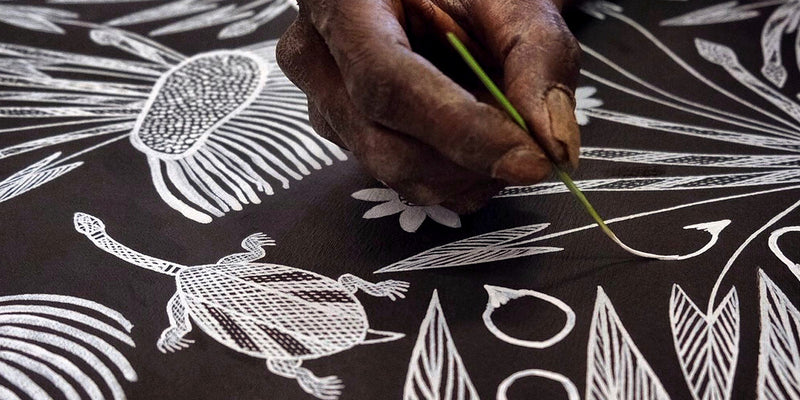
Kumpaya Girgirba, Kunawarritji (Canning Stock Route Well 33), 91x91cm
Your support helps the artist and their community art centre.
Free insured post & 120-day returns Ships from Tasmania within 1 business day Arrives in 1–3 days (Aus) · 5–10 days (Int’l*) Guaranteed colour accuracy
Community Certified Artwork
This original artwork is sold on behalf of Martumili Artists, a community-run art centre. It includes their Certificate of Authenticity.
– Original 1/1
- Details
- Artwork
- Artist
- Art Centre
- Aboriginal Artists - Kumpaya Girgirba
- Community - Kunawarritji
- Aboriginal Art Centre - Martumili Artists
- Catalogue number - 24-1051
- Materials - Acrylic paint on canvas
- Size(cm) - H91 W91 D2
- Postage variants - Artwork posted un-stretched and rolled for safe shipping
- Orientation - Painted from all sides and OK to hang as wished
“When I was a young girl, I walked everywhere, travelling along the Canning Stock Route. I walked north and west, around Wanawarla (lake). I grew up around there, going right around that Country and all the way back to Kunawarritji. But once I became a woman I stopped travelling and just stayed around Kunawarritji.
[At] Kunawarritji, all the Minyipuru (Jakulyukulyu, Seven Sisters) mima (women) there. He been chase them, Yurla.”
– Kumpaya Girgirba (Girgaba)
Kunawarritji is an important site in the Great Sandy Desert where multiple stories and histories intersect. Originally a spring water and major Martu pujiman (traditional, desert dwelling) camping site, at the turn of the 20th century Kunawarritji was converted into a well along the Canning Stock Route. Each year throughout the 1930s–50s, the well became a site of contact between the drovers, their cattle, and desert families like Kumpaya’s. Kumpaya was born at Kiwirrkurra, 350 kilometres east of Kunawarritji. She grew up in the Country between these sites, and from an early age she and her family had encounters with drovers along the Canning Stock Route. In her paintings for this area, Kumpaya frequently depicts the waterholes between Kunawarritji and Punmu that she travelled between as a young woman. These water sources include Wuranu (Canning Stock Route Well 29), Juntu-juntu (Canning Stock Route Well 30), Mujingarra, Yurrunguny, Papuly, Nyipily (Nyipil, Canning Stock Route Well 34), Pikarnu, and Yalta.
As Kumpaya describes in her account, Kunawarritji features in the Minyipuru (Jakulyukulyu, Seven Sisters) Jukurrpa (Dreaming). Minyipuru is a central Jukurrpa narrative for Martu, Ngaanyatjarra, Pitjantjatjara and Yankunytjatjara people that is associated with the seasonal Pleiades star constellation. Beginning in Roebourne on the west coast of Western Australia, the story morphs in its movement eastward across the land, following a group of women as they walk, dance, and even fly from waterhole to waterhole.
As they travelled the women left markers in the landscape and created landforms that remain to this day. During the entirety of their journey the women are pursued by a lustful old man, Yurla, although interactions with other animals, groups of men, and spirit beings are also chronicled in the narrative. The Minyipuru travelled to Kunawarritji from Nyipily (Nyipil, Nibil, Canning Stock Route Well 34), and transformed themselves into a distinctive group of trees that remain in the area between these two sites. From Kunawarritji Yurla followed the sisters to Pangkapirni, where he finally caught one of the women.
Today, Kunawarritji is a site of return, a place where people came back to continue their life in the desert with the formation of Kunawarritji Aboriginal community in the early 1980s. The community’s cultural significance endures, with the population swelling up to 1000 during cultural business.
“I came back to do painting in my side [region] and even taught the others to paint. My auntie showed me how to paint and … which part of the Country I should do, only my area and my stories on my side… From there I never stop painting, and first when I started I did so many, lots and lots of painting ... and so we taught each other and everybody else is doing it now.
Wangka is storytelling – like a drawing, putting something on the canvas. Painting it, but old people used to tell stories on the sand, with fingertips… They draw it in the sand like they do on a canvas. [I paint] my own [stories], where I came from, where my parents used to take me, where my grandparents’ area [was], where we used to hunt and go place to place, camping with my parents and grandparents.”
– Kumpaya Girgirba, as translated by Ngalangka Nola Taylor
Kumpaya is a Manyjilyjarra woman, respected law woman and cultural leader, born in the 1940s close to Kiwirrkurra, a rockhole located in the Gibson Desert and to the southwest of Lake McKay. Her brothers include the renowned artists Charlie Wallabi (Walapayi), Helicopter and Patrick Tjungurrayi, all of whom she has outlived. In her youth, Kumpaya grew up in the area surrounding Kiwirrkurra, and continued to live a pujiman (traditional, desert dwelling) lifestyle into adulthood: “When I was a young girl, I walked everywhere, travelling along the Canning Stock Route. I walked north and west, around Wanawarla (lake). I grew up around there, going right around that Country and all the way back to Kunawarritji.” (Kumpaya Girgirba)
Kumpaya intentionally avoided the European drovers that travelled along the Canning Stock Route, but eventually she, her husband, three children and the extended family group with whom she was travelling encountered surveyor Len Beadell in 1963. He was grading roads through the Western Desert for the Woomera Missile Testing Range. “That whitefella had fruit, flour and tucker... He gave all the little kids fruit [and they] made the biggest waru (fire)... and cooked it. When they came back… it had cooked away to nothing, there was nothing there to eat.” (Kumpaya Girgirba)
Len Beadell notified staff at Jigalong Mission of their whereabouts, and consequently they were tracked and persuaded to relocate to the mission. There they rejoined many relatives that had already moved in from the desert. After living for a time at the mission, Kumpaya worked on several pastoral stations throughout the Pilbara, washing clothes and making damper (a type of flat bread). In 1982, during the ‘Return to Country’ movement, she relocated with her family to Parnngurr Aboriginal community, where she continues to live today with her children and grandchildren.
Kumpaya is an extraordinary teacher and orator, with particular skill in gathering artists together for large collaborative projects. She primarily paints her ngurra (home Country, camp), along the middle section of the Canning Stock Route, and between Punmu Aboriginal community and Kiwirrkurra, more than 500 kilometres eastward. Kumpaya learned how to paint and weave baskets while visiting family in Balgo, Fitzroy Crossing and Patjarr, and is credited with introducing these skills to Martu people. Kumpaya’s work has been exhibited widely across Australia and internationally, and acquired by the National Museum of Australia.
Martumili Artists was established in late 2006 and supports Martu artists in Kunawarritji, Punmu, Parnngurr, Jigalong, Warralong, Irrungadji (Nullagine), and Parnpajinya (Newman). Many Martu artists have close relationships with established artists amongst Yulparija, Kukatja, and other Western Desert peoples and are now gaining recognition in their own right for their diverse, energetic, and unmediated painting styles. Their works reflect the dramatic geography and scale of their homelands in the Great Sandy Desert and Rudall River regions of Western Australia. Martumili Artists represents speakers of Manyjilyjarra, Warnman, Kartujarra, Putijarra, and Martu Wangka languages, many of whom experienced first contact with Europeans in the 1960s. The artists include painters working in acrylics and oils, as well as weavers coiling baskets and sculptors working in wood, grass, and wool. Martu artists proudly maintain their creative practices whilst pursuing social and cultural obligations across the Martu.
"Very smooth and trustworthy process." - Penny, Aus – ART ARK Customer Review