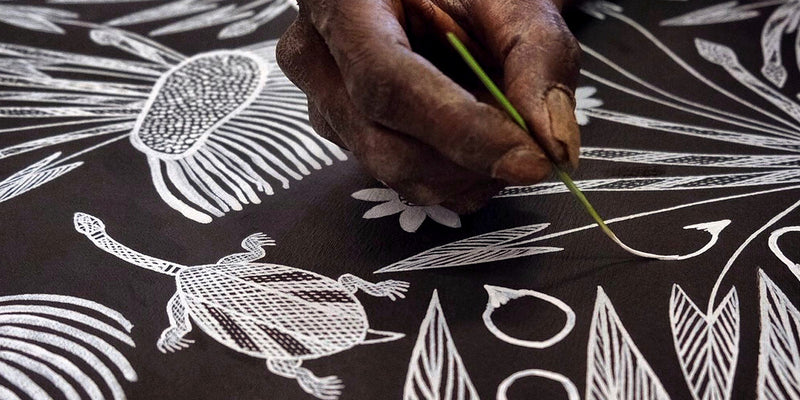
Lily Jatarr Long, Minyipuru (Jakulyukulyu, Seven Sisters), 91x91cm
Your support helps the artist and their community art centre.
Free insured post & 120-day returns Ships from Tasmania within 1 business day Arrives in 1–3 days (Aus) · 5–10 days (Int’l*) Guaranteed colour accuracy
Community Certified Artwork
This original artwork is sold on behalf of Martumili Artists, a community-run art centre. It includes their Certificate of Authenticity.
– Original 1/1
- Details
- Artwork
- Artist
- Art Centre
- Aboriginal Artists - Lily Jatarr Long
- Community - Irrungadj
- Aboriginal Art Centre - Martumili Artists
- Catalogue number - 23-289
- Materials - Acrylic paint on canvas
- Size(cm) - H91 W91 D2
- Postage variants - Artwork posted un-stretched and rolled for safe shipping
- Orientation - As displayed
The term Jukurrpa is often translated in English as the ‘dreaming’, or ‘dreamtime’. It refers generally to the period in which the world was created by ancestral beings, who assumed both human and nonhuman forms. These beings shaped what had been a formless landscape; creating waters, plants, animals, and people. At the same time they provided cultural protocols for the people they created, as well as rules for interacting with the natural environment. At their journey’s end, the ancestral beings transformed themselves into important waters, hills, rocks, and even constellations.
Minyipuru, or Jakulyukulyu (Seven Sisters) is a central Jukurrpa narrative for Martu, Ngaanyatjarra, Pitjantjatjara and Yankunytjatjara people that is associated with the seasonal Pleiades star constellation. Relayed in song, dance, stories and paintings, Minyipuru serves as a creation narrative, a source of information relating to the physical properties of the land, and an embodiment of Aboriginal cultural laws. When Martumili Artists was established in 2005, this was the first Jukurrpa story the artists agreed to paint for a broader public.
Beginning in Roebourne on the west coast of Western Australia, the story morphs in its movement eastward across the land, following a group of women as they walk, dance, and even fly from waterhole to waterhole. As they travel the women camp, sing, wash, dance and gather food, leaving markers in the landscape and creating landforms that remain to this day, such as groupings of rocks and trees, grinding stones and seeds. During the entirety of their journey the women are pursued by a lustful old man, Yurla, although interactions with other animals, groups of men, and spirit beings are also chronicled.
“This Karlamilyi area, big land. That’s a ngurra (home Country, camp) belonging to our old people, Warnman people. We talk for our land, our jila (snake). I grew up in this Country, my Country. This land belongs to our father. In pujiman (traditional, desert dwelling) days I walked around here, used to walk up and down tuwa (sandhill) and back to the main camp belonging to Martu. We are Warnman ladies, painting Kintyre and Karlamilyi. We can share this Country.”
- Sisters Wurta Amy French and Jatarr Lily Long
Jatarr Lily Long is a Warnman woman and senior custodian for Karlamilyi (Rudall River) Country. She was born in the late 1930s at Jatarrngara, a water source on the Karlamilyi River from which her name is derived. Jatarr is the sister of fellow artists Helen Dale Samson and the late Wurta Amy French. Her father was a drover who attempted, unsuccessfully, to ‘steal’ Jatarr’s mother and take her back to the Kimberley region.
Jatarr grew up with her family in the area surrounding Tiwa (Canning Stock Route Well 26), a water source located east of Parnngurr Aboriginal Community and just west of a culturally significant group of hills called Partujarrapirri. Her family returned to the Karlamilyi region for a time, moving between camps located all along the Karlamilyi River and up to the large salt lake, Nyayartakujarra (Lake Dora).
In the late 1940s her family left Karlamilyi and travelled on foot for more than 200 kilometres to Jigalong Mission, where a supply of rationed food and water was assured. There they were reunited with family members that had already moved in from the desert. At Jigalong, Jatarr lived in a dormitory with her two sisters and went to school. Later, she worked as a cook on various pastoral stations in the Pilbara and mined for tin and other minerals with a yandy (dish used for winnowing seed).
Eventually, Jatarr relocated to Irrungadji Aboriginal Community, just outside of Nullagine, where she continues to live with her sister Wurta, children and grandchildren. Today Jatarr lives at Irrungadji Community near Nullagine with her children and grandchildren. As an artist, she has always worked with her sisters at her side, and they have frequently collaborated on larger works. In her paintings, Jatarr depicts her ngurra (home Country, camp) and its animals, waterholes, and Jukurrpa (Dreaming) stories. She uses her art as a means of transferring cultural knowledge to her children and grandchildren and as a political platform, protecting her Country from mining and other disruptions.
Jatarr is known for her soft pastel palettes and dreamy landscapes, which blend aerial and frontal perspectives. Her work has been widely exhibited in Australia and internationally, and is held in major collections including the National Gallery of Victoria, Art Gallery of Western Australia, and National Museum of Australia.
Martumili Artists was established in late 2006 and supports Martu artists in Kunawarritji, Punmu, Parnngurr, Jigalong, Warralong, Irrungadji (Nullagine), and Parnpajinya (Newman). Many Martu artists have close relationships with established artists amongst Yulparija, Kukatja, and other Western Desert peoples and are now gaining recognition in their own right for their diverse, energetic, and unmediated painting styles. Their works reflect the dramatic geography and scale of their homelands in the Great Sandy Desert and Rudall River regions of Western Australia. Martumili Artists represents speakers of Manyjilyjarra, Warnman, Kartujarra, Putijarra, and Martu Wangka languages, many of whom experienced first contact with Europeans in the 1960s. The artists include painters working in acrylics and oils, as well as weavers coiling baskets and sculptors working in wood, grass, and wool. Martu artists proudly maintain their creative practices whilst pursuing social and cultural obligations across the Martu.
"Painting was exactly as pictured and well packed." - Lauren, UK – ART ARK Customer Review