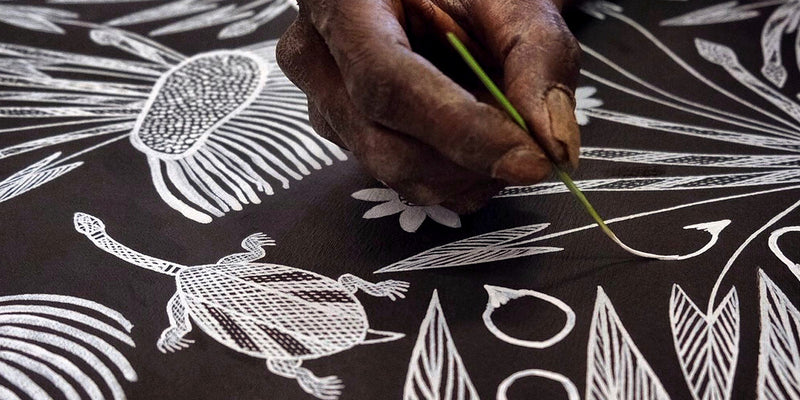
The site depicted in this painting is Pirlinyarnu (Mt. Farewell), about 165 km west of Yuendumu in the Northern Territory. The ‘kirda’ (owners) for the water Dreaming site at Pirlinyarnu are Nangala/Nampijinpa women and Jangala/Jampijinpa men.
Two Jangala men, rainmakers, sang the rain, unleashing a giant storm that collided with another storm from Wapurtali at Mirawarri. A ‘kirrkarlanji’ (brown falcon [Falco berigora]) carried the storm further west from Mirawarri. The two storms travelled across the country from Karlipirnpa, a ceremonial site for the water Dreaming near Kintore that is owned by members of the Napaljarri/Japaljarri and Napanangka/Japanangka subsections. Along the way the storms passed through Juntiparnta, a site that is owned by Jampijinpa men. The storm eventually became too heavy for the falcon. It dropped the water at Pirlinyarnu, where it formed an enormous ‘maluri’ (claypan). A ‘mulju’ (soakage) exists in this place today. Whenever it rains today, hundreds of ‘ngapangarlpa’ (bush ducks) still flock to Pirlinyarnu.
In contemporary Warlpiri paintings, traditional iconography is used to represent the ‘Jukurrpa’ (Dreaming), associated sites, and other elements. In many paintings of this Dreaming, short dashes are often used to represent ‘mangkurdu’ (cumulus & stratocumulus clouds), and longer, flowing lines represent ‘ngawarra’ (flood waters). Small circles are used to depict ‘mulju’ (soakages) and river beds.