Margot Gurawiliwili, Coil Basket, 36x32x26cm
Original artwork certified by the community art centre.
Community Certified Artwork
This original artwork is sold on behalf of Maningrida Arts and Culture, a community-run art centre. It includes their Certificate of Authenticity.
– Original 1/1
- Details
- Artwork
- Artist
- Art Centre
- Aboriginal Artist - Margot Gurawiliwili
- Community - Maningrida
- Homeland - Mankorlod
- Aboriginal Art Centre - Maningrida Arts and Culture
- Catalogue number - 1279-25
- Materials - Pandanus with natural dyes
- Size(cm) - H36 L32 W26
Coil basketry is a well-established fibre art form in the Maningrida region, especially for women from the Kuninjku, Rembarrnga, Ndjebbana and Nakkara language groups.
Artists make coiled baskets of many shapes and sizes, ranging from small round baskets to large oval baby baskets, and made mostly from pandanus fibre that is dyed with natural pigments. Bundles of fibre are formed into coils which are covered and stitched together with strands of fibre threaded onto a needle. Artists combine colours and patterns to obtain intricate new graphic patterns.
These techniques are believed to have been introduced to Arnhem Land by Greta Matthews, a missionary on Goulburn Island in the 1920s. She had probably learnt coil basketry from Aboriginal people in the south-east of Australia, possibly the Murray River people such as the Yorta Yorta or the coastal Ngarrindjeri.
The coiling technique spread quickly from Goulburn Island to people on mainland Arnhem Land.
Details are currently unavailable.
An art movement that is striking, political and enduring: this is what contemporary artists in Maningrida and the surrounding homelands have built, powered by their ancestral connections to country and djang.
Ways of learning and schools of art in Arnhem Land are based around a system of passing knowledge and information on to others. The art here has its genesis in body design, rock art and cultural practices, in concert with more than 50 years of collaborations, travel and political action to retain ownership of country. Values and law are expressed through language, imagery, manikay (song), bunggul (dance), doloppo bim (bark painting), sculptures, and kun-madj (weaving) – the arts.
The artists’ transformation of djang into contemporary artistic expression has intrigued people around the world: art curators and collectors, and stars including Yoko Ono, Jane Campion, David Attenborough and Elton John. Pablo Picasso said of Yirawala’s paintings, ‘This is what I’ve been trying to achieve all my life.’
Yirawala (c.1897–1976) was a legendary Kuninjku leader, artist, land-rights activist and teacher, and his artwork was the first of any Indigenous artist to be collected by the National Gallery of Australia as part of a policy to represent in depth the most significant figures in Australian art.
Maningrida Arts & Culture is based on Kunibídji country in Arnhem Land in Australia’s Northern Territory. The area where artists live encompasses 7,000 square kilometres of land and sea, and over 100 clan estates, where people speak more than 12 distinct languages. Aboriginal people in this region are still on country, surviving and resilient because their country is the centre of their epistemology, their belief system, culture – djang.
Artists’ works from the larger Maningrida region can be seen in collections and institutions around the world. We work with museums, contemporary galleries and high-end retailers both nationally and internationally on projects throughout the year.
Text courtesy: Maningrida Arts and Culture
"Fantastic service. I have now bought several paintings from Art Ark and can highly recommend this gallery" - Lynne, Aus – ART ARK Customer Review
Arnhem Land Art from the Maningrida Homelands
This artwork comes from Maningrida Arts & Culture, based on Kunibídji country in Arnhem Land. Artists live across homelands spanning more than 7,000 square kilometres of land and sea and over 100 clan estates where many distinct languages are spoken and people continue to live on Country.
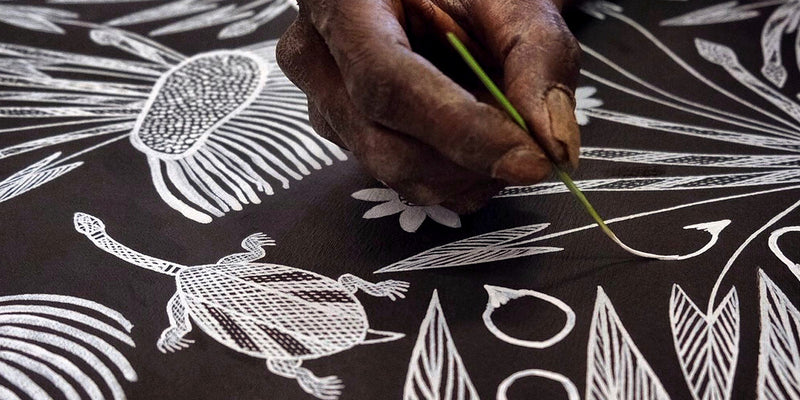
— Image: Freda Ali Wayartja harvesting pandanus, Maningrida Arts & Culture