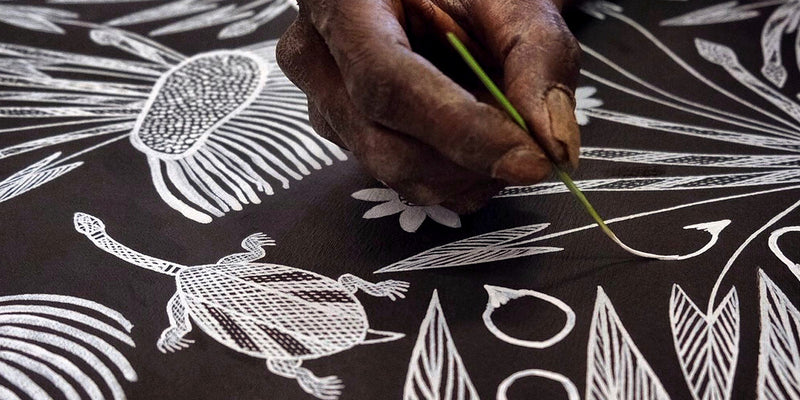
Napurrawuy #2 Wunuŋmurra Djapana, Garrapara, 84x37cm
Original artwork certified by the community art centre.

Community Certified Artwork
This original artwork is sold on behalf of Buku-Larrŋgay Mulka Centre, a community-run art centre. It includes their Certificate of Authenticity.
- Details
- Artwork Story
- Bark Process
- Artist
- Art Centre
- Aboriginal Artist - Napurrawuy #2 Wunuŋmurra Djapana
- Community - Yirkala
- Homeland - Gurrumuru
- Aboriginal Art Centre - Buku-Larrŋgay Mulka Centre
- Catalogue number - 1147-17
- Materials - Earth pigments on Stringybark
- Size(cm) - H84 W37 D1 (irregular shape)
- Postage variants - Artwork posted flat and ready to hang with a metal mount
- Orientation - As pictured
Garrapara is a coastal headland and bay area within Blue Mud Bay. It is known on the maps in English as Djalma Bay. It marks the spot of a sacred burial area for the Dhalwangu clan and a site where dispute was formally settled by Makarrata (a trial of ordeal by spear which settled serious grievance and sealed the peace forever). At Garrapara sacred Casuarina trees held these barbed spears whilst not in use.
Makani the Queenfish hugs the shore almost beaching itself as it attacks schools of baitfish and has actually formed the features of the coastline of Djalma Bay.
During the creation times of the ‘first mornings’ ancestral hunters left the shores of Garrapara in their canoe towards the horizon hunting for turtle. Sacred songs and dance narrate the heroic adventures of these two men as they passed sacred areas, rocks and saw ancestral totems on their way. Their hunting came to grief, with the canoe capsizing and the hunters being drowned. The bodies washed back to the shores of Garrapara with the currents and the tides, as the Wangupini (maternal Thunderhead cumulo-nimbus cloud) followed with its rain and wind. Their canoe with paddle and their totems Makani (Queenfish) and Minyga (Long Tom) and Garun (Loggerhead Turtle) are all referred to in the songs and landscape.
Garrapara has been rendered by the wavy design for Yirritja saltwater in Blue Mud Bay called Mungurru. The Mungurru is deep water that has many states and connects with the sacred waters coming from the land estates by currents and tidal action. This sacred design shows the water of Djalma Bay chopped up by the blustery South Easterlies of the early Dry season.
The miny’tji (sacred clan design) on this piece identifies the Dhalwangu saltwater estate of Garrapara on Blue Mud Bay. Here is the sacred site for the Dhalwangu Yingapungapu, a mortuary based sand sculpture used for the initial rites of the dead. The deceased placed within the Yingapungapu’s elliptical confines has its own contamination kept at bay. Yingapungapu used in ritual by the Manggalili, Madarrpa and the Dhalwangu clans. Detail in its construction identifies particular clan ownership thus tenure to its particular site, Dhalwangu saltwater country at Garrapara, a peninsula within Blue Mud Bay.
A giant tide that capsized the ancestral hunters’ canoe called Yinikambu washed it back to shore from the waters there out deep, to cleanse the site of Yingapungapu, the waters then imbued with the deceased’s Dhalwangu life force wash back out to the sanctified saltwaters of Garrapara.
In the songs the hooked spears sit under the Mawurraki (Casuarina) trees at the place Bati’wuy and conjure the connections between the ancient mariners and the law of mortuary for Dhalwangu. At the conclusion of the ceremony participants feast with Yambirrku (Parrot fish) within the ground. Gunyan the sand crab cleanse and renew. It is happening in the distant time before time and also in the present and the far future.
The songs include reference to the maternal Thunderhead cloud Wangupini and suggest the presence of Nyapilingu the ancestral female being who travelled from Groote Eyelandt. The saltwater on the horizon has to metamorphose through a different dimension becoming vapour in order to overcome the obstacle of mortality to be absorbed as life giving freshwater in the belly of the mother. These clouds then cross the coast and rain life into the hinterland behind the beach which flows down through the rivers to the sea again. Thus the water traces the spiritual kinship connections of the artist’s identity, and leaves a metaphor for the cycle of life. The painting records both of these aspects as well as the political and physical geography of this area. The Makarr or ceremonial spears make this site a centre for dispute resolution.
In many ways, the harvesting and material production to create bark paintings is an art in itself. The bark is stripped from Eucalyptus stringybark. It is generally harvested from the tree during the wet season. Two horizontal slices and a single vertical slice are made into the tree, and the bark is carefully peeled off. The smooth inner bark is kept and placed in a fire. After firing, the bark is flattened and weighted to dry flat. Once dry, the bark becomes a rigid surface and is ready to paint upon.

Djawakan Marika, Yilpirr Wanambi, Wukun Wanambi and Nambatj Munu+ïgurr Harvesting stringybark for artists Photo credit: David Wickens

Wanapa Munu+ïgurr, Yilpirr Wanambi and Wukun Wanambi harvesting stringybark. Photo credit: David Wickens

Wanapa and Nambatj Munu+ïgurr firing a bark to start the flattening process. Photo credit: David Wickens
Arnhem Land paintings are characterised by the use of fine crosshatched patterns of clan designs that carry ancestral power: the crosshatched patterns, known as rarrk in the west and miny’tji in the east, produce an optical brilliance reflecting the presence of ancestral forces.
These patterns are composed of layers of fine lines, laid onto the surface of the bark using a short-handled brush of human hair, just as they are painted onto the body for ceremony.

Rerrkiwaŋa Munuŋgurr painting her husbands design Gumatj fire or Gurtha. Photo credit: Buku-Larrŋgay Mulka Centre
The artist’s palette consists of red and yellow ochres of varying intensity and hues, from flat to lustrous, as well as charcoal and white clay(pictured above). Pigments that were once mixed with natural binders such as egg yolk have, since the 1960s, been combined with water-soluble wood glues.

Naminapu Maymuru White collecting gapan white clay used for painting. Photo credit: Edwina Circuitt
Details are currently unavailable
Buku-Larrŋgay Mulka Centre is the Indigenous community-controlled art centre of Northeast Arnhem Land. Located in Yirrkala, a small Aboriginal community on the north-eastern tip of the Top End of the Northern Territory, approximately 700km east of Darwin. Our primarily Yolŋu (Aboriginal) staff of around twenty services Yirrkala and the approximately twenty-five homeland centres in the radius of 200km.
In the 1960’s, Narritjin Maymuru set up his own beachfront gallery from which he sold art that now graces many major museums and private collections. He is counted among the art centre’s main inspirations and founders, and his picture hangs in the museum. His vision of Yolŋu-owned business to sell Yolŋu art that started with a shelter on a beach has now grown into a thriving business that exhibits and sells globally.
Buku-Larrŋgay – “the feeling on your face as it is struck by the first rays of the sun (i.e. facing East)
Mulka – “a sacred but public ceremony.”
In 1976, the Yolŋu artists established ‘Buku-Larrŋgay Arts’ in the old Mission health centre as an act of self-determination coinciding with the withdrawal of the Methodist Overseas Mission and the Land Rights and Homeland movements.
In 1988, a new museum was built with a Bicentenary grant and this houses a collection of works put together in the 1970s illustrating clan law and also the Message Sticks from 1935 and the Yirrkala Church Panels from 1963.
In 1996, a screen print workshop and extra gallery spaces was added to the space to provide a range of different mediums to explore. In 2007, The Mulka Project was added which houses and displays a collection of tens of thousands of historical images and films as well as creating new digital product.
Still on the same site but in a greatly expanded premises Buku-Larrŋgay Mulka Centre now consists of two divisions; the Yirrkala Art Centre which represents Yolŋu artists exhibiting and selling contemporary art and The Mulka Project which acts as a digital production studio and archiving centre incorporating the museum.
Text courtesy: Buku-Larrŋgay Mulka Centre
"Art Ark made everything so easy." - Hannah, Aus – ART ARK Customer Review

Yolŋu Art from North-East Arnhem Land
This artwork comes from Buku-Larrŋgay Mulka Centre in Yirrkala. The centre represents Yolŋu artists from surrounding homelands across north-east Arnhem Land, where art remains closely connected to Country, ceremony and the transmission of cultural knowledge.
— Image: Collecting bark for painting, Buku-Larrŋgay Mulka Centre