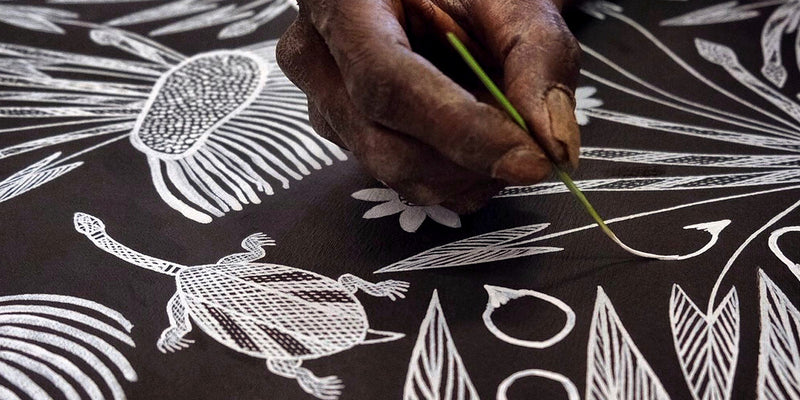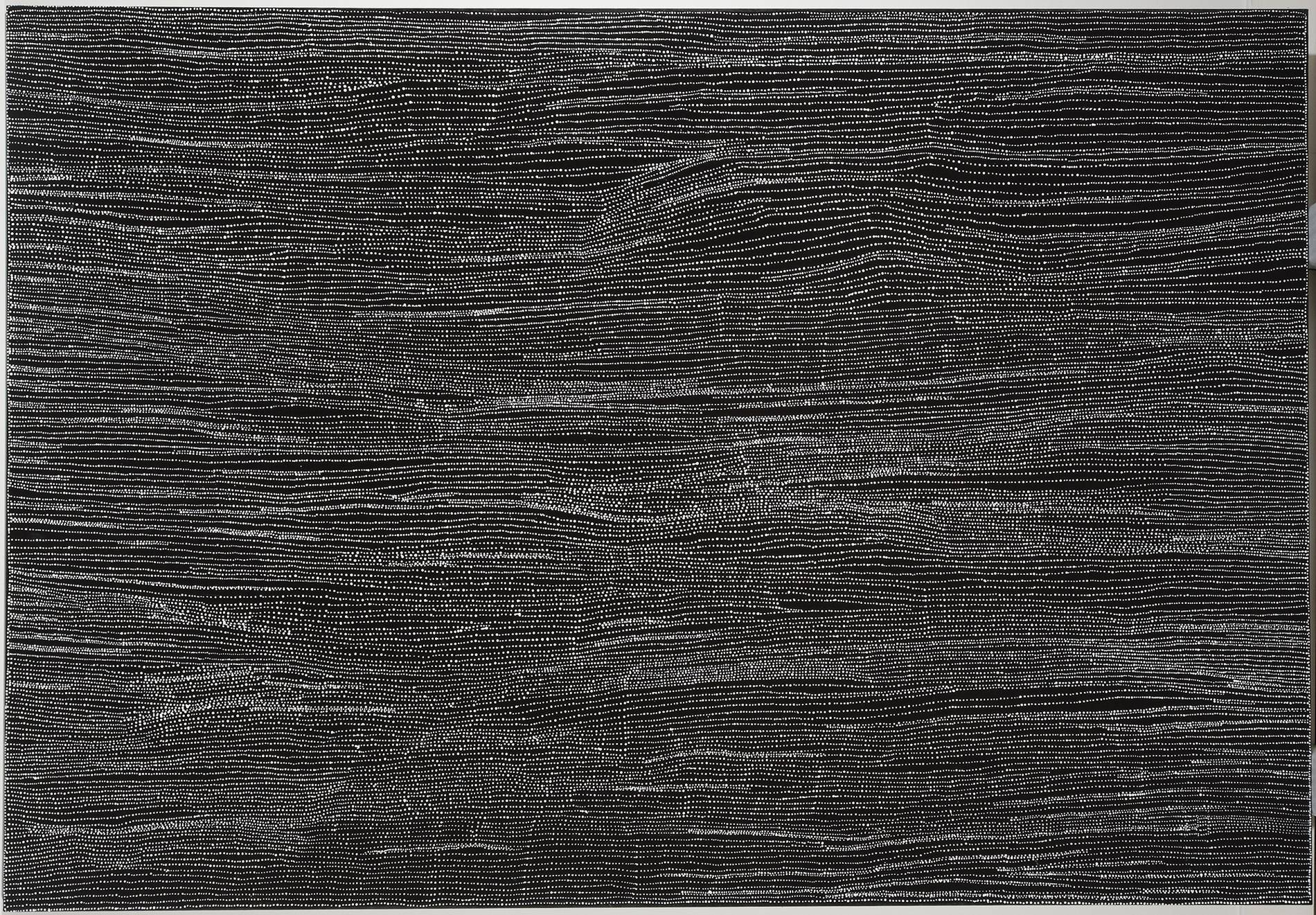
Sandhills, Dorothy Napangardi, 2009
The Warlpiri-Pintupi woman from Mina Mina who began painting bush banana stories in Alice Springs in 1987 and ended up in the Metropolitan Museum of Art
Dorothy Napangardi was born in the early 1950s at Mina Mina, a sacred site near Lake Mackay in the Tanami Desert, the daughter of a Pintupi father and a Warlpiri mother. As a young child she lived on Country with her extended family, hunting and collecting bush foods in the traditional nomadic life of the Tanami. In 1957 a patrol officer pressured the family to move to the settlement of Yuendumu. They were unhappy there and returned to Country, but eventually Dorothy and her family settled in Alice Springs. She had little formal schooling but was taught the Dreaming stories and ceremonial knowledge of her people. In 1987 she joined a group of Warlpiri women at the Centre for Aboriginal Artists in Alice Springs and began to paint, initially producing colourful images of bush banana and bush tucker stories.
The decisive shift in her practice came around 1997 when she made a return visit to Mina Mina for the first time in years. She began painting the salt country of her ancestral homeland: monochromatic works in which fine veils of white dots trace the movements of ancestral women dancing eastward through the landscape with their digging sticks. The Dreaming she depicts is Karntakurlangu, one of the most extensive women's Jukurrpa belonging to the Warlpiri, centred on the ceremonial site at Mina Mina where ancestral women gathered and took up digging sticks that had emerged from the ground. In Napangardi's hands this becomes a visual record of movement through Country, lines and grids tracking across dark-toned backgrounds with a spatial precision that art historian Christine Nicholls described as reflecting "a remarkable spatial sense and compositional ability."
In 2001 she won first prize in the 18th National Aboriginal and Torres Strait Islander Art Award for Salt on Mina Mina, having previously won lesser prizes at the same awards in 1991 and 1999. The following year the Museum of Contemporary Art Sydney mounted a major survey exhibition, Dancing up Country, cementing her place as a leading figure in contemporary Aboriginal art. She was included in the 2012 Biennale of Sydney. She died in a car accident on 1 June 2013.
A key aspect of Napangardi's (and many other desert painters') practice is that she made narrative, representational paintings. The intricate dots that cross the painting trace the movements of her women ancestors as they danced their way through the landscape. Although there is a tendency with Aboriginal art to see abstraction, it is truer to think of works like Sandhills as representational. The painting is a detailed document of country, of the many creation stories embedded in that country, and the action of moving through it. With her sure yet delicate hand, her encompassing bird's-eye view and her rich custodial knowledge, Napangardi pays tribute to the enduring vitality of her country.
Anne Loxley, Senior Curator, C3West, Museum of Contemporary Art Australia
Her works are held in the National Gallery of Australia, the National Gallery of Victoria, the Art Gallery of New South Wales, the Art Gallery of South Australia, the Museum of Contemporary Art Sydney, the Metropolitan Museum of Art in New York, and the Linden Museum in Stuttgart.
25 Famous Aboriginal Artists You Should Know
References and further reading
- Dorothy Napangardi, National Gallery of Australia — Know My Name
- Dorothy Napangardi, National Portrait Gallery
- Dancing up Country: The Work of Dorothy Napangardi, Museum of Contemporary Art Australia — 2002 survey exhibition
- Dorothy Napangardi, Wikipedia