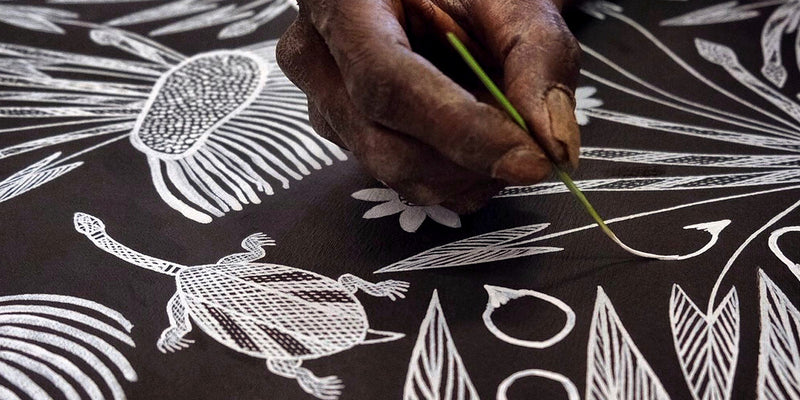
Ernabella Arts, Pukatja Community, APY Lands. Photo: Ernabella Arts
Ernabella Arts, Pukatja Community, APY Lands, South Australia
When Kunmanara (Nyukana) Baker joined the craft room at Ernabella Mission in 1958 at the age of fifteen, she spent her entire working life there as a practising artist, likely one of the first Aboriginal women to do so. The building she entered had been established ten years earlier, in 1948, when the Presbyterian Mission converted a food hall into a craft room where Anangu women began spinning wool and making hand-loomed floor rugs in a distinctive freehand pattern that became known as Anapalayaku Walka or Ernabella Design. That craft room is now Ernabella Arts, Australia's oldest continuously running Indigenous art centre, located at Pukatja Community at the eastern end of the Musgrave Ranges in the far north-west of South Australia. Pukatja was the first permanent settlement on the APY Lands.
The centre has reinvented itself repeatedly without abandoning its roots. In the early 1970s artists were introduced to batik and over the next thirty years Ernabella became recognised nationally and internationally for its intricate batik silks. In 2003 the batik studio converted to ceramics, and Ernabella Arts is now the only ceramics studio on the APY Lands. In 2023, Anne Nginyangka Thompson won the Wandjuk Marika 3D Award at the Telstra National Aboriginal and Torres Strait Islander Art Awards for her ceramic work Anangu History. Tjunkaya Tapaya OAM, who began at the craft room as a child and whose batik work features in international collections including the British Museum, is among the most widely collected artists in the centre's history. Senior artist Alison Milyika Carroll leads the ceramics studio, and works by Ernabella artists are held in all Australian state and national collections.
Ernabella Arts at a glance
- Location: Pukatja Community, eastern end of the Musgrave Ranges, APY Lands, north-west South Australia
- Language groups: Pitjantjatjara and Yankunytjatjara (Anangu people)
- Established: 1948, Australia's oldest continuously running Indigenous art centre
- Art forms: Ceramics, acrylic painting, printmaking, weaving, tjanpi (grass) sculpture, jewellery and licensed products
- Notable artists: Tjunkaya Tapaya OAM, Alison Milyika Carroll, Anne Nginyangka Thompson (2023 Telstra Wandjuk Marika 3D Award), Rupert Jack, Janice Stanley
- Collections: All Australian state and national galleries; British Museum; Edinburgh City Gallery; Japanese National Museum of Ethnology
- Getting there: APY Lands entry permit required; Pukatja is approximately 1,300km north of Adelaide via the Oodnadatta Track or Stuart Highway