Maningrida Arts & Culture: Art from the Heart of Arnhem Land
Maningrida Arts & Culture sits on the lands of the Kunibídji people on the north-central coast of Arnhem Land, on the estuary of the Liverpool River, around 500 kilometres east of Darwin. The art centre supports artists across an area of 7,000 square kilometres of land and sea, encompassing more than 100 clan estates and over 30 outstations. It is one of the largest and most culturally diverse Aboriginal art centres in Australia.
The community at Maningrida is extraordinarily multilingual. People speak Ndjébbana, Kuninjku, Rembarrnga, Dangbon, Burarra, Djinang, Kune, Wurlaki and many other languages, and most community members speak at least three. The name Maningrida derives from the Kunibídji word Manayingkarirra, meaning "the place where Dreaming changed shape."
The settlement has its origins in the late 1940s, when patrol officer Syd Kyle-Little established a trading post on the Liverpool River estuary with the intention of giving local Aboriginal people economic independence and an alternative to relocating to Darwin. The post closed in 1950 with a change in government administration. A new settlement was established in 1957, and the art centre, formally known as Maningrida Arts and Crafts, opened in 1973. It is now one of the longest continuously operating Aboriginal art centres in the country, operated through the Bawinanga Aboriginal Corporation.
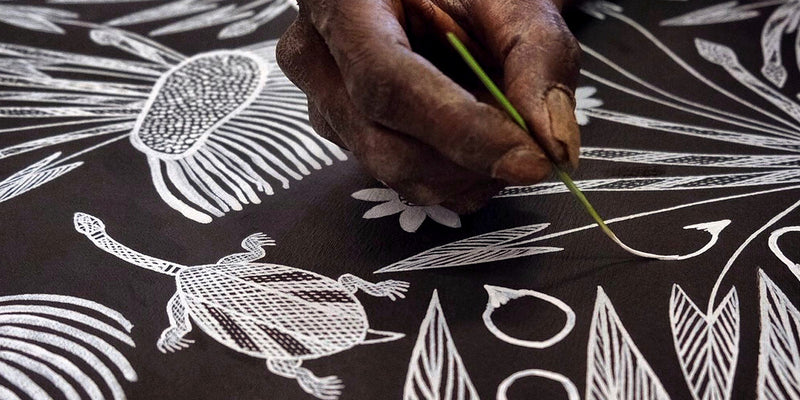
The art here has its roots in body design, rock art, and cultural practice. Values and law are expressed through language, imagery, manikay (song), bunggul (dance), bark painting, sculpture, and kun-madj (weaving). The centre currently supports more than 700 artists living on their homelands and in the township, all working with materials sourced from their own clan estates: ochres, bark, wood, roots, pandanus, vines, and feathers.
One of the centre's most significant figures was Yirawala (c.1897-1976), a Kuninjku leader, artist, and land rights activist whose work was the first by any Indigenous Australian artist to be acquired by the National Gallery of Australia. Pablo Picasso, on seeing Yirawala's paintings, is reported to have said: "This is what I've been trying to achieve all my life." His legacy continues to shape the centre's reputation internationally.


Images: Maningrida Arts and Culture
Art Styles and Cultural Practice
Rarrk is the cross-hatching technique applied in fine parallel lines using a thin brush or traditional tools, and it is one of the most recognisable visual traditions of western and central Arnhem Land. At Maningrida, rarrk is not decorative. The specific patterns used belong to individual clans and carry rights to country, ancestral knowledge, and ceremonial law. They are applied to bark paintings, larrakitj (memorial poles), and sculptural works, and their use is governed by cultural protocols around kinship and ownership.
Mimih spirit carvings are another distinctive form associated with Maningrida. These tall, attenuated figures represent the trickster spirits of the stone country, beings said to have taught Aboriginal people to hunt, cook, and dance. The sculptural representation of mimih in its contemporary form was pioneered at Maningrida in the early 1960s by Crusoe Kuningbal, whose innovations have been carried forward by artists including his son Owen Yalandja.
Fibre art is equally central. Artists from the region produce finely woven dilly bags, baskets, mats, and large-scale woven sculptures using pandanus, jungle vine, sedge grass, and kurrajong. Some of these works have been exhibited at major institutions including Sydney's Museum of Contemporary Art.
The centre's Djómi Museum holds a culturally significant collection of bark paintings, sculpture, artefacts, and material culture, with works dating back to the community's earliest years. A Cultural Research Office, established in 1993, maintains documentation of provenance, oral histories, languages, and ceremonial song series across the many clan groups of the region.
Maningrida Arts & Culture at a glance
-
Established
Art centre formally opened 1973, operated through the Bawinanga Aboriginal Corporation. -
Location
Maningrida, north-central Arnhem Land, Northern Territory, 500km east of Darwin on the Liverpool River estuary. -
Language and Culture
More than 12 distinct language groups across 100+ clan estates, including Kunibídji, Kuninjku, Rembarrnga, Burarra, and Ndjébbana speakers. -
Art Styles
Bark painting with rarrk cross-hatching, mimih spirit sculpture, larrakitj memorial poles, and fibre weaving using natural materials. -
Scale
Represents more than 700 artists across the township and surrounding homelands, one of the largest Aboriginal art centres in Australia. -
Notable Artists
Yirawala, Crusoe Kuningbal, Owen Yalandja, and many others whose work is held in Australian and international collections.
Visit Maningrida Arts & Culture website