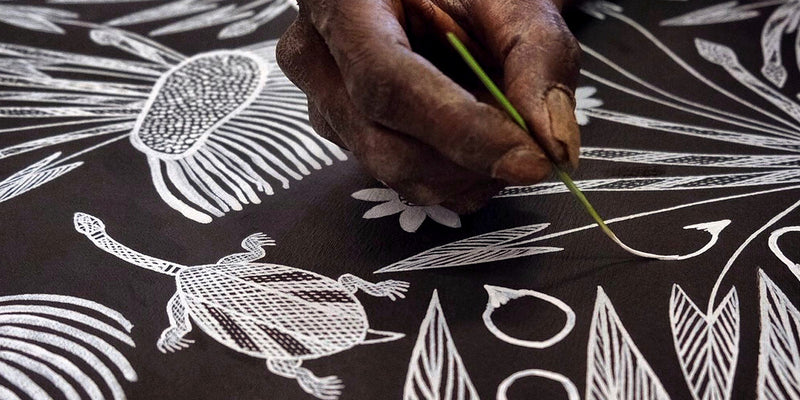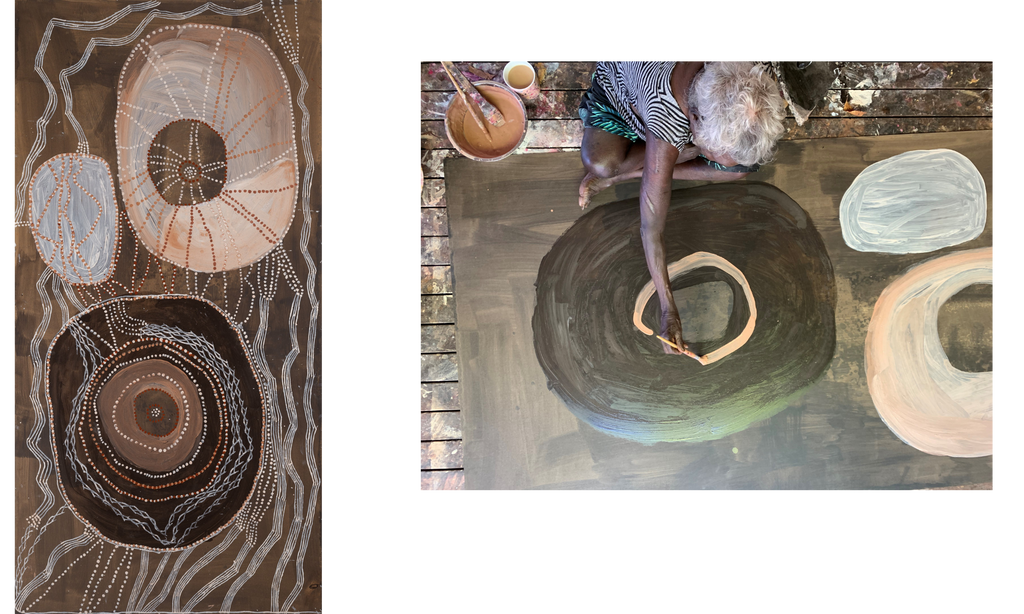
Noŋgirrŋa Marawili painting Baratjala, Buku-Larrŋgay Mulka Centre, Yirrkala ©Buku-Larrŋgay Mulka Centre
The Maḏarrpa elder from Arnhem Land who learned to paint in her fifties, then won the Telstra bark painting award twice and placed work in the Metropolitan Museum of Art
Noŋgirrŋa Marawili was born around 1939 on the beach at Darrpirra, north of Djarrakpi (Cape Shield) in northeast Arnhem Land, a member of the Maḏarrpa clan of the Yolŋu people. Her father was Mundukuḻ, a Maḏarrpa warrior whose name means Lightning Snake, and the ancestral serpent of that name runs through everything she painted. As a child she lived wakir', moving with her extended family between Blue Mud Bay and Groote Eylandt in a fleet of canoes, camping at Maḏarrpa clan sites. She did not go to school. She went to Yirrkala with her father's sisters but was too frightened to enter. Her father died on Warrpirrimatji Island near Groote; his bones were carried to Baykultji in the far west of Blue Mud Bay and placed in a ḻarrakitj (hollow memorial pole). She was given in her early teens to Djapu statesman Djutjadjutja Munuŋgurr, who had come to Yirrkala to help build the airstrip for the army during the war. Three of her children were born in the Yirrkala hospital maternity ward. That ward is now gallery two of the Buku-Larrŋgay Mulka Centre, where she later painted.
She began painting in the 1980s, learning by assisting her husband with his barks, crosshatching to teach her family the required skills. Many works attributed to him were substantially made by her hands. When he died she began painting in her own name. Her printmaking career began in 1995 when the Yirrkala Print Space opened; between 1998 and 2015 she produced 21 prints including screen prints, etchings, and woodblock prints. Sacred clan designs (miny'tji) were forbidden in the print space by the Elders Council, so her prints worked around the edges of those designs. She began focusing on bark painting from around 2005, and in 2011 began painting in the open courtyard of Buku-Larrŋgay Mulka Centre, where the space allowed her to develop her personal style.
Her subject is her country: lightning, sea spray, waves crashing on rock, the barnacles (dungunanin) that cling to the rocks at Baratjala, the Maḏarrpa clan estate where she camped as a child. "I paint water designs," she said. "The water. As it crashes onto the rocks at high tide. Sending the spray into the sky. Rocks which stand strong. That's what I do." The lightning in her paintings connects directly to her father. Mundukuḻ the Lightning Snake lives deep beneath the sea at Baratjala; when freshwater mixes with saltwater at the coast during the monsoonal season, the serpent rises and spits lightning into the sky. The narrow parallel lines tracking across her bark surfaces are the traces of those bolts. The dotted lines are sea spray.
One of the most distinctive innovations in her practice came when she found a discarded magenta printer toner cartridge on her country. Following Yolŋu philosophy that if you paint the land you should use the land, she began incorporating the magenta ink into her work alongside ochres and charcoal. The resulting pink-toned barks, depicting cyclonic weather and waves against boulders, became some of her most recognised works internationally. She won the Bark Painting Award at the National Aboriginal and Torres Strait Islander Art Awards in 2015 for Lightning in the Rock, subsequently acquired by the National Gallery of Victoria, and again in 2019 for Lightning Strikes. In 2019 she also won the Roberts Family Aboriginal and Torres Strait Islander Prize as part of the Wynne Prize at the Art Gallery of New South Wales.
A solo exhibition, Noŋgirrŋa Marawili: From My Heart and Mind, was held at the Art Gallery of New South Wales in 2019, accompanied by a stand-alone publication. Her work featured in the 2020 Biennale of Sydney and in Bark Ladies: Eleven Artists from Yirrkala at the National Gallery of Victoria in 2021. Her works are held in the National Gallery of Victoria, the Art Gallery of New South Wales, the Tate Modern in London, the Metropolitan Museum of Art in New York, the Kluge-Ruhe Aboriginal Art Collection at the University of Virginia, and the Voilà Collection in Brussels. Both her daughters, Marrnyula and Rerrkirrwaŋa, are artists; Rerrkirrwaŋa won the Telstra bark painting award in 2009.
Noŋgirrŋa Marawili died at Yirrkala in October 2023. Her family has authorised the use of her name in written form but asks that it not be spoken aloud in the presence of people from Arnhem Land or the Miwatj region, as her spirit has a long journey to return to her origin point.
25 Famous Aboriginal Artists You Should Know
References and further reading
- Noŋgirrŋa Marawili, Buku-Larrŋgay Mulka Centre
- Noŋgirrŋa Marawili: Lightning in the Rock, National Gallery of Victoria
- Noŋgirrŋa Marawili, The Metropolitan Museum of Art
- Maḏayin: Eight Decades of Aboriginal Australian Bark Painting from Yirrkala, Kluge-Ruhe Aboriginal Art Collection
- Noŋgirrŋa Marawili, Wikipedia