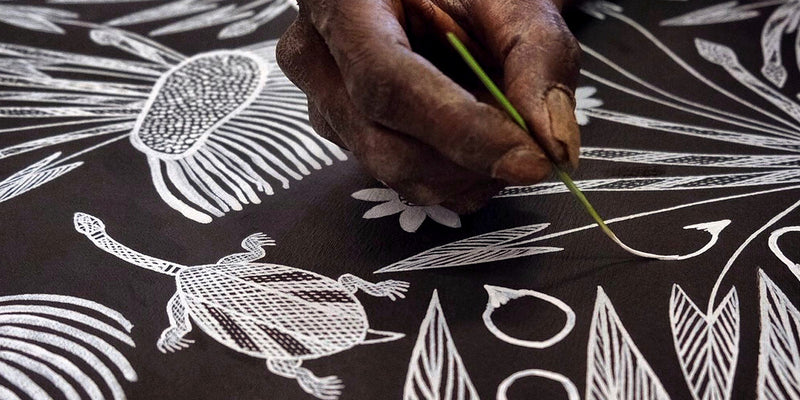
Mirdidingkingathi Juwarnda Sally Gabori with her work
The Kaiadilt woman from Bentinck Island who began painting at 81 with no prior tradition to draw on, and represented Australia at the Venice Biennale seven years later
Mirdidingkingathi Juwarnda Sally Gabori was born around 1924 at Mirdidingki, a small creek on the south side of Bentinck Island in the Gulf of Carpentaria, Queensland. Her name encodes her origins: in Kaiadilt tradition, the suffix -ngathi means "born at," so Mirdidingkingathi means "born at Mirdidingki." Juwarnda is her totemic name, meaning dolphin. She grew up speaking Kayardilt language in a community that had little contact with Europeans until the 1940s, fishing, gathering shellfish, and maintaining the stone fish traps built by her people along the island's shores. She was also skilled in weaving grass nets and dilly bags.
In 1947 and 1948 severe drought and cyclonic flooding devastated Bentinck Island. Presbyterian missionaries used the crisis to remove the entire Kaiadilt community of 63 people to Mornington Island (Gununa), the country of the Lardil people, where they were not made welcome and were pressured to adopt Western names and lifestyles. Gabori came to Mornington Island with her husband Pat Gabori. The Kaiadilt maintained their connection to Bentinck Island in memory, but most would not return for decades. Gabori herself was unable to return permanently, and it was the revered memory of her country that became the subject of all her painting.
In April 2005, when she was around 81 and living at the aged persons' hostel at Gununa, the Mornington Island Arts and Crafts Centre offered painting workshops to older community members. Gabori had come to the centre as a weaver. She picked up a brush and immediately produced a work that the Indigenous Australian artist Melville Escott could read as a map: the river, the sandbar, the ripples fish leave on water, her brother's country and the fish traps she had tended. The Kaiadilt people had no two-dimensional art tradition before 2005. She had nothing to draw on but memory. She held her first solo exhibition in Brisbane the following year and began producing nearly one canvas a day. Over the eight years of her painting career she made more than 2,000 works.
She painted six key places on Bentinck Island hundreds of times each: her own birthplace Mirdidingki, her husband's country Dibirdibi, her father's place Thundi, and the outstation Nyinyilki among them. Her works feature large organic areas of intense colour rendered with free, gestural brushstrokes, recording both the physical landscape and the emotional and ceremonial life associated with each place. "This is my land, this is my sea, this is who I am," she said.

Dibirdibi Country, 2008. Synthetic polymer paint on linen, 198 × 304 cm. National Gallery of Victoria, Melbourne.
She exhibited at the Royal Academy of Arts in London and represented Australia at the 55th Venice Biennale in 2013, showing at Palazzo Bembo. She died on 11 February 2015 on Mornington Island. The following year QAGOMA and the National Gallery of Victoria mounted a joint retrospective, Dulka Warngiid — Land of All, which travelled between Brisbane and Melbourne in 2016 and 2017. In 2022 the Fondation Cartier pour l'art contemporain in Paris presented the first major solo survey of her work outside Australia, developed in close collaboration with her family and the Kaiadilt community. The exhibition then travelled to Triennale Milano in 2023.
Her works are held in the National Gallery of Australia, all Australian state galleries, the Musée du quai Branly in Paris, the Fondation Cartier, and the Kluge-Ruhe Aboriginal Art Collection at the University of Virginia.

Exhibition of the works of Mirdidingkingathi Juwarnda Sally Gabori, Fondation Cartier pour l'art contemporain, Paris, 2022.

Installation view, National Gallery of Victoria, Melbourne.
25 Famous Aboriginal Artists You Should Know