Shell Stringing: An Unbroken Tradition
Shell necklace-making is the oldest continuing cultural practice in Tasmania and the most important cultural tradition of Tasmanian Aboriginal women. It has continued without a break since before colonisation in 1803, and while colonisation disrupted so much of Tasmanian Aboriginal life, necklace-making has not only survived but evolved.
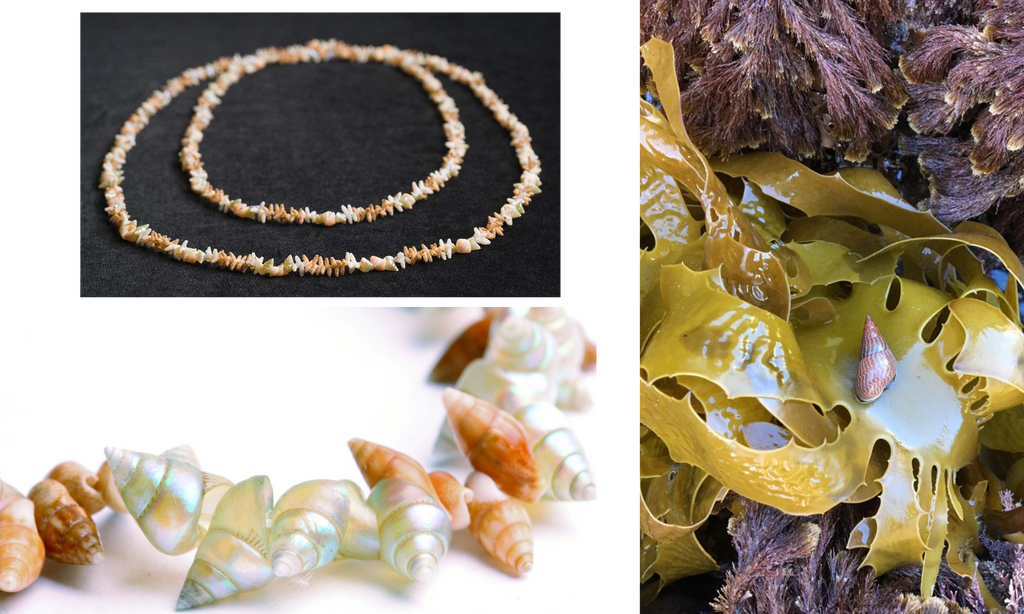
Top left: Aunty Dulcie Greeno, National Museum of Australia. Bottom left and right: Aunty Lola Greeno, Australian Museum
Maireener and Other Shells
The traditional shell is the maireener, or rainbow kelp shell (Phasianotrochus irisodontes), prized for its iridescent green and blue-green colours. There are four species of maireener in Tasmanian waters, and the largest, the king maireener, was used in the oldest necklaces. Maireener were originally the only shell threaded. When women began using sewing needles after colonisation, they added smaller shells such as rice, toothy, gull, cockle and black crow shells, creating the patterned necklaces made today.
How the Necklaces Are Made
Maireener live on seaweed and seagrass and must be collected live during spring tides, one at a time, wading in knee-deep water, to keep their strength and lustre. The shells are treated to reveal the pearly layer beneath and polished, traditionally with muttonbird oil. In the past, shells were pierced with a bone point or a kangaroo's eye tooth and strung on sinew or twine. A single necklace can take days to thread. Knowledge of where and when to collect each shell, and of tides and seasons, is passed from grandmothers and aunties to younger women, and making necklaces together is a way of sharing stories and culture.
History
The oldest evidence is several pierced shells from a cremation site on Tasmania's north-west coast, reported by archaeologist Rhys Jones in 1966 as about 2,600 years old. Europeans recorded the necklaces from their first visits. In 1793, during Bruni d'Entrecasteaux's expedition, naturalist Labillardière was offered a garland of shells by a young man. In 1802 artists on Nicolas Baudin's expedition painted Baraourou, a man from Maria Island, wearing a circlet of maireener. Necklaces collected by the French and later visitors are now held in museums across Australia and Europe, including the British Museum and Oxford's museums.
After colonisation, women kept the practice alive. Pilunimina (Flora) made a maireener necklace around 1854 at the Oyster Cove settlement, now one of the oldest in the Tasmanian Museum and Art Gallery's collection. Truganini was photographed wearing a necklace around 1866 and also made them. On the Furneaux Islands, women made necklaces to support their families, exchanging them at the Flinders Island store for food and clothes. That trade formed the Bowman Collection, now at the Furneaux Museum on Flinders Island. In the early 1900s, women on Cape Barren Island sold necklaces to a local minister, which became an important collection for the Stanley Museum.
Notable Makers
Women from the Furneaux Islands, especially Cape Barren and Flinders Islands, have carried the tradition into the present. Aunty Dulcie Greeno, born on Cape Barren Island in 1923, learnt from her grandmother and aunties and made necklaces for more than 40 years. Her work is held by the National Museum of Australia.
Aunty Lola Greeno, a pakana shell artist, curator and educator born on Cape Barren Island and based in Launceston, is one of Australia's most respected shell workers. She learnt from her mother, and her necklaces are held in national and state collections, including the Australian Museum and the Australian National Maritime Museum. In 2021 one of her necklaces was projected onto Parliament House in Canberra during the Enlighten festival. Her daughter, Vanessa Greeno, continues the family tradition as a shell necklace maker.
In 2009 the necklaces were listed as a Tasmanian Heritage Icon by the National Trust.
Today
The shell beds are under pressure. Maireener collecting areas are shrinking because of warming seas and kelp loss, run-off, fish farming, tourism and over-collecting, and some shells can now only be found around Flinders Island. Makers teach younger women to take only what they will use, so the practice and the shells both continue.
References and Further Reading
- Greeno, Lola. "Tasmanian Aboriginal Shell Necklaces: A Significant Cultural Practice." Australian Museum.
- National Museum of Australia. Tasmanian Aboriginal shell necklaces.
- Tasmanian Museum and Art Gallery. Pilunimina's (Flora's) shell necklace.
- University of Tasmania. "Cultural Artefact: Shell Necklaces." The Companion to Tasmanian History.
- Australian Design Centre. Australian Masters of Craft, Episode 2: Lola Greeno.
- Plomley, N. J. B. (ed.). Friendly Mission: The Tasmanian Journals and Papers of George Augustus Robinson, 1829–1834. Tasmanian Historical Research Association, 1966.
- Plomley, N. J. B. The Baudin Expedition and the Tasmanian Aborigines, 1802. Blubber Head Press, 1983.
- Ryan, Lyndall. The Aboriginal Tasmanians. University of Queensland Press, 1981.
- Artlink. "kanalaritja: An Unbroken String."