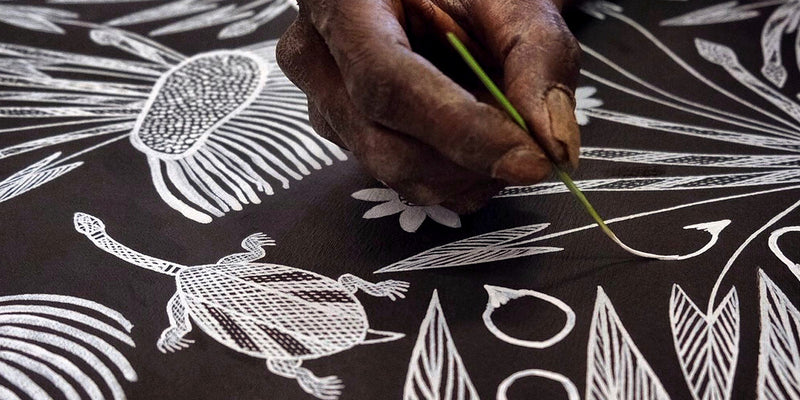
Repetition is the Point
Many Aboriginal artists will paint one subject for a lifetime. Hundreds of paintings of the same site, over decades. The best way to think about it is to abandon the Western notion that an artist chooses a subject and changes it as they wish. It is their birthright, and each repetition reinforces the story and their custodianship of it. That is the point.
Australia holds more than 250 distinct languages and cultures, and kinship systems differ between them. Moieties, sections, subsections, different names, different spellings. There is no single system to describe. But the principle is broadly shared: country and its stories are inherited, and with them comes the authority to paint. What an artist may depict is settled at birth not chosen.
Warlpiri culture, in the central desert, shows how it works.
Warlpiri has eight skin groups, each with a male and a female form. The male begins with J, the female with N.
Jangala – Nangala
Japangardi – Napangardi
Jungarrayi – Nungarrayi
Jakamarra – Nakamarra
Jampijinpa – Nampijinpa
Jupurrurla – Napurrurla
Japanangka – Napanangka
Japaljarri – Napaljarri
The term skin name has nothing to do with skin. It is a birthright name, received from a person's parents and kept for life. It is the middle name you see in artists' names, and it is not a family name. It defines their relationship to everyone else in the system, including who they can and cannot marry, and the country they are custodian of.
Each Jukurrpa(Dreaming) and the country it belongs to is held by two groups. Kirda are the owners and inherit through their father. Kurdungurlu are the managers, inherit through their mother's father, and are responsible for checking the kirda's work. The Emu Dreaming, Yankirri Jukurrpa, is held by Nangala women and Jangala men. Ngarlikirlangu, north of Yuendumu, is one of its sites. An artist from another skin group does not paint it.
So an artist paints what their birthright gives them, and often that is one Dreaming across a working life. A hundred paintings of the same site are the same story told again, not a hundred attempts at different ideas. The imagery stays stable because the kurdungurlu keep it stable. A region looks related because everyone in it works within the same tradition, on stories that overlap by design.
Two artists with rights to the same Jukurrpa still paint different work. Knowledge is authority. A senior artist with decades of ceremony behind them holds more of the story than an emerging one, and paints only what can be shown publicly. Both have the right. The depth differs. This is why an art centre catalogue spans such a range.
If a group of paintings starts to feel familiar, you are beginning to read the visual language.