Types of Aboriginal Art
The main types of Aboriginal art are dot painting, bark painting, ochre painting, carved sculpture, hollow logs and rock art. Each belongs to a particular region, uses its own materials and methods, and records the stories, law and Country of the people who make it. Aboriginal art is the oldest continuous art tradition in the world. Rock art in Australia dates back tens of thousands of years, and the forms made today, from the cross-hatched barks of Arnhem Land to the dot paintings of the desert, carry the same knowledge forward.
Each section below covers one type and links to a detailed guide on its origins, materials and meaning.
Dot Painting
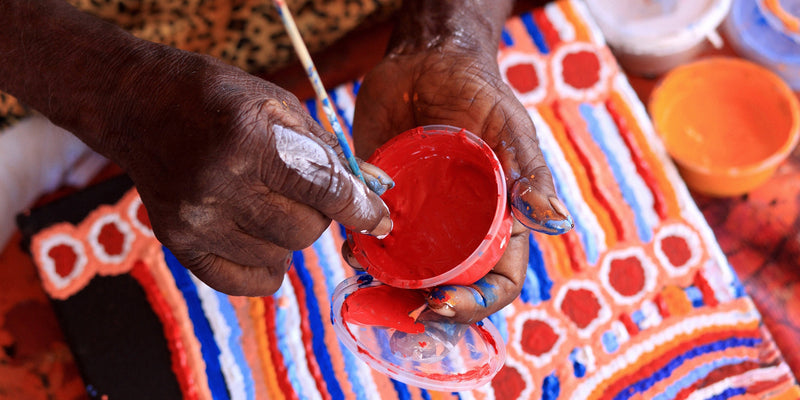
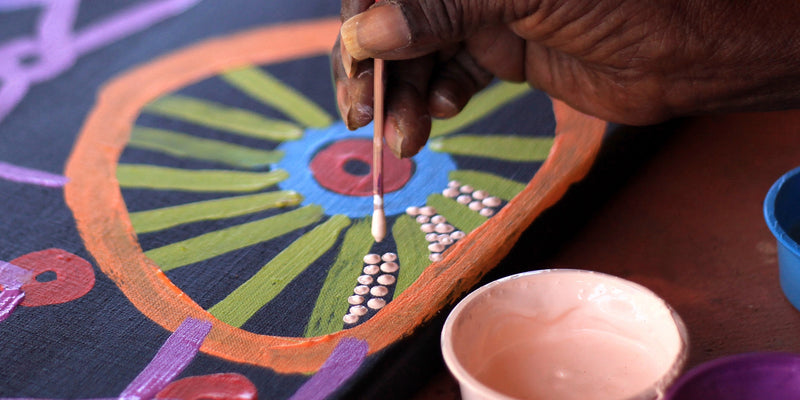
Dot painting comes from the Central and Western Desert. It began at Papunya in 1971, when senior men, encouraged by schoolteacher Geoffrey Bardon, started transferring the designs used in ceremony, sand drawings and body painting onto boards and later canvas. Dotting let artists show a story while keeping restricted details hidden. Concentric circles, lines and U-shapes map sites, travel routes and the actions of ancestral beings across Country. Dot painting is now made at art centres across the desert, from Papunya Tula and Warlukurlangu to the APY Lands, and each community has its own style.
Browse Aboriginal dot paintings
Read the history of dot painting
Bark Painting and Cross-Hatching
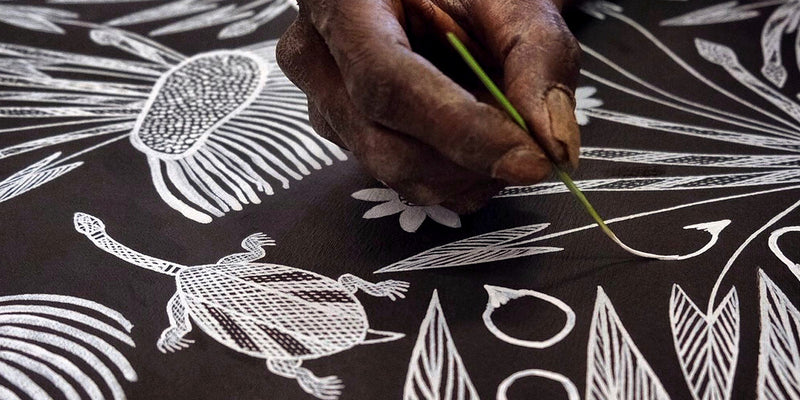
Bark painting comes from Arnhem Land. Artists cut sheets of stringybark in the wet season, when the sap is running, then heat them over a fire and weight them flat to dry. They paint with ochres ground on a stone and mixed with a binder. Many barks carry rarrk (western Arnhem Land) or miny’tji (north-east Arnhem Land), fine cross-hatched patterns that identify clan and Country. The finest lines are painted with a marwat, a brush made from a few strands of human hair bound to a stick. Barks were first made for ceremony and teaching. Senior artists still paint within clan law, and some are taking the form in new directions.
Read about rarrk and miny’tji cross-hatching
Ochre Artworks
Ochre is natural earth pigment coloured by iron oxides, ranging from yellow through red to brown. White usually comes from pipeclay and black from charcoal or manganese. Aboriginal people have used ochre for tens of thousands of years on rock walls, bodies, ceremonial objects and bark, and traded it over long distances. Ground and mixed with water, sap or other binders, it still carries ceremonial weight. Kimberley artists at centres such as Warmun paint in ochre on canvas, and most bark painters use nothing else.
Read about ochre in Aboriginal art
Sculpture and Spirit Figures
Much Aboriginal sculpture represents spirit beings. In western Arnhem Land, carvers make Mimih, tall thin spirits who live in rock crevices and taught people to hunt and paint. Warraburnburn are ghost spirits. Yawkyawk are young female water spirits, often shown with a fish tail. In north-east Arnhem Land, Yolŋu carvers make Mokuy, spirit figures tied to Yolŋu law. The figures are carved from local softwood and painted with ochre, and many began as ceremonial objects.
Read more:
Larrakitj and Lorrkon: Hollow Logs
Larrakitj (Yolŋu) and lorrkon (Kunwinjku) are hollow logs from Arnhem Land, cut from stringybark trunks hollowed out by termites. They held the bones of the dead in the final stage of mortuary ceremony and were painted with the clan designs of the deceased. Artists now make them as standing sculptures painted with clan designs and ancestral stories. The best-known group is the Aboriginal Memorial at the National Gallery of Australia, 200 hollow logs made by Ramingining artists in 1987 and 1988.
Read about larrakitj and lorrkon
Rock Art
Rock art is found across Australia, painted and engraved on shelters, escarpments and boulders. Major sites are in Arnhem Land, the Kimberley, the Pilbara and the Western Desert. The images record ancestral beings, animals, hunting, ceremony and contact with outsiders, including Macassan praus and European ships. Many sites are still cared for by Traditional Owners, who hold the stories and responsibilities that go with them.
Read about Aboriginal rock art
Every type of Aboriginal art is tied to the Country and community it comes from. Buying through community-run art centres means the artist is paid fairly and the work comes documented with its story.