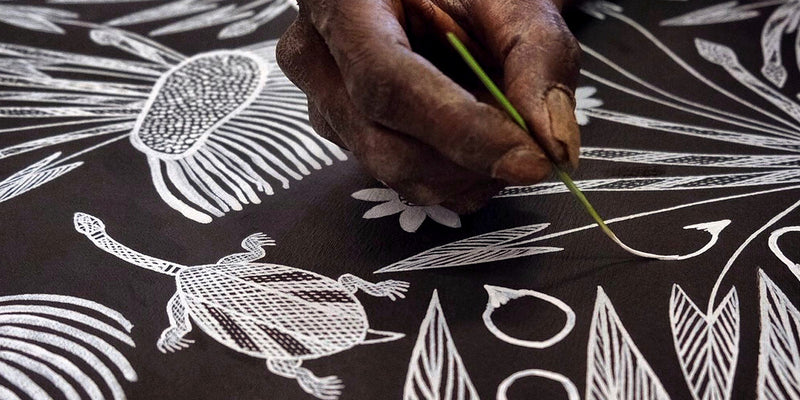
Jennifer Prudence, Woven Mat, 130cm
Your support helps the artist and their community art centre.
Free insured post & 120-day returns Ships from Tasmania within 1 business day Arrives in 1–3 days (Aus) · 5–10 days (Int’l*) Guaranteed colour accuracy
Community Certified Artwork
This original artwork is sold on behalf of Maningrida Arts and Culture, a community-run art centre. It includes their Certificate of Authenticity.
– Original 1/1
- Details
- Artwork details
- Artist
- Art Centre
- Aboriginal Artist - Jennifer Prudence
- Community - Maningrida
- Homeland -
- Aboriginal Art Centre - Maningrida Arts and Culture
- Catalogue number - 527-25
- Materials - Pandanus and Natural Dyes
- Size(cm) - Total: D130 (irregular) Centre: D67
Commonly used fibres include the leaves of pandanus (Pandanus spiralis) and palms (Livistona), mírlírl (burney or jungle vine, Malaisia scandens), and the inner bark of kurrajong and stringybark eucalyptus trees. Weaving is physically hard work, now done only by women. Artists commonly use a mix of naturally dyed and undyed fibre to create a striking variation of coloured bands. They colour the pandanus using natural dyes made from the roots, leaves, or flowers of plants within the weaver’s clan estate. Some artists also incorporate different types of looping to produce unique patterns and textured finishes. Each type of mat, fibre bag, basket, and dilly bag has its own name in the various languages spoken in the Maningrida region.
Artists weave many different kinds of mats. Conical mats were traditionally used to shield babies from mosquitoes. Long flat mats were used for blocking creeks so that fish would be diverted into fish traps. A small triangular mat made of pandanus fibre used to be worn by women during ceremonial gatherings, tied around their back and covering them at the front. Mats are also used for wrapping and rinsing food in water.
Artists usually use ngarakáya (Pandanus spiralis) to weave fragrant, decorative round or oblong mats, as well as the less common triangular and conical shapes. The radial woven patterns of the finest round mats appear to vibrate with colour—sometimes regarded as an aesthetic manifestation of deep cultural meaning—as there is a significant spiritual dimension to pandanus mats.
Details are currently unavailable.
An art movement that is striking, political and enduring: this is what contemporary artists in Maningrida and the surrounding homelands have built, powered by their ancestral connections to country and djang.
Ways of learning and schools of art in Arnhem Land are based around a system of passing knowledge and information on to others. The art here has its genesis in body design, rock art and cultural practices, in concert with more than 50 years of collaborations, travel and political action to retain ownership of country. Values and law are expressed through language, imagery, manikay (song), bunggul (dance), doloppo bim (bark painting), sculptures, and kun-madj (weaving) – the arts.
The artists’ transformation of djang into contemporary artistic expression has intrigued people around the world: art curators and collectors, and stars including Yoko Ono, Jane Campion, David Attenborough and Elton John. Pablo Picasso said of Yirawala’s paintings, ‘This is what I’ve been trying to achieve all my life.’
Yirawala (c.1897–1976) was a legendary Kuninjku leader, artist, land-rights activist and teacher, and his artwork was the first of any Indigenous artist to be collected by the National Gallery of Australia as part of a policy to represent in depth the most significant figures in Australian art.
Maningrida Arts & Culture is based on Kunibídji country in Arnhem Land in Australia’s Northern Territory. The area where artists live encompasses 7,000 square kilometres of land and sea, and over 100 clan estates, where people speak more than 12 distinct languages. Aboriginal people in this region are still on country, surviving and resilient because their country is the centre of their epistemology, their belief system, culture – djang.
Artists’ works from the larger Maningrida region can be seen in collections and institutions around the world. We work with museums, contemporary galleries and high-end retailers both nationally and internationally on projects throughout the year.
Text courtesy: Maningrida Arts and Culture
"This is my third artwork purchase from Art Ark, and I am thrilled to bits with every one of them!" - Gabrielle, Aus – ART ARK Customer Review