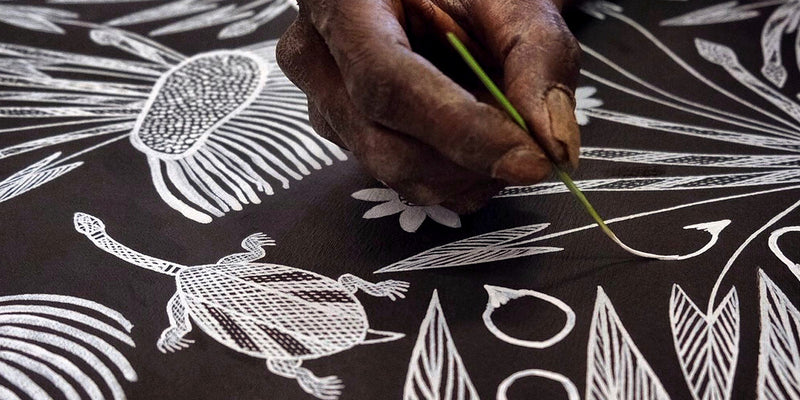
Muluymuluy Wirrpanda, Gathul - Mangroves, 88x54cm Bark
Original artwork certified by the community art centre.

Community Certified Artwork
This original artwork is sold on behalf of Buku-Larrŋgay Mulka Centre, a community-run art centre. It includes their Certificate of Authenticity.
- Details
- Artwork
- Bark Process
- Artist
- Art Centre
- Aboriginal Artist - Muluymuluy Wirrpanda
- Community - Yirkala
- Homeland - Dhuruputjpi
- Aboriginal Art Centre - Buku-Larrŋgay Mulka Centre
- Catalogue number - 7139-22
- Materials - Earth pigments on Stringybark
- Size(cm) - H88 W54 D1 (irregular)
- Postage variants - Artwork posted flat and ready to hang with a metal mount for hanging
- Orientation - As displayed
In Arnhem Land mangroves are full of rich smells and the clicking music of hidden life.
Harvesting the fruits of the mangrove is the particular obsession of Yolŋu women. Their knowledge of what lies within and under the trees and the mud is incredible. For, as beautiful as what can be seen is, there is hidden treasure everywhere, for those who can crack the code.
One example only of the hundreds of delicious foods on offer is Dhän’pala. The King, or more likely Queen, of Shellfish in East Arnhem is one that sustains many people and anchors many hunting trips. Found by feeling with feet or combing with hands, knife blades or rakes or sometimes spotted as cryptic lips just poking free of the mud or as a hole or crack in the surface of the mud indicating a subsidence below where she has moved.
It is a fist-sized clam with many names. The typically ugly English common name is Mud Mussel Geloina oviformis, , (previous scientific names Gelonia coaxans, Polymesoda erosa). Also known in Yolŋu matha as Dhäkururru, Räwiya, Rruŋundhaŋaniŋ, Yiwaḻkurr, Yuwaḻkurr. Rägudha. Rägudha means kneecap. This maypal (shellfish) belongs to the Dhuwa half of the world.
The group will emerge from the forest following ancient pathways with hundreds and hundreds of shells in buckets, bags and pockets. And then the feast will begin.
There is a technique where a small fire is constructed using specially chosen size and type of kindling around a stacked pyramid of Dhän’pala so that lighting one match will cook and open as many as thirty at a time.
Hidden aside these treasures are Djiny’djalma or Nyuka. Appetisingly named Mud Crabs by English speakers. Yolŋu women trek for kilometres atop the network of buttress roots anchoring the mangrove forest in the sweet black mud. There is a rhythm to the mud which a buried mud crab disturbs. Their holes, which are often wedged into hidden sections beneath the trees, are visible only to the trained eye. Then begins the task of extricating the crab with massive vice like pincers, from their deep dark wet hole usually with bare hands!
In many ways, the harvesting and material production to create bark paintings is an art in itself. The bark is stripped from Eucalyptus stringybark. It is generally harvested from the tree during the wet season. Two horizontal slices and a single vertical slice are made into the tree, and the bark is carefully peeled off. The smooth inner bark is kept and placed in a fire. After firing, the bark is flattened and weighted to dry flat. Once dry, the bark becomes a rigid surface and is ready to paint upon.

Djawakan Marika, Yilpirr Wanambi, Wukun Wanambi and Nambatj Munu+ïgurr Harvesting stringybark for artists Photo credit: David Wickens

Wanapa Munu+ïgurr, Yilpirr Wanambi and Wukun Wanambi harvesting stringybark. Photo credit: David Wickens

Wanapa and Nambatj Munu+ïgurr firing a bark to start the flattening process. Photo credit: David Wickens
Arnhem Land paintings are characterised by the use of fine crosshatched patterns of clan designs that carry ancestral power: the crosshatched patterns, known as rarrk in the west and miny’tji in the east, produce an optical brilliance reflecting the presence of ancestral forces.
These patterns are composed of layers of fine lines, laid onto the surface of the bark using a short-handled brush of human hair, just as they are painted onto the body for ceremony.

Rerrkiwaŋa Munuŋgurr painting her husbands design Gumatj fire or Gurtha. Photo credit: Buku-Larrŋgay Mulka Centre
The artist’s palette consists of red and yellow ochres of varying intensity and hues, from flat to lustrous, as well as charcoal and white clay(pictured above). Pigments that were once mixed with natural binders such as egg yolk have, since the 1960s, been combined with water-soluble wood glues.

Naminapu Maymuru White collecting gapan white clay used for painting. Photo credit: Edwina Circuitt
Muluymuluy was born at Ngukurr, her Father is Molulmi. She was the young wife of Wakuthi Marawili. Wakuthi was one of the oldest men in Arnhem land. He was known as Banbay – “Blind one” because of his poor eyesight. He passed away in 2005. His sons Djambawa and Nuwandjali have a large role in the day-to-day management of the large Maḏarrpa clan homeland, Yilpara. Muluymuluy has worked with them in her art as well as under Wakuthi’s direction to produce important Maḏarrpa clan paintings. Her son was Daymathuna Marawili who passed away in Ramingining. Her sister Mulkuṉ Wirrpanda was also a senior artist. Her Mother’s clan is Maŋgalili.
After Wakuthi’s passing in 2005 she moved to care for Dr. Gawirriṉ Gumana AO at Gäṉgan until his death. She kept close company with her sister and was influenced to adopt botanic themes during the collaboration between Mulkuṉ and John Wolselely. She is a matriarch for her family and is constantly moving from ceremony to ceremony to participate in the Yolŋu spiritual cycle. She supports her family through her art.
Buku-Larrŋgay Mulka Centre is the Indigenous community-controlled art centre of Northeast Arnhem Land. Located in Yirrkala, a small Aboriginal community on the north-eastern tip of the Top End of the Northern Territory, approximately 700km east of Darwin. Our primarily Yolŋu (Aboriginal) staff of around twenty services Yirrkala and the approximately twenty-five homeland centres in the radius of 200km.
In the 1960’s, Narritjin Maymuru set up his own beachfront gallery from which he sold art that now graces many major museums and private collections. He is counted among the art centre’s main inspirations and founders, and his picture hangs in the museum. His vision of Yolŋu-owned business to sell Yolŋu art that started with a shelter on a beach has now grown into a thriving business that exhibits and sells globally.
Buku-Larrŋgay – “the feeling on your face as it is struck by the first rays of the sun (i.e. facing East)
Mulka – “a sacred but public ceremony.”
In 1976, the Yolŋu artists established ‘Buku-Larrŋgay Arts’ in the old Mission health centre as an act of self-determination coinciding with the withdrawal of the Methodist Overseas Mission and the Land Rights and Homeland movements.
In 1988, a new museum was built with a Bicentenary grant and this houses a collection of works put together in the 1970s illustrating clan law and also the Message Sticks from 1935 and the Yirrkala Church Panels from 1963.
In 1996, a screen print workshop and extra gallery spaces was added to the space to provide a range of different mediums to explore. In 2007, The Mulka Project was added which houses and displays a collection of tens of thousands of historical images and films as well as creating new digital product.
Still on the same site but in a greatly expanded premises Buku-Larrŋgay Mulka Centre now consists of two divisions; the Yirrkala Art Centre which represents Yolŋu artists exhibiting and selling contemporary art and The Mulka Project which acts as a digital production studio and archiving centre incorporating the museum.
Text courtesy: Buku-Larrŋgay Mulka Centre
"Painting was exactly as pictured and well packed." - Lauren, UK – ART ARK Customer Review

Yolŋu Art from North-East Arnhem Land
This artwork comes from Buku-Larrŋgay Mulka Centre in Yirrkala. The centre represents Yolŋu artists from surrounding homelands across north-east Arnhem Land, where art remains closely connected to Country, ceremony and the transmission of cultural knowledge.
— Image: Collecting bark for painting, Buku-Larrŋgay Mulka Centre