Mimih: Spirits of the Western Arnhem Land Escarpment
Mimih are tall, extremely thin spirits who live in the rocky escarpment country of western Arnhem Land, in the lands of Kunwinjku, Kuninjku and other Bininj peoples. They are so thin they can slip through cracks in the rock, passing between their world inside the stone and the world of people.

Top: Mimih spirit sculptures at HOTA Gallery. Inset: Rock painting of Mimih spirits in the Anbangbang gallery at Nourlangie Rock (Burrungkuy), Kakadu
Life in the Rock
Mimih are so slender that a strong wind could snap their necks, so they come out to hunt only on still days and nights. One Kuninjku artist describes how, when they feel the wind, they go back inside their rock caves and slam the doors shut. Inside the rock is a world much like the one outside, with its own plants, animals and country. Mimih society is like human society, using the same kinship terms and language as the local people, and is said to have existed before humans.
Teachers of the First People
Mimih are said to have taught the first people the foundations of culture: ceremony, song and dance, how to hunt and butcher kangaroo, and how to survive in the rocky escarpment country. They also taught people to paint on rock. Only "clever" people with special powers (marrkidjpu) can see and speak with mimih, and some are taught their songs and dances and shown their secret places.
Mimih are not always benign. There are stories of mimih leading hunters astray into their rock world, where the hunters fall in love with mimih women and never return.
Mimih and Rock Art
Many of the oldest rock paintings in western Arnhem Land, including small, active red figures shown hunting and running, are attributed to the mimih, who left their images on the rock. At Ubirr in Kakadu, where some paintings sit high on the rock face, the explanation is that the mimih painted them themselves, bringing the rock down to ground level to paint it.
Mimih in Contemporary Art
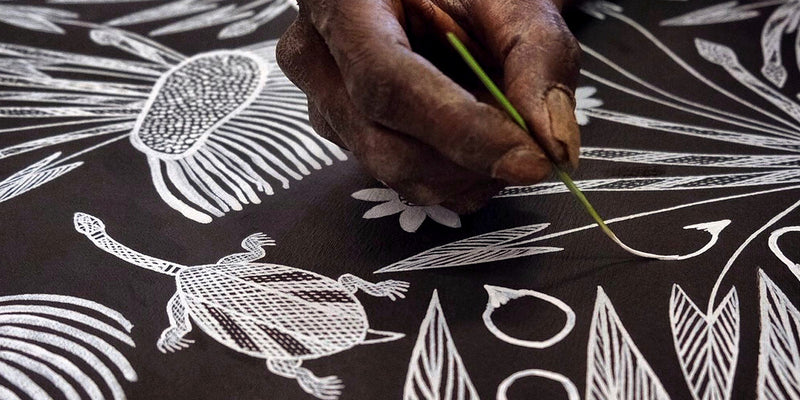
Mimih are a recurring subject in Kuninjku and Kunwinjku bark painting, and are celebrated in song and dance. From around 1968 Crusoe Kuningbal began carving mimih sculptures for sale through Maningrida's art centre, and carved mimih figures, made from slender trunks and painted with ochre, have since become one of the region's best-known art forms.
References and Further Reading
- Taylor, Luke. Seeing the Inside: Bark Painting in Western Arnhem Land. Clarendon Press, 1996.
- Chaloupka, George. Journey in Time: The World's Longest Continuing Art Tradition. Reed, 1993.
- Perkins, Hetti (ed.). Crossing Country: The Alchemy of Western Arnhem Land Art. Art Gallery of New South Wales, 2004. Exhibition highlights.
- Penn Museum. "The World of Ancient Ancestors." Expedition magazine.
- Parks Australia. Burrungkuy (Nourlangie), Kakadu National Park.
Discover artworks from Arnhem Land: