Aboriginal Dot Painting
Understanding the Evolution and History of Australian Aboriginal Dot Painting
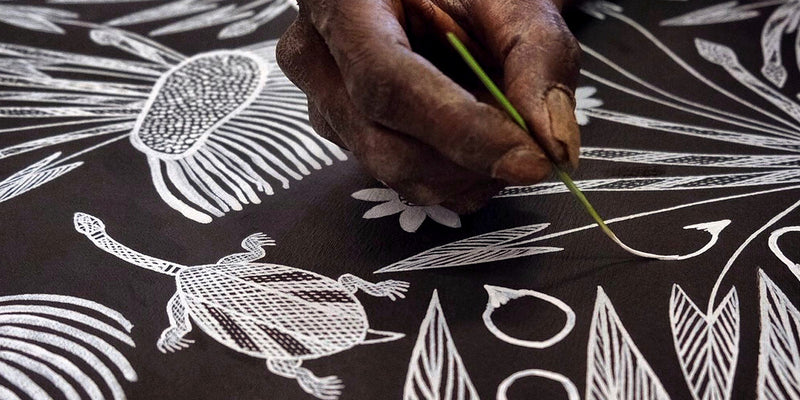
Aboriginal dot painting is one of the most recognisable art forms in the world. The paintings are contemporary works, but they carry historical, cultural, spiritual and political meaning at the same time.
The form grew out of much older traditions of rock, ground and body art, and holds a deep connection to the land and to the Dreaming. Here we trace where it came from, clear up a common misconception about how it began, and follow its move onto canvas and into the wider world.
Above Image: Bunjil the Creator, Gariwerd (Grampians National Park)
The Origins of Aboriginal Dot Painting
Let's be clear: Aboriginal dot painting is not a new invention. It is the evolution of an age-old tradition. Aboriginal Australians have one of the oldest continuous cultures in the world, and their art, particularly rock and cave painting, is a core part of that heritage. These older works, many in sacred sites, depict Dreaming stories and were understood to be made by ancestral beings. Body painting and ground painting, used in ceremony, sit directly behind the dot painting we see today.
The art served several functions at once. It was educational, spiritual, and a means of passing on lore and law.


Examples of the use of dots prior to modern artworks in cultural body designs and rock art.
Aboriginal Ground Paintings

Artists creating a ground painting, 2002, Excerpt from, Wamulu, pg 52 - 53
The images above show open, contemporary examples of ground painting, part of public and sacred ceremony for millennia. The designs are built up on the earth from ochre, plant down and grass, and the dot on canvas depicts those same materials. Anthropologists have documented ground designs since first contact, leaving a rich visual record. Seen from above, those older designs look remarkably like the dot paintings being made today, which points to a long and unbroken continuity behind the form.
Symbolism in Dot Painting
The symbols in Aboriginal dot painting are a language. Each carries meaning, tied to the Dreaming, and together they teach law, social values and belief. They map Country, journeys and significant events, connecting people to their land and their ancestors. Learn more about the meaning of Aboriginal Art Symbols.
This is why the art is more than creative expression. It holds knowledge handed down over generations, a record of history, spirituality and law. Much of that meaning is sacred, and some of it is understood only by those initiated into it.

Walinynga (Cave Hill) archaeological site, oldest parts are dated to 24,000 years old.
Debunking The Western Influence Misconception
The arrival of dot painting in contemporary Aboriginal art is often credited to a schoolteacher, Geoffrey Bardon, in the 1970s. Bardon worked with the Papunya Tula artists and encouraged them to put their symbols and stories onto canvas and board. His role mattered, and it brought the work to a much wider audience. But this was not the birth of a new art form. It was an ancient tradition moved onto a new surface.
That move carried its own problem. As sacred designs went onto canvas for a public audience, the dotting could obscure the inner stories and symbols, keeping them from the uninitiated. It worked as a protective measure, shielding cultural knowledge from outsiders, and that function continues to some extent today.

L Bush-fire II, ©Clifford Possum Tjapaltjarri, 1972 R Sandhill country west of Wilkinkarra, Lake Mackay, ©Timmy Payungka Tjapangati, 1972
Art in the Aboriginal Rights Movement
Through the civil rights movements of the 1960s and 70s, dot painting found a new purpose. It became a form of political expression, a way for Aboriginal people to assert their rights, their identity and their connection to Country. The work carried this quietly, in its layers and its coded meaning. It is worth remembering that Aboriginal people were banned from practising their own culture during and before this period, under an assimilation policy that tied Indigenous advancement to school attendance, training and regular working hours.
From Canvas to the World
The shift onto canvas and board did not cost the art its meaning. If anything it amplified it, letting the work reach a global audience while artists carried their techniques and stories across to the new surface. Browse our collection of Aboriginal dot paintings to see the form as it stands today. Discover 25 Famous Aboriginal Artists who have shaped both Australian and international art.

Emily Kame Kngwarreye, Earth’s Creation, 1994 (275 x 632cm). Exhibited in the Venice Biennale 2015 and later sold for $2.1 Million in 2017.
That global demand has made art centres central to the communities they sit in. More than production sites, they are places where artists keep their cultural practice alive, earn a living, and pass their heritage to a wider audience. It also brings real pressures: appropriation, over-commercialisation, and the work of holding cultural integrity as demand grows. Learn more about Aboriginal Art Centres.
About Aboriginal Art
Aboriginal Art History Aboriginal Art Symbols What is The Dreaming? Origins of Dot Painting Aboriginal Art Regions