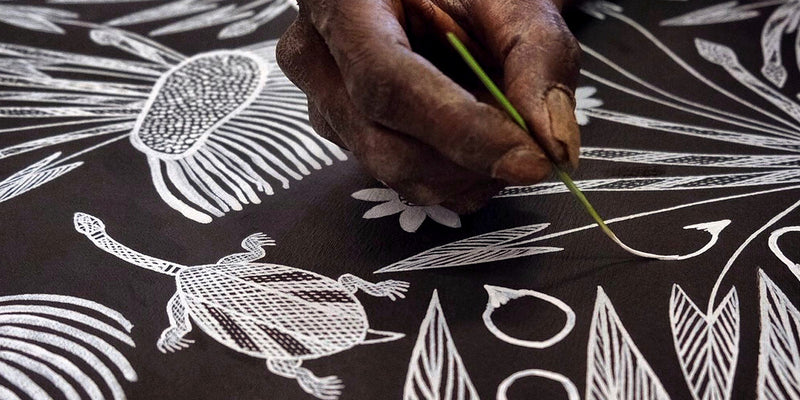
Noreena Ashley Matay, Gapuwiyak - Woven Mat, 120cm
- 120-day returns
- Free insured express
- Ships from Tasmania in 1 business day, arrives in about a week
- Original art is tax and duty free in the US
- Colour-accurate images
Community Certified Artwork
This original artwork is sold on behalf of the community-run art centre. It includes their Certificate of Authenticity.
– Original 1/1
- Details
- Artwork
- Gapuwiyak
- Materials
- Aboriginal Artist - Noreena Ashley Matay
- Community - Gapuwiyak
- Aboriginal Art Centre - Gapuwiyak Culture and Arts
- Catalogue number - 21-1594
- Materials - Pandanus, natural and synthetic dyes
- Size(cm) - Total: H110 W120(irregular) Centre H61 W60
- Postage Variant - Sent rolled for safe shipping and requires flattening before hanging/use
Mat (Maad) made from Gunga (Pandanus Spiralis), using a twining process. The twinning technique may be thought of as the twisting together of elements. Artists take two twisting lengths of pandanus and work them across a series of vertical or radiating lengths. The twisting lengths are the 'active' elements of the structure and the radiating lengths are 'passive'. The twining technique is traditional and a number of forms were made for ceremonial and utilitarian purposes. A conical mat was made for initiation ceremonies, and flattened, use for various purposes. Variation in the twinning occurs through changing the density, the order, or the colour. The Gunga is coloured with natural bush dyes. Flat mats are traditionally used for sitting on, shelter or preparing food etc.
Gapuwiyak Culture and Arts Aboriginal Corporation is a recent initiative of the remote East Arnhem Land community of Gapuwiyak, also known as Lake Evella. The organisation is not-for-profit. It was created to enhance the wellbeing of Yolngu people living in the region by supporting their cultural practices, values and intellectual property while providing opportunities for leadership, meaningful employment, and professional development.
Pandanus are palm-like, dioecious trees and shrubs, their leaves “pandan” are commonly used in traditional handicraft. The young leaves are harvested and sliced into fine strips, followed by a colouring process, in which the strips are placed in drums of bush dyes, roots and leaves from different plants sourced in the area. Dye is extracted through bashing and crushing techniques, then added to the water with the pandanus to create these vivid hues. The pandan strips are then woven into intricate baskets and mats or rolled into ropes for other designs.
"The painting had both authentication and a history of the artist Karen. The artwork was more beautiful than I expected. Guy answered all my questions about having the painting mounted and positioning on the wall." - Alyson, Aus
– Read all 1,680+ ART ARK Customer Reviews