This page provides historical context for understanding the Australian frontier and its lasting impact on Aboriginal communities. The violence described here formed part of the foundation upon which modern Australia was built, and its effects continue to shape cultural life, memory, and connection to Country today.
War on the Frontier
The Australian frontier was the site of a brutal, undeclared war that lasted roughly 140 years. From the arrival of the First Fleet in 1788 until the Coniston killings in 1928, a systemic pattern of violence was used to clear the land for the British pastoral industry. This was not a series of accidental “clashes”. It was a consistent pattern of massacres designed to break Indigenous resistance and secure territory for sheep and cattle.
For generations, this history was hidden by a code of silence. Modern research, most notably from the University of Newcastle, has since identified at least 438 massacre sites across the continent. By the research definition, a massacre involved the killing of six or more defenceless people. This means the more than 10,600 deaths currently documented in these specific events are only the tip of the iceberg, as they do not include the thousands killed in smaller groups or individual murders that fall below this threshold.
The Logic of the Punitive Expedition
Most massacres were organised, military-style operations commonly referred to as punitive expeditions. These were not spontaneous outbursts of anger. They were often funded, encouraged, or supported by wealthy pastoralists who saw Aboriginal people as a threat to their investment, namely the livestock grazing on stolen land.
When a single cow was speared or a shepherd was killed in a skirmish, the retaliation was intentionally disproportionate. Armed groups of settlers and police would track a group back to their camp. They rarely attempted to identify a specific individual. Instead, they practiced collective punishment. Men, women, and children were killed to ensure the local group was too broken to ever resist again. This was a strategy of localised total war, intended to terrorise survivors into fleeing their ancestral country.
The Native Police and the Northern Frontier
The violence intensified as the frontier pushed north and west. More massacres occurred between 1860 and 1930 than in the seventy years before.
Queensland's Native Police accounted for much of it. Formed in 1848 and disbanded around 1905, the corps was made up of Aboriginal troopers recruited from distant regions and commanded by white officers. Their orders were to disperse. The word appears throughout official dispatches and in the Queensland parliamentary record, where it was understood to mean shooting on sight.
The Northern Territory ran a smaller force in the 1880s. Western Australia had none. There, the same work was done by regular police, who took Aboriginal trackers on patrol, arrested men in numbers on cattle-killing charges, and walked them to gaol in neck chains.
Governments relied on these units because they were expert trackers who could locate groups in rugged ranges or dense scrub where settlers could not easily operate. Because these men were far from their own country and often did not speak the local languages, they had no kinship ties to the people they were ordered to pursue. This turned the landscape itself into a trap. With the introduction of high-powered repeating rifles, the average death toll in these northern massacres increased sharply. In Queensland alone, historians estimate that the Native Police were responsible for the deaths of tens of thousands of Aboriginal people, with some estimates exceeding 20,000.
Tactics of Erasure
These attacks were rarely fair fights. They were calculated to cause maximum terror and to leave as little evidence as possible.
One of the most common tactics was the dawn raid. Camps were surrounded at first light while people were sleeping near waterholes or rivers. This allowed attackers to trap everyone at once. Those who tried to escape by swimming were often shot from the banks.
In the dry interior, settlers took control of permanent waterholes. By guarding these and killing anyone who approached, they used thirst as a weapon. Indigenous groups were forced into an impossible choice. Remain away from water and die, or approach it and risk being shot.
In many cases, settlers used gifts instead of guns. Flour laced with arsenic or strychnine was distributed to groups, leading to slow, agonising deaths. At Kilcoy in 1842 and Kangaroo Creek in 1847, dozens were killed in this way. Poisoning was a method that left little physical evidence, made no noise, and was extremely difficult to prove in court.
The Code of Silence and the Legal Barrier
The legal system rarely protected Indigenous people. Although Aboriginal people were technically classified as British subjects, colonial courts were heavily biased. In most colonies, Aboriginal testimony was excluded until late in the nineteenth century because witnesses were not Christians and could not take the oath. This meant a massacre could usually only be prosecuted if a white man testified against another, which was exceptionally rare.
According to the University of Newcastle’s Colonial Frontier Massacres Project, in over half of all documented massacres the perpetrators were official agents of the state, including police, mounted police, or military forces. When the law did intervene, such as after the Myall Creek massacre in 1838 where seven settlers were hanged, the public backlash from the colonial population was so severe that it effectively ended further prosecutions of white men for frontier crimes. To avoid scrutiny, bodies were often burned, buried in mass graves, or weighted and sunk in rivers. This frontier code of silence ensured the true scale of killing remained hidden for more than a century.
Long-Term Impact
Coniston in 1928 is often described as the last officially sanctioned frontier massacre. This is not distant history. It occurred in the era of cars, radios, and modern policing. Survivors of these later killings carried the trauma into the present, and their descendants continue to live with these histories today.
These massacres did more than take lives. By targeting elders, the violence destroyed the living knowledge of communities, including law, language, ceremony, and songlines. When a group was reduced from hundreds to a handful of survivors in a single attack, its social structure was irreparably damaged. Families were fractured, cultural continuity was disrupted, and connection to Country was forcibly broken.
Much of Australia’s pastoral and extractive wealth was built directly on land cleared through this violence. Many stations, towns, and industries now occupy places where Indigenous communities were removed through force. Understanding this history is not about assigning guilt to the present, but about acknowledging how the foundations of modern Australia were laid and why the consequences of frontier violence continue to shape the country today.
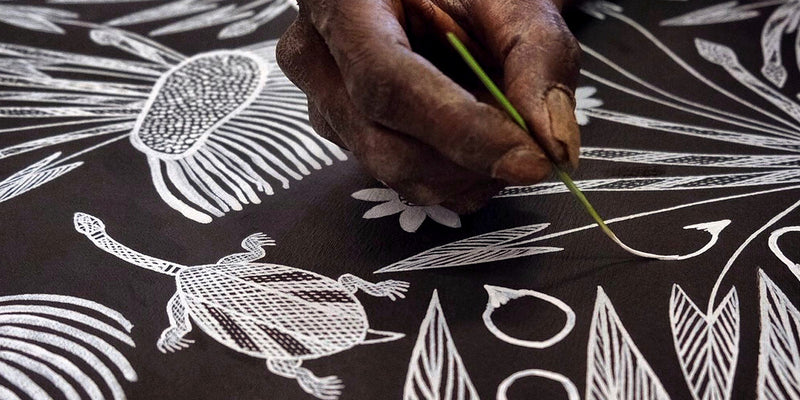
Understanding this history helps explain why land, culture, and continuity remain central to Aboriginal life today. Aboriginal art is one way these connections are maintained and expressed across generations. Appreciating this context is part of respecting artists, their work, and the communities they come from.
References and Further Reading
Readers who wish to explore the historical record in greater detail can refer to the Colonial Frontier Massacres in Australia digital map, developed by the University of Newcastle. The map documents verified massacre sites between 1788 and 1930, with supporting evidence drawn from archival records, historical research, and community knowledge.
View the Colonial Frontier Massacres Map
- Queensland State Archives, frontier wars and Native Police records
- Australian War Memorial, Words of War: Defining War and Australian History
- Henry Reynolds, Forgotten War (NewSouth Publishing, 2013)
- Jonathan Richards, The Secret War: A True History of Queensland's Native Police (University of Queensland Press, 2008)
- Timothy Bottoms, Conspiracy of Silence: Queensland's Frontier Killing Times (Allen & Unwin, 2013)
- National Library of Australia, Trove (digitised colonial newspapers)
- Australian Institute of Aboriginal and Torres Strait Islander Studies (AIATSIS) collections and teaching resources