Four Things People Get Wrong About Aboriginal Art
The same comments turn up under Aboriginal art on social media again and again. They come from not knowing the history, and sometimes from not wanting to know it. Here are the facts.
Misconception 1: "A white man taught Aboriginal people to paint in the 1970s."
Reality check: Aboriginal people have used ochre for at least 65,000 years, and Australia has some of the oldest rock art in the world, including paintings more than 17,000 years old. Rock art, bark painting, body painting, ground designs and carved objects were all made long before the 1970s.
The comment usually refers to Geoffrey Bardon, an art teacher who arrived at Papunya in the Northern Territory in 1971. He didn't teach the men to paint. He encouraged senior men who already held the designs to paint a Honey Ant Dreaming mural on the school wall in mid-1971, led by Kaapa Tjampitjinpa with Billy Stockman Tjapaltjarri and Long Jack Phillipus Tjakamarra, and then supplied boards and paint. In 1972, with Bardon's help, the men formed their own company, Papunya Tula Artists, with Kaapa as its first chairman. It is still owned by its artists.
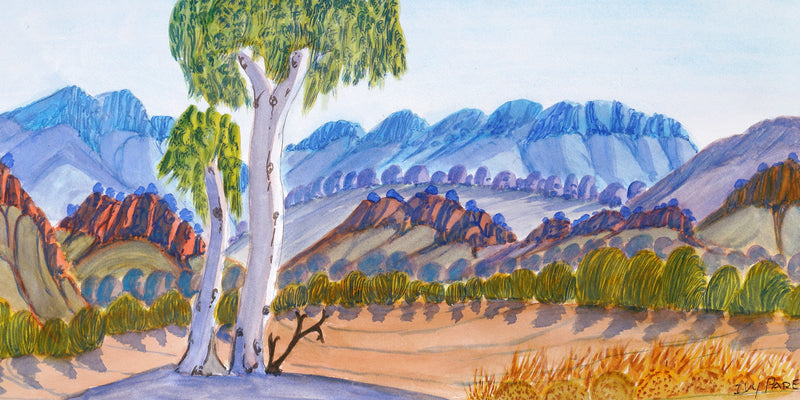
There is one case where the claim has some truth. In 1934 Western Arrernte man Albert Namatjira saw an exhibition of watercolours by visiting artist Rex Battarbee at Hermannsburg, and in 1936 Battarbee gave him eight weeks of lessons in exchange for work as a guide and cameleer. Namatjira learned a European medium, but he painted his own country.
Misconception 2: "A kindergarten kid could do better art than this."
Reality check: Simple or abstract doesn't mean unskilled. A child could copy the look, but not the knowledge. Aboriginal paintings record specific stories, places and laws that the artist has the right to paint, and the most admired works show decades of control over line, colour and composition. Paintings by artists such as Emily Kame Kngwarreye and Rover Thomas hang in the world's major galleries for good reason. The kindergarten comparison says more about the viewer than the painting.
Misconception 3: "Dot painting isn't Aboriginal."
Reality check: Dot painting on canvas is recent, but dots are not. In the desert, people made ground designs for ceremony on cleared, smoothed earth, outlined with circles and dots, and painted designs on their bodies with dots and lines. Concentric circles and other motifs used in these designs also appear in ancient desert rock engravings. The symbols record the stories of a family's country: creation stories, sacred sites, food sources and waterholes.

Examples of dots in body painting and rock art
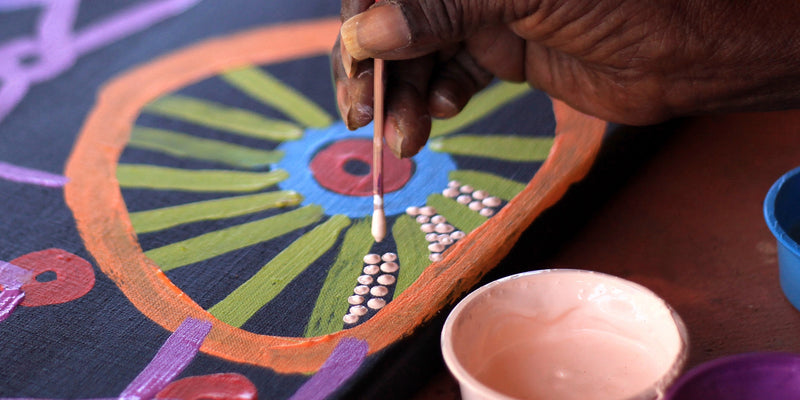
It is true that dot painting as most people know it began in the 1970s. The first Papunya paintings in 1971 used few dots. In 1972 a dispute broke out at an exhibition at Yuendumu over paintings that showed sacred designs, and artists began removing restricted elements or covering them with layers of dots. Dotting also had an aesthetic purpose. Anthropologist Fred Myers records that artists wanted to "make 'em flash", creating a shimmering effect. The style spread across the Western and Central Desert and gave artists a way to share their culture, keep it strong, and earn an independent income.
Misconception 4: "All Aboriginal art looks the same."
Reality check: At the time of colonisation there were more than 250 Aboriginal languages, each with its own country, stories and art. Desert dot painting looks nothing like the rarrk cross-hatching of Arnhem Land bark painting, the Wandjina figures of the Kimberley, or the ochre paintings of the East Kimberley. Subjects range across ancestral stories, country, kinship, water, animals and plants, and art is made in many media, including painting, carving, weaving, fibre sculpture, prints, ceramics and new media.
Within each region, individual artists develop their own styles, just as artists do everywhere. Aboriginal art is a living tradition, and artists keep finding new ways to paint old stories.
References and Further Reading
- Bardon, Geoffrey, and James Bardon. Papunya: A Place Made After the Story. Miegunyah Press, 2004.
- Johnson, Vivien. Lives of the Papunya Tula Artists. IAD Press, 2008.
- Perkins, Hetti, and Hannah Fink (eds). Papunya Tula: Genesis and Genius. Art Gallery of New South Wales, 2000.
- Myers, Fred R. Painting Culture: The Making of an Aboriginal High Art. Duke University Press, 2002.
- Caruana, Wally. Aboriginal Art. Thames & Hudson, World of Art series.
- National Gallery of Victoria. Tjukurrtjanu: Origins of Western Desert Art, Geoffrey Bardon.
- Kluge-Ruhe Aboriginal Art Collection. Papunya Tula: The Dots.