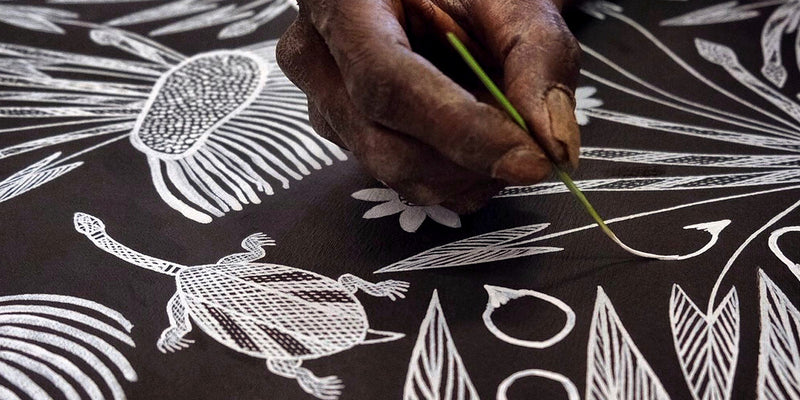
Martha Nakamarra Poulson painting at Arlpwe Aboriginal Art and Culture Centre © Arlpwe Art and Culture Centre
Aboriginal Art from Ali Curung
Arlpwe Art and Culture Centre sits on Kaytetye country in Ali Curung, an Aboriginal community about 400 kilometres north of Alice Springs in the Northern Territory. The art centre opened in 2008, and the name Arlpwe (pronounced Ahl-boa) was chosen by the Traditional Owners. Ali Curung, or Alekarenge, means "belonging to the dog," referring to the dog dreaming site on which the town sits.
The art centre represents artists from four nations: Kaytetye, Alyawarr, Warlpiri, and Warumungu. Each brings distinct cultural knowledge to the work. The Dreamtime is known by a different name in each language: Altyerre in Kaytetye, Altyerr in Alyawarr, Jukurrpa in Warlpiri, and Winkara in Warumungu. The landscape surrounding Ali Curung is central to the art: local bush foods, bush medicines, water, and animals are the predominant subjects of paintings.
Ali Curung has a long history of exceptional carving, and the art centre reflects this with a woodworking shed alongside separate Men's and Women's painting studios. A fully equipped ceramics studio with wheels, a kiln, a pug mill, and glazing materials extends the range of media available to artists. The painting program is comparatively recent and growing rapidly. As Arts Manager Levi McLean has noted, the work is "beautiful, fresh, and profound" and represents a genuine renaissance in the community's artistic output.
Among the centre's well-known artists is Marcus Camphoo Kemarre, an Alyawarr painter whose large abstract grid works on oil and linen have been acquired by the National Gallery of Victoria and shown at the 20th Biennale of Sydney. Martha Poulson Nakamarra, born at Yuendumu in 1949, is another prominent artist. Warrick Miller Japangardi is a Warlpiri man whose practice spans painting and the making of traditional objects including boomerangs, spears, coolamons, stone knives, and ceremonial hair belts.
Arlpwe Aboriginal Art and Culture Centre at a glance
-
Founded
Art centre opened 2008. Located in Ali Curung, 400km north of Alice Springs, NT. Gallery open Monday to Thursday, 10am to 4pm, 15 minutes off the Stuart Highway. -
Language and Culture
Kaytetye, Alyawarr, Warlpiri, and Warumungu peoples, on Kaytetye country. -
Art Style
Paintings depicting bush foods, bush medicines, water, and animals. Wood carving, ceramics, and traditional object-making. Separate Men's and Women's studios. -
Notable Artists
Marcus Camphoo Kemarre (NGV collection, Biennale of Sydney), Martha Poulson Nakamarra, Warrick Miller Japangardi.