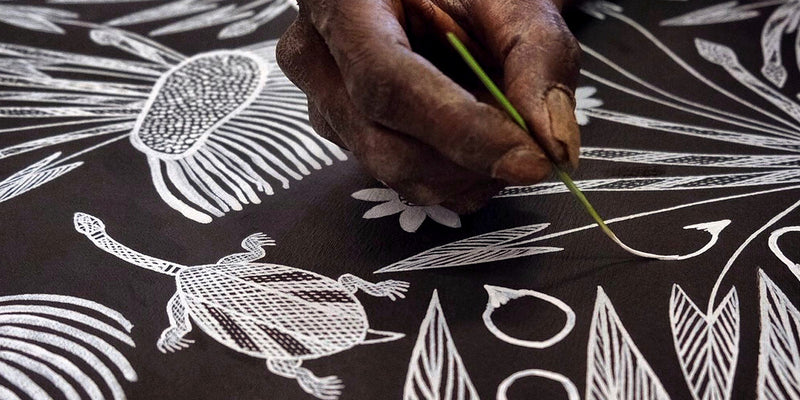
Textile artists at Bábbarra Women's Centre © Bábbarra Aboriginal Women's Centre
Aboriginal Art Textiles from Maningrida, Arnhem Land
Bábbarra Women's Centre was founded in 1983 by Ndjébbana leader Helen Williams and Helen Bond-Sharp, originally as a women's refuge in Maningrida, West Arnhem Land. It has grown into one of Australia's most significant Indigenous-led women's organisations, supporting women across the Maningrida community and 32 surrounding homelands across more than 7,000 square kilometres.
The name Bábbarra comes from the Ndjébbana language of the Kunibídji people, on whose Country the community of Maningrida lies. It is the name of a fertile freshwater billabong south of the town, belonging to the Dukúrrdji clan. Maningrida is one of the world's most linguistically diverse communities per capita. Artists at Bábbarra represent more than 12 distinct language groups, with individuals commonly speaking four to six languages.
The centre's main enterprise is Bábbarra Designs, a textile business that has been operating since 1989 and is one of the oldest continuously operating Indigenous textile enterprises in Australia. It is one of a small number of Indigenous art centres in the country that design, print, and sew products entirely on site, in community. Artists work primarily in lino-tile printing, screen printing, and natural dyeing. Each length of hand-printed fabric is unique, depicting the ancestral stories, djang and wangarr, of the artists' Arnhem Land country and cultures. The archive now holds over 70 screen designs.
In the 1990s, Bábbarra developed printmaking skills through joint workshops with Maningrida Arts and Culture, building expertise in etching, lithography, and screen printing. Many leading Bábbarra artists trace their artistic education to the renowned bark painters in their families, including James Iyuna, Mary Marabamba, and Lena Kuriniya. Senior artists Susan Marawarr, Jennifer Wurrkidj, Deborah Wurrkidj, Janet Marawarr, and Helen Lanyinwanga have been central to the development of Bábbarra's textile practice. Susan Marawarr has demonstrated printmaking at the Kluge-Ruhe Aboriginal Art Collection at the University of Virginia, and Bábbarra textiles have been exhibited in China, Mexico, the USA, and across Australia. Works are held in major institutional collections including the Art Gallery of Western Australia and the Art Gallery of South Australia.
Bábbarra also runs a community op shop, a laundromat, and has helped establish the Maningrida Women's Committee. The centre governs five remote women's centres on homelands at Cadell, Mumeka, Buluhkaduru, Ji-Mardi, and Mankorlod, ensuring that families remain connected to Country. The centre is governed by the Bábbarra Women's Governance Board, and is owned by Bawinanga Aboriginal Corporation.
Bábbarra Women's Centre at a glance
-
Founded
1983, by Helen Williams and Helen Bond-Sharp, originally as a women's refuge. Bábbarra Designs textile enterprise established 1989. -
Location
Maningrida, West Arnhem Land, Northern Territory. Serves 32 surrounding homelands across more than 7,000 square kilometres. -
Language and Culture
Artists from more than 12 language groups across the Maningrida region. Maningrida is one of the world's most linguistically diverse communities per capita. -
Art Style
Lino-tile printing, screen printing, and natural dyeing on fabric. Designs reference Country, ancestral stories, flora, fauna, and cultural knowledge. -
Notable Artists
Susan Marawarr, Jennifer Wurrkidj, Deborah Wurrkidj, Janet Marawarr, Helen Lanyinwanga. -
Collections
Art Gallery of Western Australia, Art Gallery of South Australia, and international collections. Exhibited in China, Mexico, and the USA. -
Governance
Run by women, for women. Governed by the Bábbarra Women's Governance Board. Owned by Bawinanga Aboriginal Corporation.
Bábbarra Women's Centre website