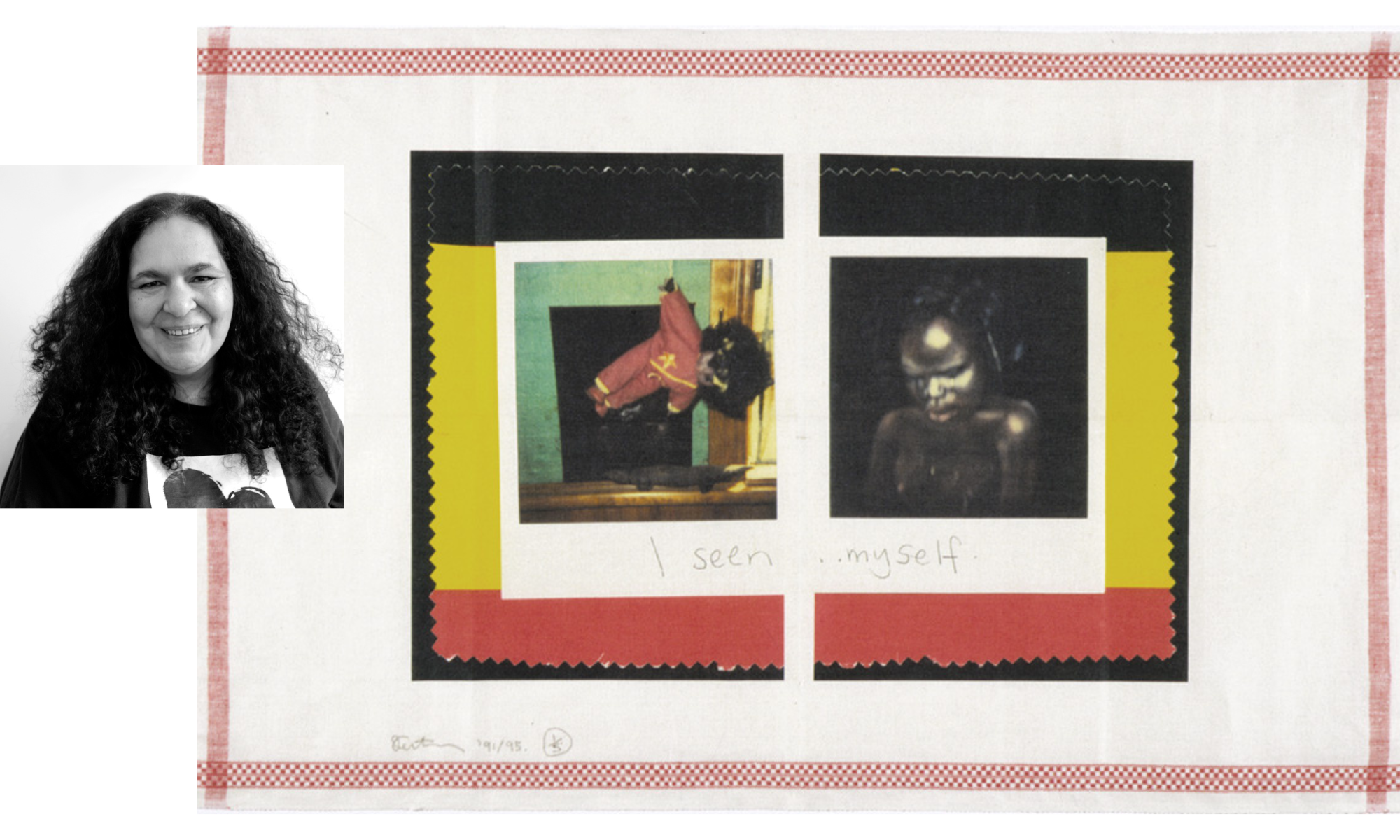
Destiny Deacon, Teatowel — I seen myself, 1991, printed 1995
The Kuku Yalanji and Erub/Mer woman from Brunswick who coined the term "Blak," worked for Charles Perkins, and was the only Australian artist selected for documenta 11
Destiny Deacon was born on 6 February 1957 in Maryborough, Queensland, of Kuku Yalanji (Far North Queensland) and Erub/Mer (Torres Strait Islander) heritage. Her family moved to Port Melbourne in 1959 and she grew up in Melbourne's inner suburbs, raised by her mother Eleanor Harding in a household where Aboriginal politics were a daily subject. She completed a Bachelor of Arts in politics at the University of Melbourne in 1979 and a Diploma of Education at La Trobe University in 1981, then taught history in secondary and community schools before becoming a tutor and lecturer in Australian writing, culture, and Aboriginal and Torres Strait Islander cultural production at the University of Melbourne. Inspired by her mother, she went to Canberra to work as a staff trainer for Aboriginal activist Dr Charles Perkins (one of what his staff called "Charlie's Angels") before beginning her art career in 1990.
In 1991 she coined the term "Blak" by removing the "c" from "black," an act of defiance against a racial slur she had heard shouted at her growing up. The term, first used in her series Blak lik mi shown at the Boomalli Aboriginal Artists Cooperative in November 1991, has since entered the broader Australian cultural vocabulary as the preferred term for First Nations art, culture and history. Her first solo exhibition, Caste Offs, was held at the Australian Centre for Photography in Sydney in 1993. Working primarily in photography, video and installation, she used a large personal collection of kitsch Aboriginalia (black dolls, boomerangs, tourist ceramics) to construct domestic scenarios that were, as she put it, "intensely disturbing and disarmingly comedic," staging tales of dispossession and alienation through objects that had themselves been used to caricature Aboriginal people. "I like to think there is a laugh and a tear in each picture," she said.
A brilliant performer, academic and activist, Destiny Deacon's several careers reflect the complexity of her role as artist. Her work is a direct expression of her life; she is, as she once put it, 'just an old-fashioned political artist.' In installations, videos and laser-generated prints, Deacon considers the casual cruelty and indirect violence of everyday racism through a humour particular to her identity, that of an 'urban Australian Aboriginal survivor ... of the colonial wars.'
Marcia Langton, 'The valley of the dolls', Art and Australia, vol. 35, no. 1, 1997, p. 100.
In 2002 she was the only Australian artist selected for documenta 11 in Kassel, curated by Okwui Enwezor. In 2004 the Museum of Contemporary Art Australia mounted her first major retrospective, Walk and don't look blak, which toured to the Ian Potter Museum of Art in Melbourne, the Adam Art Gallery and City Gallery Wellington in New Zealand, the Jean-Marie Tjibaou Cultural Centre in Noumea, and the Tokyo Metropolitan Museum of Photography. She also exhibited at the Johannesburg Biennale (1995), Yokohama Triennale (2001), Havana Biennial (1994 and 2009), and the Biennale of Sydney (2000 and 2024). In 2019 La Trobe University awarded her an honorary doctorate. In 2022 she received the Red Ochre Award for lifetime achievement in First Nations arts. Her longtime collaborator and partner Virginia Fraser died in 2021. Destiny Deacon died on 23 May 2024 in Melbourne.
25 Famous Aboriginal Artists You Should Know