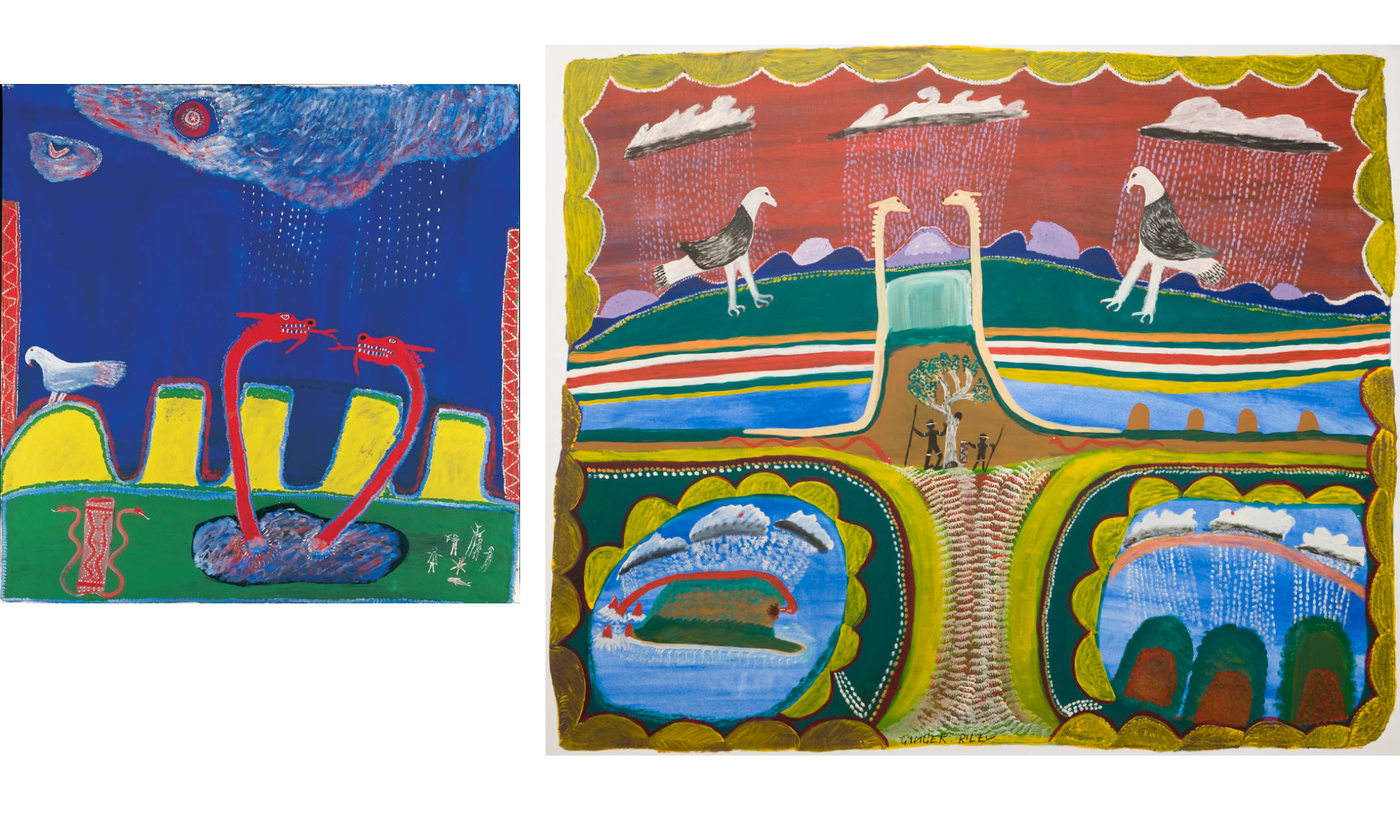
L: Garimala (The Two Snakes), 1988 R: Ceremony Time in Limmen Bight Country During the Wet Season, 1996
The Marra saltwater man who spent the 1950s droving cattle across the Northern Territory before becoming the first living Aboriginal artist honoured with a retrospective at the National Gallery of Victoria
Ginger Riley Munduwalawala was born around 1936 in South-East Arnhem Land, in the coastal saltwater country of the Marra people near the Limmen Bight River in the Gulf of Carpentaria. His first language was Marra, now critically endangered. After his mother's death the family moved to the Roper River Mission, where he attended school intermittently. From the 1950s he worked as a stockman and laborer on Nutwood Downs Station and elsewhere across the Northern Territory. During those years he watched Albert Namatjira painting his country and was struck by the colour. He began painting himself around 1986, when he had returned to Ngukurr, and within two years had developed the large-scale, brilliantly coloured landscape style that would define his career. In 1988 Gabrielle Pizzi included his work in the second exhibition at her new Melbourne gallery, and Riley travelled to the opening to speak about the works.
His paintings interpret a sequence of events centred on his mother's country: the area around the Four Archers (Barrkuwiriji), a group of pyramidal rock formations about 45 kilometres inland on the Limmen Bight River, which Riley described as "the centre of the earth, where all things start and finish." Recurring across his canvases are Garimala, the taipan creator snake who formed the Four Archers and later transformed into the Rainbow Serpent; Bulukbun, the angry fire-breathing serpent-dragon; and Ngak Ngak, the white-breasted sea eagle who guards the country. His mother is represented in his paintings as cloud and sun. Riley painted from an aerial perspective, describing his vantage point as being "on a cloud, on top of the world, looking down." His flat, bold forms and incandescent palette, which could turn a sky yellow or the earth pink, defied easy categorisation. He was neither a bark painter in the Arnhem Land tradition nor a dot painter in the Western Desert manner, and he was openly aware that his work "looks different from other mob."
In 1992 he won the Alice Prize and produced a series of works for the new Australian Embassy in Beijing. The following year he won the inaugural National Heritage Commission Aboriginal and Torres Strait Islander Art Award and the John McCaughey Memorial Art Prize. In 1997 the National Gallery of Victoria mounted a ten-year retrospective, Mother Country in Mind: The Art of Ginger Riley Munduwalawala, making him the first living Aboriginal artist to be honoured with a retrospective and publication by a major public institution in Australia. He also received an Australia Council Fellowship for 1997 and 1998. In July 2000 the Federal Court of Australia recognised native title rights over his mother's country, affirming his right as traditional owner and custodian. He died in September 2002.
25 Famous Aboriginal Artists You Should Know
References and further reading
- Ginger Riley Munduwalawala, National Portrait Gallery
- Ginger Riley Munduwalawala, Art Gallery of New South Wales
- Ginger Riley Munduwalawala, Wikipedia
- Ryan, Judith. Mother Country in Mind: The Art of Ginger Riley Munduwalawala. National Gallery of Victoria, 1997.