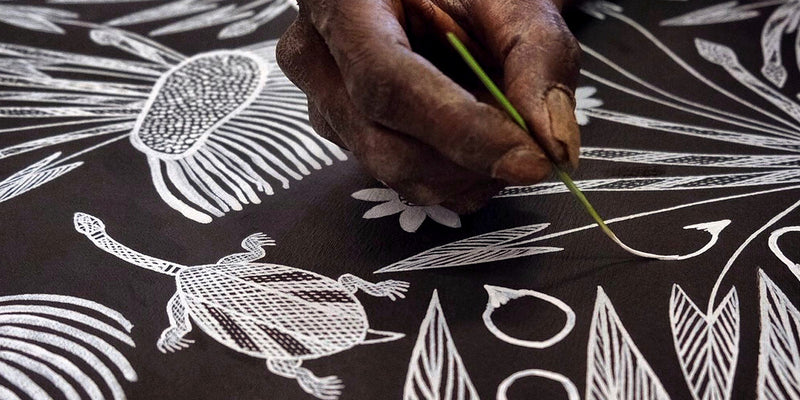
The Yorta Yorta-Scottish mechanic from Melbourne who became a bridge between urban and remote Aboriginal art

Lin Onus (1948-1996)
In 1974, a 26-year-old mechanic and spray painter found a set of watercolour paints left behind at his father's Aboriginal Enterprises shop in the Dandenongs. He made a painting. It sold. The following year he held his first exhibition at the Aborigines Advancement League in Melbourne, an organisation his father Bill Onus had helped establish. His name was Lin Onus, born William McLintock Onus on 4 December 1948 in Kew, Melbourne, the only child of a Yorta Yorta father and a Scottish mother. He would go on to hold 18 solo exhibitions and around 80 exhibitions in total, win the Order of Australia, and help place urban Aboriginal art on the national cultural map. He died of a heart attack on 23 October 1996, aged 47.
His father Bill Onus was a significant figure: founder of the Aboriginal Advancement League, the first Aboriginal Justice of the Peace, and a campaigner for the 1967 referendum. His Scottish mother Mary McLintock Kelly was politically active on the left; his parents had met at a rally, and she was crowned Miss Communist Party 1947. Lin's political education came from both directions. Expelled from Balwyn High School at 14, he became a mechanic and spray painter, then worked making artefacts for his father's tourist business. He taught himself to paint. In 2000, the principal of Balwyn High School issued a posthumous public apology for the expulsion.
The turning point in his artistic development came in 1986 when he visited Maningrida in Arnhem Land and began a close collaboration with Djinang artist Djiwul Jack Wunuwun and other central Arnhem Land artists including John Bulunbulun. Wunuwun gave him permission to use rarrk, the ceremonial crosshatching of Arnhem Land, and this became the defining visual element of Onus's most celebrated works. The collaboration was a two-way exchange, not appropriation: Onus brought Arnhem Land imagery into urban and suburban contexts while helping to build recognition for the remote artists he worked with. His uncle Aaron Briggs gave him his Koori name, Burrinja, meaning "star."

Lin Onus, Guyi Rirrkyan (Fish and Rocks), 1990
His paintings of the Barmah Forest, the flooded eucalypt country near his Yorta Yorta homeland at Cummeragunja on the Murray River, often feature rarrk-patterned fish beneath the water's surface: Country seen through Arnhem Land eyes, the two traditions held in the same image without dissolving either. A jigsaw puzzle piece of the landscape that cannot fit is a recurring motif, a comment on the irreparable damage to the Murray River ecosystem. The landscape is always political in Onus's hands.

Fruit Bats, Lin Onus, 1991. National Gallery of Australia.
Fruit Bats (1991), shown at the Australian Perspecta, is the work he is best known for. A flock of fibreglass bats painted with Murrungun-Djinang rarrk hang from a Hills Hoist clothesline, with wooden discs below representing bat droppings, each painted with flower-like ceremonial motifs. The Hills Hoist is the icon of suburban Australian domesticity; the bats, with their ancestral markings, have come to reclaim the backyard. The sacred and the mundane occupy the same structure. It is the collision Onus was always interested in, and it is very funny, which was also the point.
He was appointed to the Aboriginal Arts Board of the Australia Council in 1986 and served as its chairman from 1989 to 1992. He won the Kate Challis RAKA Award in 1993 and was made a Member of the Order of Australia the same year. In 1994 he won the overall prize and the People's Choice Award at the National Indigenous Heritage Art Award in Canberra. He was a founding member and director of Viscopy in 1995. After his death, the youth award at the National Aboriginal and Torres Strait Islander Art Awards was renamed the Lin Onus Youth Prize. His ashes were scattered at the Cummeragunja cemetery on the NSW-Victorian border, his spiritual home.
The retrospective Urban Dingo: The Art of Lin Onus 1948-1996, curated by Margo Neale and organised by the Queensland Art Gallery, opened at the Museum of Contemporary Art Sydney in 2000 as part of the Olympic Arts Festival. It had been developed before his death and was completed with the help of his family. His work is held in the National Gallery of Australia, the Art Gallery of New South Wales, and major collections across the country.
25 Famous Aboriginal Artists You Should Know
References and further reading
- Lin Onus, Art Gallery of New South Wales
- Lin Onus, Design and Art Australia Online
- William Lin Onus AM, First Peoples Relations Victoria
- Lin Onus, Wikipedia