Ronnie Tjampitjinpa: the Pintupi painter from Muyinnga who helped shape the Western Desert art movement
Around 1956, a teenage boy walked with his family out of the Western Desert and into the government settlement of Papunya, following years of drought that had forced the Pintupi from their country near Muyinnga, about 100 kilometres west of the Kintore Ranges in Western Australia. He had grown up travelling the desert with his family, moving across Pintupi country and around Wilkinkarra (Lake Mackay), and had been initiated into Pintupi law at the site of Yumari near his birthplace. At Papunya he found work fencing aerodromes. In 1971, when a group of men began painting their ancestral designs on boards and canvas under the encouragement of school teacher Geoffrey Bardon, he joined them. He was one of the youngest participants, and one of the founders of Papunya Tula Artists. His name was Ronnie Tjampitjinpa, and he was the nephew of Uta Uta Tjangala, one of the movement's most senior figures.
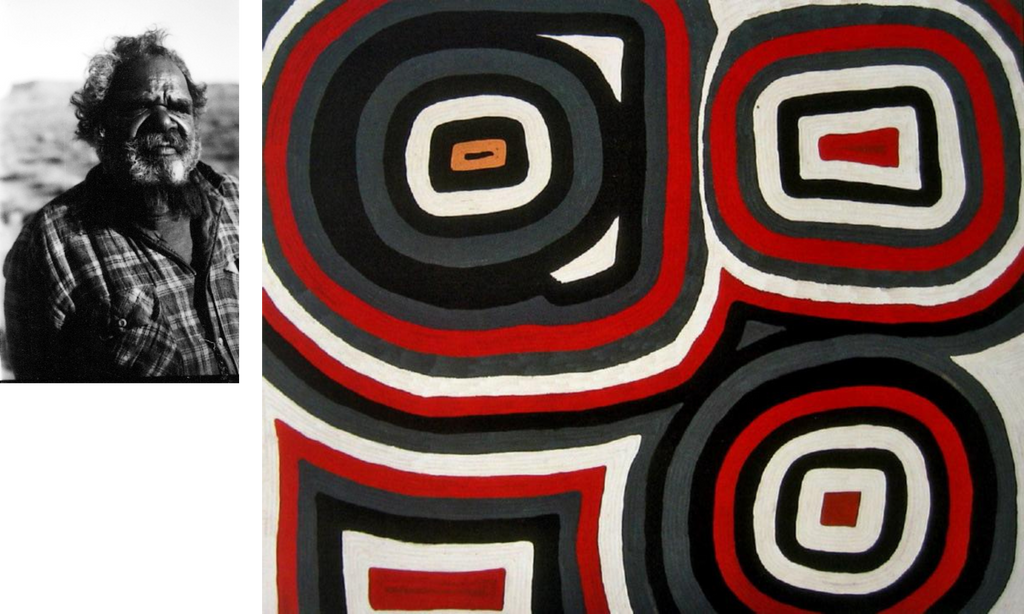
L Ronnie Tjampitjinpa R Two Boys at Wilkinkarra (Lake Mackay), 1992
Throughout the 1970s Tjampitjinpa was as much an activist as an artist, travelling constantly between Papunya, Yuendumu, Wirrimanu (Balgo) and Mount Doreen Station, urging people to return to their traditional lands. When the settlement of Walungurru (Kintore) was established in 1981, his goal was achieved. He moved there with his family in 1983, established an outstation at Ininti (Redbank), and served as chairman of the Kintore Outstation Council. During this period he set aside painting to pursue land rights claims, later describing the experience as "too much humbug for too long." When he returned to painting it was with renewed focus, and he rapidly emerged as one of Papunya Tula's major artists. In 1984 he won the Northern Territory Art Award, a victory that became a landmark when a judge upheld his entry against complaints from other contestants that Papunya art was not "high art."
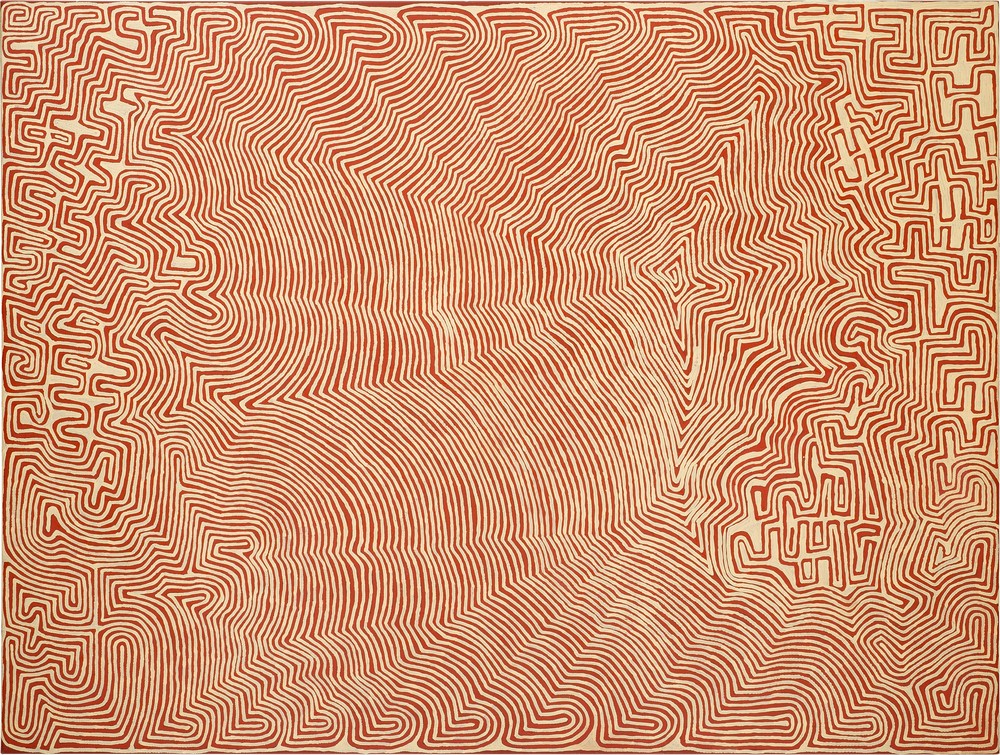
Ngarru, 2008, Ronnie Tjampitjinpa
Tjampitjinpa's paintings centre on the Tingari cycle: the ancestral beings who, in the creation era, travelled vast stretches of the Western Desert performing ceremonies, shaping the country and teaching law. These are sacred narratives belonging to initiated Pintupi men, and their full meaning is not available to the uninitiated. What is visible is a body of work marked by bold geometric forms, concentric circles linked by lines of travel, and a pulsating optical energy that became increasingly stripped back over time. From the early 1990s he accentuated graphic qualities by replacing the standard circular Tingari forms with squared elements and reducing his palette to two or three colours, developing an approach that has been compared to minimalism. He won the Alice Springs Art Prize in 1988, was named one of Australia's 50 most collectable artists by Australian Art Collector magazine in 2001 and again in 2009, and in 2015 the Art Gallery of New South Wales held a survey exhibition celebrating his forty-year career.
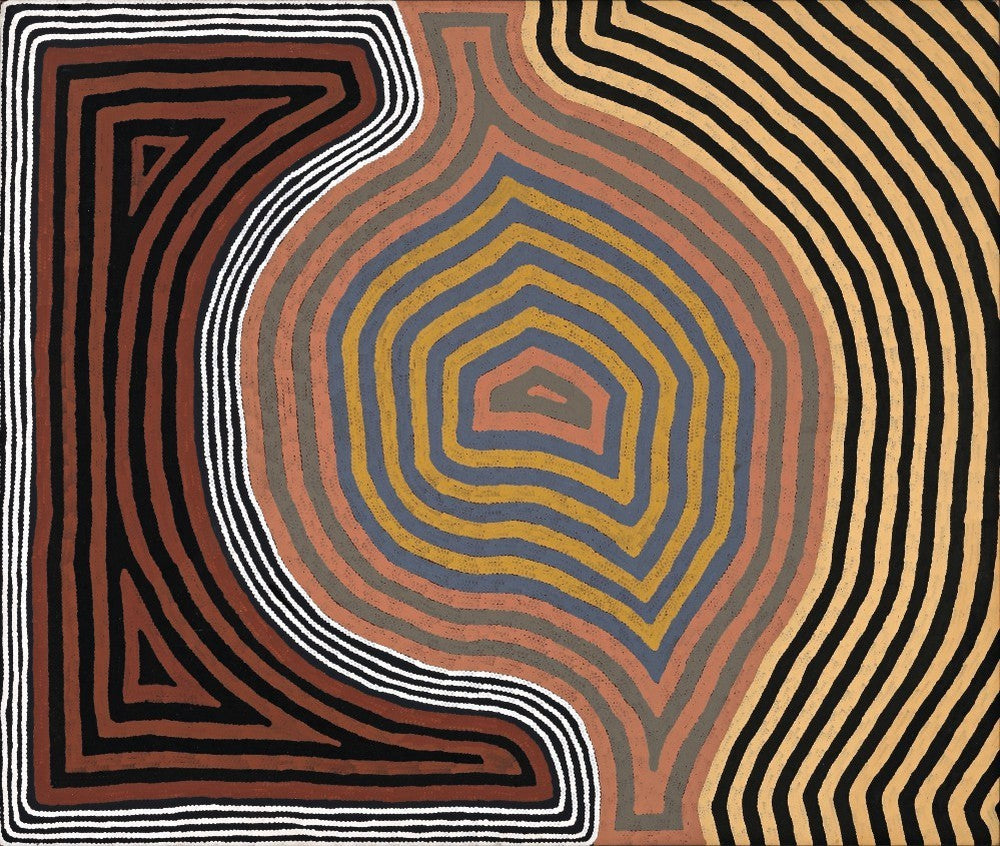
Tingari Ceremonies at the Site of Pintjun, Ronnie Tjampitjinpa. Sold at Sotheby's New York, 2019, $370,000 AUD
His work is held in the NGA, NGV, AGNSW, AGWA, AGSA, the Musée du quai Branly in Paris, the Seattle Art Museum, the Groninger Museum in the Netherlands, and more than thirty major collections worldwide. Tjampitjinpa is one of the most heavily copied and misattributed artists in the Aboriginal art market; buyers should verify provenance through Papunya Tula Artists, the cooperative that represents him. He passed away in Alice Springs in June 2023.
25 Famous Aboriginal Artists You Should Know