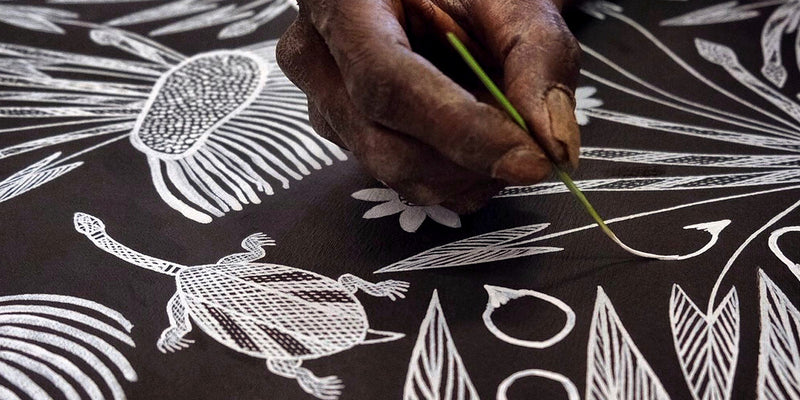
Spinifex Arts Project: Pila Nguru, Tjuntjuntjara, Great Victoria Desert, WA
In 1997, senior men and women of the Pila Nguru began painting two large collaborative canvases. One was painted by the men, one by the women. Each documented birthplaces and Jukurrpa (ancestral stories) across the entire claim area of the Great Victoria Desert. These paintings were produced as legal evidence for the Pila Nguru's native title claim over 55,000 square kilometres of country. When the Federal Court granted that claim in 2000, the two paintings were formally included in the preamble of the land agreement between the Spinifex people and the Western Australian Government, passed through state parliament. As a celebration of the successful outcome, the Spinifex people gifted ten large canvas paintings to the people of Western Australia. As one artist put it: "Painting helped us get our land back."
Tjuntjuntjara sits 700km east of Kalgoorlie, making it one of the most remote communities in Australia. The Pila Nguru, whose name means "people from the land of the spinifex," had been displaced from their country when the British and Australian governments conducted atomic weapons testing at Maralinga in the 1950s and 1960s. Some began returning in the early 1980s. The Spinifex Arts Project is based at a purpose-built studio in Tjuntjuntjara, opened in 2015, with an adjoining multimedia space called Milpa. The centre is a non-profit, Aboriginal-owned organisation and a member of Desart. Works are held in collections including the British Museum in London. Senior artists include Simon Hogan, Tjaruwa (Angelina) Woods, Ian Rictor, Carlene West, and Kunmanara (Fred) Grant.
Spinifex Arts Project at a glance
- Location: Tjuntjuntjara Community, Great Victoria Desert, WA. 700km east of Kalgoorlie.
- Established: 1997, co-founded by Dr Peter Twigg and Pila Nguru artists as part of the native title documentation process.
- People: Pila Nguru (Pitjantjatjara and Ngaanyatjarra), Great Victoria Desert.
- Art forms: Acrylic painting on canvas and linen, collaborative large-scale canvases, punu (woodwork).
- Notable artists: Simon Hogan, Tjaruwa (Angelina) Woods, Ian Rictor, Carlene West, Kunmanara (Fred) Grant (dec.), Byron Brooks (dec.).
- Access: Tjuntjuntjara is on restricted Aboriginal land. A permit is required to visit. Contact Paupiyala Tjarutja Aboriginal Corporation for permit requirements.