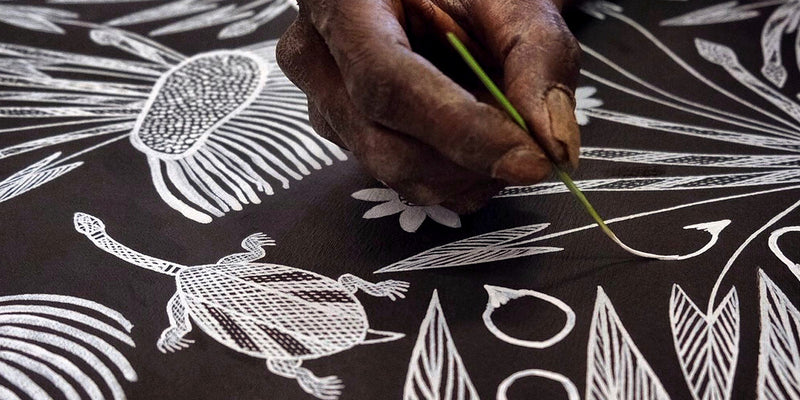
Alice Djulman Dullman, Nguyno (flower), 77x70cm
Your support helps the artist and their community art centre.
Free insured post & 120-day returns Ships from Tasmania within 1 business day Arrives in 1–3 days (Aus) · 5–10 days (Int’l*) Guaranteed colour accuracy
Community Certified Artwork
This original artwork is sold on behalf of Maningrida Arts and Culture, a community-run art centre. It includes their Certificate of Authenticity.
– Original 1/1
- Details
- Artwork details
- Artist
- Art Centre
- Aboriginal Artist - Alice Djulman Dullman
- Community - Maningrida
- Homeland - Maliny
- Aboriginal Art Centre - Maningrida Arts and Culture
- Catalogue number - 395-25
- Materials - Pandanus and Bush Cane with Natural Dyes
- Size(cm) - L77 W70 D2
- Postage - Posted flat
Works in fibre from the Maningrida region are widely recognised as some of the finest in Australia. Artists confidently push the boundaries of fibre craft and cultural expression, adapting traditional techniques and forms to produce strikingly inventive and aesthetically exquisite artworks.
In 2003, Kuninjku artist Marina Murdilnga introduced a revolutionary new form of pandanus weaving to Maningrida Arts & Culture – a flat yawkyawk made from knotted pandanus on a jungle-vine frame, painted with natural pigments. She later experimented with dyed pandanus and feathers in this way. Murdilnga’s innovation inspired many other weavers, who now produce an array of beautifully resolved flat figurative works – stingrays, butterflies, spiderwebs – as well as spiritual figures and Ancestral beings. Alongside Murdilnga, leading artists of this fibre art form include Anniebell Marnngamarnnga, Frewa Bardaluna, and Rembarrnga artists Vera Cameron and Maisie Cameron. Lulu Larandjbi has woven interpretations of the rock pools at Kobumi, where Ngalyod, the Rainbow Serpent, entered and died.
Commonly used fibres include the leaves of pandanus (Pandanus spiralis), palms (Livistonus), mírlírl (burney or jungle vine, Malaisia scandens), and the inner bark of kurrajong and stringybark eucalyptus trees. Weaving is physically demanding work, now undertaken only by women. They colour the pandanus using natural dyes made from the roots, leaves, or flowers of plants within the weaver’s clan estate. The same dye bath is often used for several batches of fibre, with colour variations depending on immersion time and dye strength. The women skilfully use salt and wood ash as mordants and colour enhancers.
Details are currently unavailable
An art movement that is striking, political and enduring: this is what contemporary artists in Maningrida and the surrounding homelands have built, powered by their ancestral connections to country and djang.
Ways of learning and schools of art in Arnhem Land are based around a system of passing knowledge and information on to others. The art here has its genesis in body design, rock art and cultural practices, in concert with more than 50 years of collaborations, travel and political action to retain ownership of country. Values and law are expressed through language, imagery, manikay (song), bunggul (dance), doloppo bim (bark painting), sculptures, and kun-madj (weaving) – the arts.
The artists’ transformation of djang into contemporary artistic expression has intrigued people around the world: art curators and collectors, and stars including Yoko Ono, Jane Campion, David Attenborough and Elton John. Pablo Picasso said of Yirawala’s paintings, ‘This is what I’ve been trying to achieve all my life.’
Yirawala (c.1897–1976) was a legendary Kuninjku leader, artist, land-rights activist and teacher, and his artwork was the first of any Indigenous artist to be collected by the National Gallery of Australia as part of a policy to represent in depth the most significant figures in Australian art.
Maningrida Arts & Culture is based on Kunibídji country in Arnhem Land in Australia’s Northern Territory. The area where artists live encompasses 7,000 square kilometres of land and sea, and over 100 clan estates, where people speak more than 12 distinct languages. Aboriginal people in this region are still on country, surviving and resilient because their country is the centre of their epistemology, their belief system, culture – djang.
Artists’ works from the larger Maningrida region can be seen in collections and institutions around the world. We work with museums, contemporary galleries and high-end retailers both nationally and internationally on projects throughout the year.
Text courtesy: Maningrida Arts and Culture
"So proud to support artists through Art Ark." - Lisa, Aus – ART ARK Customer Review