- Details
- Artwork Story
- Bark Process
- Artist
- Art Centre
- Aboriginal Artist - Dhuwarrwarr Marika
- Community - Yirkala
- Homeland - Yirrkala / Yalaŋbara / Gulurunga / Bremer Island
- Aboriginal Art Centre - Buku-Larrŋgay Mulka Centre
- Catalogue number - 3800-18
- Materials - Earth pigments on Stringybark
- Size(cm) - H144 W64 D1 (irregular shape)
- Postage variants - Artwork posted flat and ready to hang with a metal mount for stability
- Orientation - Ready to hang as displayed but can be displayed horizontally
Wulthu or Yambirrpa is an ancestral fish trap area close to Yirrkala on a rock platform at the feet of the mountainous sea cliff known as Djuwalpawuy or “Old Man”. This hill is a manifestation of Bol’ŋu or Djambawal the Thunderman. Associated with the saltwater estates close to Yirrkala belonging to the Rirratjiŋu and Djambarrpuyŋu clans is the ancestral Thunderman Djambawal.
Controller of the seasons he directs the weather by pointing with his spear Larrpan relative to the location of the clan groups that sing of the Thunderman. Other clans that are part of this sacred cycle of song and dance include the Dätiwuy, Djapu and
Galpu.
Lightning and storm are associate with Djambawal as are shooting meteors seen in the night sky - Larrpan his spear affirming connections through the heavens. The waterspout phenomenon seen in this country during certain seasons is the Ancestors penis marking the location of special fonts containing the (Rirratjiŋu/Djambarrpuyŋu) life force in underwater wells spewing freshwater up into the sea. The Bolŋu or waterspout sucks saltwater into the sky which completes the cycle of raining down as
freshwater.
The colours of coral and Gunbilk the spawn slick that the reefs emit on the full moon are reflected in this work. The natural rock pools and gutters are modified by the Rirratjiŋu clan with walls laid from lumps of coral to form a trap that feeds the
tribe. These actions are recorded and rehearsed through sacred song (manikay) which is the source of this work.
Rirratjiŋu elder Dhuwarrwarr Marika has said of this area ' This fish trap, we call it yambirrpa. The yambirrpa fills up when the gapu (water) comes in and out with the tides. The yambirrpa is built of gunda and when the gapu comes in the guya (fish) swim into the yambirrpa, when the tides goes out the guya are trapped and we can go there and catch the guya. This yambirrpa was shown to us by the old people and years later now, it’s still there. One yambirrpa is Rirratjiŋu and one is Bararrŋu
(Rarrakalawuy) and one is Djambarrpuyŋu and they are all still there.
In many ways, the harvesting and material production to create bark paintings is an art in itself. The bark is stripped from Eucalyptus stringybark. It is generally harvested from the tree during the wet season. Two horizontal slices and a single vertical slice are made into the tree, and the bark is carefully peeled off. The smooth inner bark is kept and placed in a fire. After firing, the bark is flattened and weighted to dry flat. Once dry, the bark becomes a rigid surface and is ready to paint upon.

Djawakan Marika, Yilpirr Wanambi, Wukun Wanambi and Nambatj Munu+ïgurr Harvesting stringybark for artists Photo credit: David Wickens

Wanapa Munu+ïgurr, Yilpirr Wanambi and Wukun Wanambi harvesting stringybark. Photo credit: David Wickens

Wanapa and Nambatj Munu+ïgurr firing a bark to start the flattening process. Photo credit: David Wickens
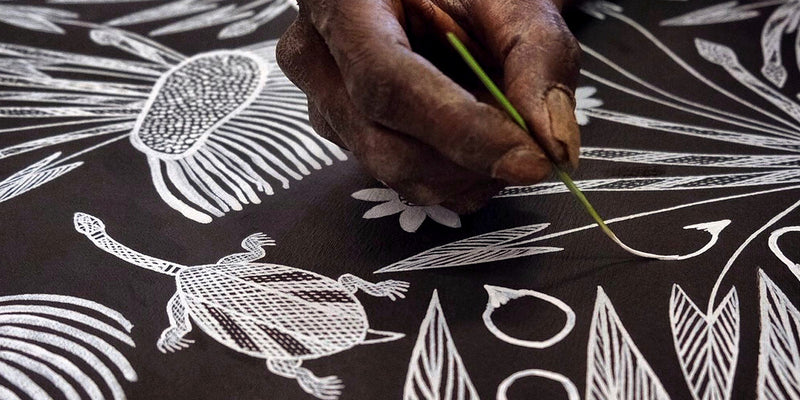
Arnhem Land paintings are characterised by the use of fine crosshatched patterns of clan designs that carry ancestral power: the crosshatched patterns, known as rarrk in the west and miny’tji in the east, produce an optical brilliance reflecting the presence of ancestral forces.
These patterns are composed of layers of fine lines, laid onto the surface of the bark using a short-handled brush.

Rerrkiwaŋa Munuŋgurr painting her husbands design Gumatj fire or Gurtha. Photo credit: Buku-Larrŋgay Mulka Centre
The artist’s palette consists of red and yellow ochres of varying intensity and hues, from flat to lustrous, as well as charcoal and white clay(pictured above). Pigments that were once mixed with natural binders such as egg yolk have, since the 1960s, been combined with water-soluble wood glues.

Naminapu Maymuru White collecting gapan white clay used for painting. Photo credit: Edwina Circuitt
Dhuwarrwarr Marika is a senior Yolngu woman from East Arnhem Land, a member of the Rirratjingu clan and part of a family ‘dynasty’ whom are accomplished artists and passionate advocates of indigenous rights that included involvement in the historic Gove Land Right Case that led to the passing of the first land rights legislation in Australia. As a senior states person for her people, Dhuwarrwarr has been on numerous local and national committees, including being an executive member and women’s council representative for the Northern Land Council.
Dhuwarrwarr is the daughter of Mawalan 1 Marika (c 1908-1967). Her father was a highly influential ceremonial leader, political activist and artist. It was her father who broke convention by teaching his oldest daughters how to paint along with his sons. This paved the way for Yolngu women to eventually establish themselves as painters in their own right and today this legacy is continued on by his daughters Banduk and Dhuwarrwarr.
Dhuwarrwarr has devoted herself to a range of artistic, cultural and community-based activities throughout her life. Having completed school she worked as a nurse at Yirrkala, Darwin and then Sydney before returning home to pursue her artistic talents — learning basketry from her mother and aunt and then the basics of Rirratjingu painting from her father, Mawalan. She continues to depict many of his designs, although with her own interpretation, giving them a contemporary look.
Her earliest paintings were done in the 1970s and over time Dhuwarrwarr artistic path included bark painting, carver, mat maker and print maker. She has also done murals for community buildings at Yirrkala, for Darwin Airport, the Batchelor Institute of Indigenous Tertiary Education, and the Atherton School in Queensland.
Her work has been consistently represented in group shows since the late 1980s and is represented in most Australian state galleries.
Buku-Larrŋgay Mulka Centre is the Indigenous community-controlled art centre of Northeast Arnhem Land. Located in Yirrkala, a small Aboriginal community on the north-eastern tip of the Top End of the Northern Territory, approximately 700km east of Darwin. Our primarily Yolŋu (Aboriginal) staff of around twenty services Yirrkala and the approximately twenty-five homeland centres in the radius of 200km.
In the 1960’s, Narritjin Maymuru set up his own beachfront gallery from which he sold art that now graces many major museums and private collections. He is counted among the art centre’s main inspirations and founders, and his picture hangs in the museum. His vision of Yolŋu-owned business to sell Yolŋu art that started with a shelter on a beach has now grown into a thriving business that exhibits and sells globally.
Buku-Larrŋgay – “the feeling on your face as it is struck by the first rays of the sun (i.e. facing East)
Mulka – “a sacred but public ceremony.”
In 1976, the Yolŋu artists established ‘Buku-Larrŋgay Arts’ in the old Mission health centre as an act of self-determination coinciding with the withdrawal of the Methodist Overseas Mission and the Land Rights and Homeland movements.
In 1988, a new museum was built with a Bicentenary grant and this houses a collection of works put together in the 1970s illustrating clan law and also the Message Sticks from 1935 and the Yirrkala Church Panels from 1963.
In 1996, a screen print workshop and extra gallery spaces was added to the space to provide a range of different mediums to explore. In 2007, The Mulka Project was added which houses and displays a collection of tens of thousands of historical images and films as well as creating new digital product.
Still on the same site but in a greatly expanded premises Buku-Larrŋgay Mulka Centre now consists of two divisions; the Yirrkala Art Centre which represents Yolŋu artists exhibiting and selling contemporary art and The Mulka Project which acts as a digital production studio and archiving centre incorporating the museum.
Text courtesy: Buku-Larrŋgay Mulka Centre
"I'm very pleased to have one of Jeani's paintings. It travelled all the way to Switzerland and found a nice place on my wall! I'm also very happy to support your organisation and their artists." - Catherine, CH
– Read all 1,680+ ART ARK Customer Reviews