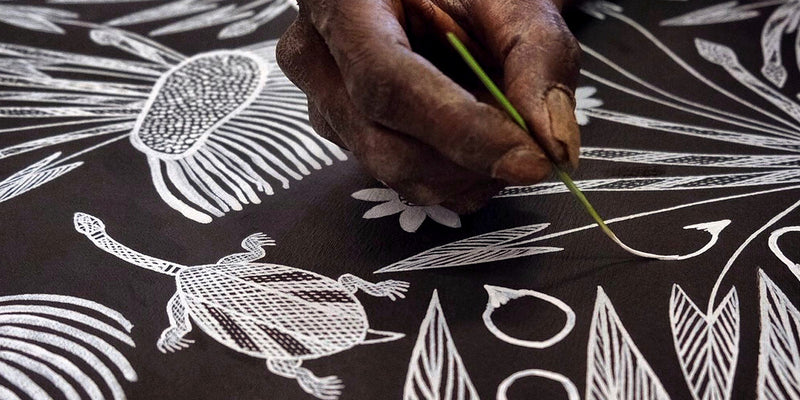
Dorothy Bunibuni, Komrdawh (Northern snake-necked turtle) 101x76cm
Original artwork certified by the community art centre.
Community Certified Artwork
This original artwork is sold on behalf of Maningrida Arts and Culture, a community-run art centre. It includes their Certificate of Authenticity.
– Original 1/1
- Details
- Artwork
- Artist
- Art Centre
- Aboriginal Artist - Dorothy Bunibuni
- Community - Maningrida
- Homeland - Kakodbebuldi, Ji-balbal
- Aboriginal Art Centre - Maningrida Arts and Culture
- Catalogue number - 9-26
- Materials - Pandanus, bush cane, and natural dyes
- Size(cm) - H101 W76 D2
Chelodina rugosa
Komrdawh are a popular food source for Kunikjuku people of West Arnhem. They would be caught using a Mandjabu (Concial Fish Trap) in rivers and creeks as well as using spears or digging sticks in billabong and floodplain areas.
Yoh kalawan la borlokko birringuyi kalawan nungan karrangbulurlhme, komrdawh, Bulkay. Yes, they ate goanna and water pythons, and goannas, the mangrove monitor and northern snake-necked turtles there at Bulkay
Dorothy is one of Maningrida Arts & Culture's most exciting emerging fibre artists. She is sister to acclaimed artist and weaver Anniebell Marrngamarrnga. Dorothy's innovative designs are made from locally collected pandanus and bush dyes which she collects from around Ji-balbal Outstation, on her father's country.
An art movement that is striking, political and enduring: this is what contemporary artists in Maningrida and the surrounding homelands have built, powered by their ancestral connections to country and djang.
Ways of learning and schools of art in Arnhem Land are based around a system of passing knowledge and information on to others. The art here has its genesis in body design, rock art and cultural practices, in concert with more than 50 years of collaborations, travel and political action to retain ownership of country. Values and law are expressed through language, imagery, manikay (song), bunggul (dance), doloppo bim (bark painting), sculptures, and kun-madj (weaving) – the arts.
The artists’ transformation of djang into contemporary artistic expression has intrigued people around the world: art curators and collectors, and stars including Yoko Ono, Jane Campion, David Attenborough and Elton John. Pablo Picasso said of Yirawala’s paintings, ‘This is what I’ve been trying to achieve all my life.’
Yirawala (c.1897–1976) was a legendary Kuninjku leader, artist, land-rights activist and teacher, and his artwork was the first of any Indigenous artist to be collected by the National Gallery of Australia as part of a policy to represent in depth the most significant figures in Australian art.
Maningrida Arts & Culture is based on Kunibídji country in Arnhem Land in Australia’s Northern Territory. The area where artists live encompasses 7,000 square kilometres of land and sea, and over 100 clan estates, where people speak more than 12 distinct languages. Aboriginal people in this region are still on country, surviving and resilient because their country is the centre of their epistemology, their belief system, culture – djang.
Artists’ works from the larger Maningrida region can be seen in collections and institutions around the world. We work with museums, contemporary galleries and high-end retailers both nationally and internationally on projects throughout the year.
Text courtesy: Maningrida Arts and Culture
"The art is beautiful and has brightened our home." - Barbara, Aus – ART ARK Customer Review
Arnhem Land Art from the Maningrida Homelands
This artwork comes from Maningrida Arts & Culture, based on Kunibídji country in Arnhem Land. Artists live across homelands spanning more than 7,000 square kilometres of land and sea and over 100 clan estates where many distinct languages are spoken and people continue to live on Country.
— Image: Freda Ali Wayartja harvesting pandanus, Maningrida Arts & Culture