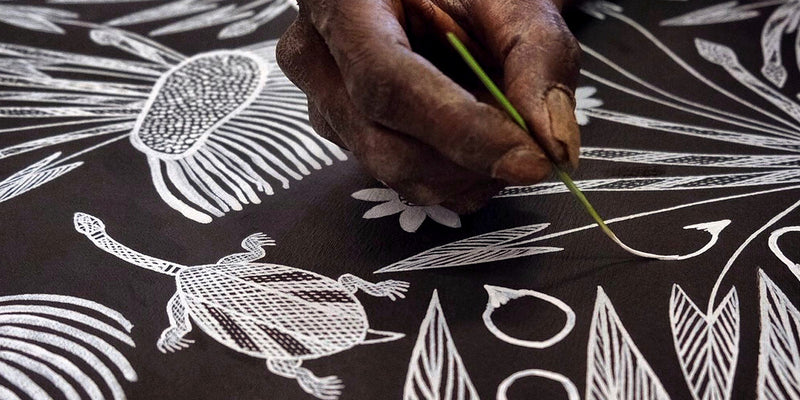
Flora Nakamarra Brown, Mina Mina Jukurrpa, 61x46cm
Community Certified Artwork
This original artwork is sold on behalf of the community-run art centre. It includes their Certificate of Authenticity.
– Original 1/1
- Details
- Artwork
- Artist
- Aboriginal Artist - Flora Nakamarra Brown
- Community - Nyirripi/Papunya
- Aboriginal Art Centre - Warlukurlangu Artists Aboriginal Corporation
- Catalogue number - 775/21
- Materials - Acrylic on linen
- Size(cm) - H61 W46 D2
- Postage variants - Artwork posted un-stretched and rolled for safe shipping
- Orientation - Painted from all sides and OK to hang as wished
Mina Mina is an extremely important ceremonial site for Napangardi and Napanangka women that is located approximately 600kms west of Yuendumu, just east of Lake Mackay and the WA border. The area has a ‘marluri’ (salt lake or claypan) that is usually dry, without water. There are also a number of ‘mulju’ (soakages), sandhills, and a large stand of ‘kurrkara’ (desert oaks [Allocasuarina decaisneana]). The Mina Mina Jukurrpa is an important source of Warlpiri ritual knowledge and social organization, particularly relating to the different roles performed by men and women.
The ‘kirda’ (owners) of this country are Napangardi/Napanangka women and Japangardi/Japanangka men, who can depict portions of the Mina Mina Jukurrpa in their paintings. There are a number of different components of the Mina Mina Jukurrpa; artists usually choose to depict one particular aspect. These can include ‘karnta’ (women), ‘karlangu’ (digging sticks), ‘majardi’ (hairstring skirts/tassels), ‘ngalyipi’ (snakevine [Tinospora smilacina]), ‘jintiparnta’ (desert truffle [Elderia arenivaga]), and ‘kurrkara’ (desert oak [Allocasuarina decaisneana]).
The Mina Mina Jukurrpa tells the story of a group of ancestral ‘karnta’ (women) who traveled from west to east. In the Dreamtime, these ancestral women danced at Mina Mina and ‘karlangu’ (digging sticks) rose up out of the ground. They collected these digging sticks and started travelling to the east. They carried their digging sticks over their shoulders and they were adorned with ‘majardi’ (hairstring belts), white feathers, and necklaces made from ‘yinirnti’ (bean tree [Erythrina vespertilio]) seeds. They continuously anointed themselves with ‘minyira’ (shiny fat) to increase their ritual powers as they went along. As the women travelled, they were followed by a ‘yinkardakurdaku’ (spotted nightjar [Eurostopodus argus]) from the Jakamarra subsection. The bird would call out and then hide in the bushes behind them as they travelled.
When the women danced at Mina Mina, they created a large dust cloud that swept up the ‘walyankarna’ (snake ancestors). The ‘walyankarna’ had previously transformed themselves from witchetty grubs into snakes at Kunajarrayi (Mount Nicker, 200km southwest of Yuendumu), and they had stopped at Mina Mina to watch the women dance. This dust cloud blew the ‘walyankarna’ further north to Yaturluyaturlu (near the Granites gold mine). In this way, the ‘karnta Jukurrpa’ (women’s Dreaming) and ‘ngarlkirdi Jukurrpa’ (witchetty grub Dreaming) intersect. This allowed the ancestral women to observe the witchetty grubs and learn how to best locate and cook them, which are skills that Warlpiri women still use today.
The women went east from Mina Mina, dancing, digging for bush tucker, and creating many places as they went. As they went east, they passed through Kimayi (a stand of ‘kurrkara’ (desert oak)). They passed through sandhill country where the ‘yarla’ (bush potato or ‘big yam’ [Ipomea costata]) ancestors from Yumurrpa and the ‘ngarlajiyi’ (pencil yam or ‘small yam’ [Vigna lanceolata]) ancestors from Yumurrpa were engaged in a huge battle over women. This battle is also a very important Warlpiri Jukurrpa narrative. The women went on to Janyinki and stopped at Wakakurrku (Mala Bore), where they stuck their digging sticks in the ground. These digging sticks turned into mulga trees, which still grow at Wakakurrku today. The women then went on to Lungkardajarra (Rich Bore), where they looked back towards their country in the west and started to feel homesick for what they’d left behind.
The women split up at Lungkardajarra. Some of them travelled eastwards to Yarungkanyi (Mount Doreen), and kept going east. They passed through Coniston in Anmatyerre country, and then went on to Alcoota and Aileron and beyond. The other group of women travelled travelled northwards from Lungkardajarra to Karntakurlangu. These women stopped at Karntakurlangu to dig for ‘wardapi’ (sand monitor/goanna [Varanus gouldii]) and ‘jintiparnta’ (desert truffle) before going further north. Both groups eventually got so homesick for their desert oak country in the west that they went all the way back to Mina Mina, where they stayed for good.
This Jukurrpa contains important information about the different roles that men and women play in Warlpiri culture, particularly in the context of ritual performance. It alludes to an earlier time in which their ritual and social roles were reversed, in which women controlled the sacred objects and weapons that are now exclusively “owned” by men.
In contemporary Warlpiri paintings, traditional iconography can be used to represent the Jukurrpa, particular sites, and other elements. In paintings of the Mina Mina Jukurrpa, sinuous lines are often used to represent ‘ngalyipi’ (snakevine). Circles and roundels can represent the ‘jintiparnta’ (desert truffle) that the women collected as they travelled, and straight lines are used to represent the ‘karlangu’ (digging sticks). ‘Majardi’ (hairstring skirts) are represented by wavy lines suspended from a single curved line.
Flora Nakamarra Brown was born on the first of August 1963 In Yuendumu, a remote aboriginal community located approximately 290 km from Alice Springs in the Northern Territory of Australia. Both her parents are deceased but were well-known Warlpiri artists. She has one brother and one sister. She is also kin to Joy Nangala Brown, also a major Warlpiri artist. Flora grew up in Yuendumu and went to the local school. She married Marshall Poulson, they have four children and lots of grandchildren. She now lives in Nyirripi, a remote aboriginal community 130 km west of Yuendumu.
She began painting with Warlukurlangu Artists Aboriginal Corporation, an Aboriginal owned and governed art centre located in Yuendumu and Nyirripi, in 2017. She paints her mother’s Mina Mina Jukurrpa (Mina Mina Dreaming – Ngalyipi) - a very important women’s dreaming site west of Yuendumu and Nyirripi, near Lake Mackay and the WA border. These stories have been passed down to her by her mother and her mother’s mother before her for millennia. “I love my Mina Mina story.”
When Flora’s not painting, or looking after her grandchildren, she likes to “sometimes go hunting for kangaroo”.
"Beautifully packed with certificate enclosed." - Olivia, Aus – ART ARK Customer Review