Dots on a Letterhead
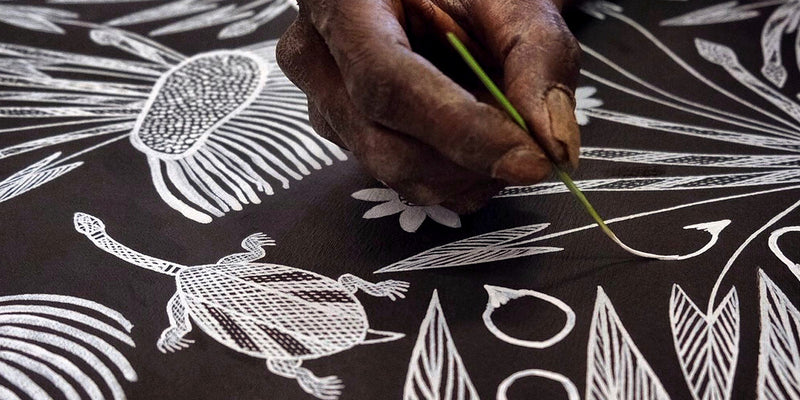
Organisations regularly approach us about their Reconciliation Action Plan, their RAP. What they usually want is artwork, a stylised letterhead, images they can use, licensed for pennies, so they can be seen to be doing something. We don't facilitate them, mostly because we don't agree with the empty idea.
And what does the letterhead do anyway? Because the company that blew up a 47,000-year-old sacred site held this country's highest reconciliation ranking while it did it.
On 24 May 2020, in the days before National Sorry Day and National Reconciliation Week, Rio Tinto detonated the Juukan Gorge rock shelters in the Pilbara. This was not ignorance. The site had been excavated six years earlier, and the company knew exactly what it held: evidence of 47,000 years of continuous human occupation, including a plait of human hair, DNA-matched to the living Traditional Owners, the Puutu Kunti Kurrama and Pinikura people, who had fought for seven years to save the place and were still trying in its final days.
The destruction was legal. It was also a choice: the mine plan that took the caves was worth an extra $135 million to a company with $43 billion in annual revenue.
At the time of the blast, Rio Tinto held an Elevate RAP, the top tier of the system, reserved for organisations providing "leadership in reconciliation." Reconciliation Australia revoked it afterwards. The caves were already gone.
It wasn't a one-off. Telstra also held an Elevate RAP when the Federal Court ordered it to pay $50 million for unconscionable conduct, selling exploitative phone contracts across more than a hundred Indigenous communities. Also revoked after the fact.
A RAP is a voluntary document, administered by Reconciliation Australia, a not-for-profit, in which an organisation writes down its reconciliation intentions across four ascending tiers. There are now well over two thousand of them, covering more than a quarter of the working-age population. Government departments write their own. Corporations need one, in practice, to win government tenders. A consulting industry exists to produce them. What they have actually achieved is hard to find. A 2026 peer-reviewed analysis found corporate RAPs privilege reputation over structural change, with reporting arranged to limit transparency and accountability. Indigenous critics have said it more plainly for years: a box to tick, a construct to make non-Indigenous organisations feel good about themselves.
Many people inside these organisations are sincere, and some RAPs do real work. But a system whose highest honour could be held by the company blasting a sacred site is not measuring reconciliation. It is measuring paperwork.
So if you're researching a RAP of your own: what do you hope to achieve, really? If the honest answer is to be seen to be doing something, the letterhead will do that, and nothing else. If the answer is reconciliation, that doesn't start with a design brief.
Meanwhile, in the national curriculum, the reckoning is optional. Australian history is compulsory now, but the hard words, invasion, massacre, the Frontier Wars, sit almost entirely in the elaborations teachers are free to skip. Whether a child ever encounters them, or the Stolen Generations, depends on which teacher they get. Teachers themselves told researchers it would be easy to cover nothing, and many do, not from malice but from fear of saying the wrong thing, because no one above them will lead.
One side of reconciliation is funded, staffed, ranked and applauded every year. The other side, teaching children the plain facts of their own country, is left to chance.
It seems unworldly that common sense hasn't prevailed here. Call it black and white, but wouldn't it be something to get some cold hard fact into the education system, an actual curriculum, so this generation and the next can come together over a shared and known past? You cannot reconcile with a history you were never told. The Uluru delegates said the same: the history is not understood because it is not taught. Education compounds, generation after generation. It is cheaper than the RAP industry, harder to fake, and impossible to revoke once the damage is done.
Every child deserves the facts. Just the facts, so they can make up their own minds. That is reconciliation.
Not dots on a letterhead.