Bush Tucker Foods
Bush Tucker and Australian Bush Foods
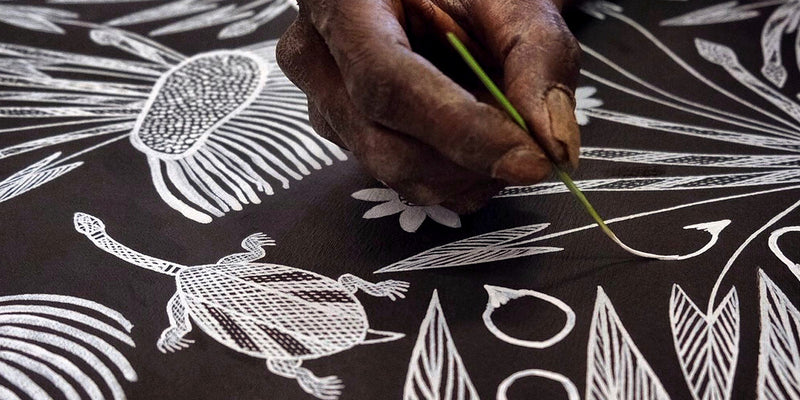
Bush tucker is the food Aboriginal people have taken from country for tens of thousands of years. It covers plants, seeds, fruit, insects, reptiles and animals. Knowing where food grows, when it fruits and how to prepare it is knowledge held in families and passed down, and it carries into ceremony, song and painting. Much of the work that comes out of desert art centres is about food: where it is found, its seasons, and the ancestral events that put it there.
Above Image: Quandongs in Coolamon
Traditional Bush Tucker Categories
Bush foods fall into a few broad groups. What is available depends entirely on region and season.
-
Animal Foods: Kangaroo, wallaby, emu, bush turkey, goanna and perentie across the desert, and magpie goose, crocodile and flying fox in the north. Hunting depends on reading tracks, weather and season. Animal tracks and hunting scenes are common subjects in desert painting.
-
Plant-Based Foods: Fruit, tubers and greens make up a large part of the diet and most of it is gathered rather than hunted, usually by women. Bush tomato (Solanum centrale), quandong (Santalum acuminatum), bush banana (Marsdenia australis) and desert yam (Ipomoea costata) are among the best known in Central Australia.
-
Seeds and Grains: Acacia seed, including mulga and other wattles, was winnowed, ground into flour and cooked as damper. Grinding stones are found right across the desert.
-
Insects and Grubs: Witchetty grubs, honey ants and bush coconut are all high in fat and protein. Grubs are dug from the roots of the witchetty bush, usually by women, and the digging sites and the tracks between them appear often in paintings from Central Australia.
-
Honey and Nectar: Native bees and honey ants were the main sources of sweetness. Honey ant sites around Papunya and Yuendumu are significant places and are painted regularly.
Culinary and Medicinal Use of Bush Tucker
Many plants were used as both food and medicine, and the line between the two is not always drawn. The bush orange (Capparis mitchellii) was eaten and also used to treat ailments. Alpar, the rat-tail plant (Ptilotus species, 'alpar' in Anmatyerr), was used as a medicinal wash.
Depictions of Bush Tucker in Aboriginal Art
Paintings record where food is found and how country is read. Two things you will see repeatedly:
- Dot Paintings: Concentric circles usually mark a site or a waterhole, U-shapes mark people seated. What any given element stands for is set by the artist and the story behind the work, not by a universal key.
- Storytelling in Aboriginal Art: Many works follow a Dreaming that accounts for a particular plant or animal. At Utopia the pencil yam (anwerlarr, Vigna lanceolata) is a long-running subject, with the root systems and the cracked earth above them worked into the surface of the painting.
Sustainability and Cultural Preservation
Knowledge of bush tucker kept people alive across some of the driest country on earth. Colonisation cut into that directly. People were moved off their land, rations replaced local food, and the seasonal rounds the knowledge depended on were broken. Interest in bush foods has picked up again over the last few decades, both in communities and outside them.
Art centres, ranger programs and school programs all carry part of this work. Painting is one of the ways knowledge about country and food gets recorded and passed to the next generation.
Modern Use of Bush Tucker
Lemon myrtle, finger lime, macadamia, wattleseed and Kakadu plum now turn up on restaurant menus and supermarket shelves. Aboriginal ownership of that industry remains small, and most native food sold in Australia is grown and processed by non-Indigenous businesses.
Both wild harvest and cultivation feed the market. Kakadu plum is the clearest case where Aboriginal enterprises supply a large share, mostly through wild harvest in the Northern Territory and the Kimberley.
Here's a List of Australian Bush Tucker and Bush Food
Fruits
- Quandong (Santalum acuminatum)
- Bush Tomato / Desert Raisin (Akatyerr / Solanum centrale)
- Bush Plum (Anwekety / Santalum lanceolatum)
- Conkerberry (Carissa lanceolata)
- Bush Orange (Capparis mitchellii)
- Desert Fig (Ficus platypoda)
- Wild Passionfruit (Capparis spinosa subsp. nummularia)
- Mulga Apple (gall on Acacia aneura)
- Riberry (Syzygium luehmannii)
- Finger Lime (Citrus australasica)
- Davidson's Plum (Davidsonia spp.)
- Kakadu Plum (Terminalia ferdinandiana)
- Midyim (Austromyrtus dulcis)
- Muntries (Kunzea pomifera)
- Emu Apple (Owenia acidula)
- Native Currant (Acrotriche depressa)
Vegetables and Yams
- Desert Yam / Bush Potato (Anaty / Ipomoea costata)
- Pencil Yam (Anwerlarr / Vigna lanceolata)
- Yam Daisy (Murnong / Microseris walteri)
- Warrigal Greens (Tetragonia tetragonoides)
- Bush Banana (Marsdenia australis)
- Sea Celery (Apium prostratum)
- Native Spinach (Bower Spinach / Tetragonia implexicoma)
Seeds and Nuts
- Wattle Seeds (Acacia spp., roasted and ground)
- Mulga Seeds (Acacia aneura)
- Kurrajong Seeds (Brachychiton populneus)
- Pigweed Seeds (Portulaca oleracea)
- Macadamia Nuts (Macadamia integrifolia)
- Bunya Nuts (Araucaria bidwillii)
- Cycad Palm Seeds (Cycas media, detoxified before consumption)
- Native Millet (Panicum decompositum)
Insects and Grubs
- Witchetty Grubs (cossid moth larvae, Endoxyla leucomochla, dug from the roots of the witchetty bush, Acacia kempeana)
- Bush Coconut (bloodwood gall formed around the scale insect Cystococcus pomiformis)
- Cicadas
- Caterpillars
Animal Foods
- Kangaroo
- Bush Turkey (Australian bustard)
- Emu
- Goanna
- Crocodile
- Perentie (large monitor lizard)
- Other Lizards
- Snakes
- Possums
- Wallaby
- Goose (Magpie Goose)
- Flying Fox (Fruit Bat)
- Bilby (now a protected species and no longer hunted)
- Echidna
Honey and Nectar
- Honey Ants (Yerrampe)
- Native Bee Honey (sugarbag)
- Nectar from Bloodwood Trees
- Nectar from Corkwood Trees (Hakea spp.)
Spices and Flavourings
- Lemon Myrtle (Backhousia citriodora)
- Mountain Pepper (Tasmannia lanceolata)
- Aniseed Myrtle (Syzygium anisatum)
- Native Thyme (Prostanthera incisa)
- River Mint (Mentha australis)