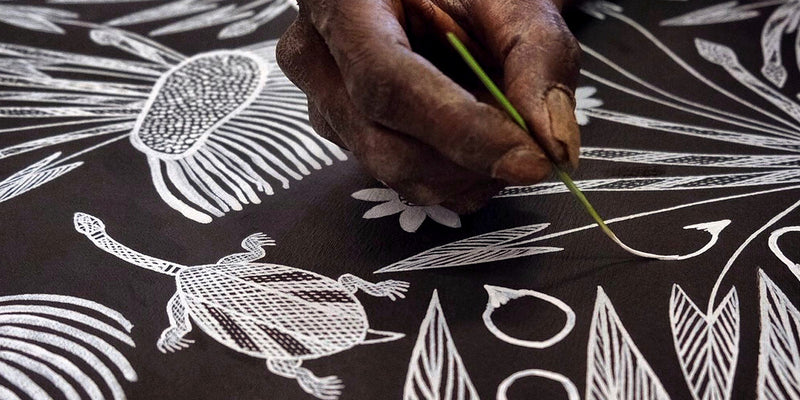
Life is better with art!
  • Aboriginal Artwork by Lola Nampijinpa Brown, Ngapa Jukurrpa - Mikanji, 76x61cm
  • Aboriginal Artwork by Lola Nampijinpa Brown, Ngapa Jukurrpa - Mikanji, 76x61cm
  • Aboriginal Artwork by Lola Nampijinpa Brown, Ngapa Jukurrpa - Mikanji, 76x61cm
  • Aboriginal Artwork by Lola Nampijinpa Brown, Ngapa Jukurrpa - Mikanji, 76x61cm

Lola Nampijinpa Brown, Ngapa Jukurrpa - Mikanji, 76x61cm

Warlukurlangu Artists Certificate of Authenticity

Community Certified Artwork

This original artwork is sold on behalf of Warlukurlangu Artists, a community-run art centre. It includes their Certificate of Authenticity.

  • Aboriginal Artist - Lola Nampijinpa Brown
  • Community - Yuendumu
  • Aboriginal Art Centre - Warlukurlangu Artists Aboriginal Corporation
  • Catalogue number - 1070/25
  • Materials - Acrylic on linen
  • Size(cm) - H76 W61 D2
  • Postage variants - Artwork is posted un-stretched and rolled for safe shipping
  • Orientation - Painted from all sides and OK to hang as wished

The country associated with this 'ngapa Jukurrpa' (water Dreaming) is Mikanji, a watercourse west of Yuendumu that is usually dry. There are ‘mulju’ (soakages) in this creek bed. The 'kirda' (owners) of this Dreaming site are Nangala/Nampijinpa women and Jangala/Jampijinpa men. Mikanji is an important water Dreaming site, and features in at least three different water Dreaming tracks.

In one story, the water Dreaming travelled from Puyurru, northwest of Yuendumu, to a ‘mulju’ (soakage) in the Mikanji creek. It unleashed a huge storm there. Two old blind women of the Nampijinpa skin group were sitting by the side of the soakages. As the two women strained their eyes to see the sky, tears formed in their eyes, creating the rain. Their spirits can still be seen at Mikanji in the form of two ‘ngapiri’ (river red gums) growing near the soakage.

A second water Dreaming track that passes through Mikanji is also owned by the Nangala/Jangala and Nampijinpa/Jampijinpa subsections, and travels further west. At Mikanji, the storm rained so hard it created a hole in the ground which became a soakage. At Mirawarri a ‘kirrkarlanji’ (brown falcon [Falco berigora]) picked up the storm and carried it on its wings to the west until it became too heavy for it. The falcon eventually dropped the storm at Pirlinyarnu (Mt. Farewell) about 165 km west of Yuendumu, where it formed an enormous ‘maluri’ (claypan). A ‘mulju’ (soakage) exists in this place today.

A third Dreaming track that passes through Mikanji is the story of the water Dreaming and ‘pamapardu Jukurrpa’ (termite Dreaming). This Dreaming travels further north. This water Dreaming is owned by Nakamarra/Napurrurla women and Jakamarra/Jupurrurla men. The termite and water Dreamings travelled together from Warntungurru in the east past Warlura (a waterhole 8 miles east of Yuendumu), Wirnpa, Kanaralji, Ngamangama, and Jukajuka. A portion of this Dreaming track also includes the ‘kurdukurdu mangkurdu Jukurrpa’ (children of the clouds Dreaming). The termite Dreaming moved on to the west to Nyirrpi, a community approximately 160 km west of Yuendumu, whereas the water Dreaming travelled on to Mikanji. A ‘kirrkarlanji’ (brown falcon) eventually picked up the water and tied it to its head using hairstring. The falcon travelled north with the water Dreaming; at Puyurru, it flew under a tree and the water fell off of its head, forming a soakage there. The Dreaming then travelled on through other locations including Yalyarilalku, Mikilyparnta, Katalpi, Lungkardajarra, Jirawarnpa, Kamira, Yurrunjuku, and Jikaya before moving on into Gurindji country to the north.

In contemporary Warlpiri paintings, traditional iconography is used to represent the ‘Jukurrpa’ (Dreaming), associated sites, and other elements. In many paintings of this Dreaming, short dashes are often used to represent ‘mangkurdu’ (cumulus & stratocumulus clouds), and longer, flowing lines represent ‘ngawarra’ (flood waters). Small circles are used to depict ‘mulju’ (soakages) and river beds.

“My dreaming, My Grandmother, Mother and Aunty at Willowra, they taught me to paint my dreaming.” Lola Nampijinpa Brown was born in Ti-Tree, NT, a small community 193 kms north of Alice Springs. When she was a little girl her mother and father took her to Willowra where she grew up. She went to school there and then to Alice Springs where she attended high school before moving to Mount Allen where she married her promised husband. She was married for 25 years. While living in Mount Allen Lola was an active member of the Museum. She made music sticks and necklaces, and painted coolamons and beads. Lola has 7 children and 11 grandchildren. Her three sons still live in Mount Allen and her daughters live in Willowra, Tennant Creek and Mount Allen. She likes to visit her children whenever she can. In 1994 Lola returned to Willowra for a short time before returning in 1997 to Mount Allen to live with her children. At Mount Allen she began painting but as there is no longer a Museum and Art centre in Mount Allen, she was dependent on the availability of materials. In 2002 Lola moved to Yuendumu, a remote Aboriginal community 290 kms north-west of Alice Springs in the NT of Australia, to paint with Warlukurlangu Artists Aboriginal Corporation, an Aboriginal owned and governed art centre. It was here in Yuendumu that she also met and married her present husband, Christopher Japangardi Poulson, who also paints with Warlukurlangu Artists. Lola has been painting with Warlukurlangu Artists since 2002. Lola attends the Art Centre every week day where she paints her Water Dreaming stories, stories which relate directly to her land, its features and animals. These stories were passed down by her grandmother, mother and aunty and their parents before them for millennia.

Warlpiri Art from the Tanami Desert

Warlpiri Art from the Tanami Desert

This artwork comes from Warlukurlangu Artists in Yuendumu. The art centre represents Warlpiri artists from Yuendumu and Nyirripi, located in the Tanami Desert northwest of Alice Springs. This remote region of red sand and open desert Country is central to the stories and knowledge shared through the paintings.

— Image: Nyirripi community in the Northern Territory of Australia

"Incredible colours and careful packaging." - Chloe, Aus – ART ARK Customer Review


← Previous Page Arnhem Land Weaving Arnhem Land Art Dot Paintings Subscribers Stretched Paintings Desert Weavings Landscape Paintings


Remote Aboriginal artists share their culture through art

Supporting Aboriginal Artists

By sharing their culture, remote artists create opportunities for themselves. Buying Aboriginal art ethically supports these artists while bringing warmth and meaning into your home.


Aboriginal artwork displayed in a home

Original Art That Will Look Great at Your Place

Beautiful, original art that fits perfectly into your home. Your purchase supports Aboriginal artists and helps us continue our mission in celebrating and promoting ethical Aboriginal art.

We're confident you will love your artwork, but if it’s not right for any reason, return it within 120 days. Easy. Over 1,670 past customers have shared their experiences, and they love their artworks.

Reserving a Work

You're welcome to secure a work with a 20% deposit. Use code DEPOSIT20 at checkout and settle the balance within 30 days (we'll email you an invoice).

Deposits are non-refundable, but once paid in full your artwork ships as normal, covered by our 120-day returns.


Aboriginal painting in situ with the certificate of authenticity shown

Authenticity Certified by Community Art Centres

Only certificates from community-based Aboriginal art centres guarantee ethical sourcing, ensuring your purchase supports the artist and their community. Every ART ARK® piece includes this documentation, offering transparency and trust in its origin. Proof of provenance ensures authenticity and contributes to the artwork’s long-term value.

Learn more about Aboriginal Art Authenticity.


Aboriginal artwork being photographed and colour corrected

Colour Accuracy Guaranteed

We spend hours to ensure your artwork will arrive as shown. Carefully packed, colour-accurate, and ready to love.

Colours are matched as closely as possible, and with returns under 0.2%, our customers are consistently delighted with their artworks.


Example of an Aboriginal painting framed in a float frame

Framing Aboriginal Art

We keep pricing transparent by delivering artworks without added third-party costs, allowing us to offer free shipping and maintain pricing in accordance with each art centre. Canvas and linen pieces are sent rolled for safe delivery and easy re-stretching at your local framer.

Learn more about Framing Aboriginal Art.


Worldwide shipping from ART ARK

Fast, Free Post

From Tasmania to your doorstep, no matter where you are in the world. Orders ship within 1 business day and arrive in 1 to 3 days within Australia and 5 to 10 days internationally. Enjoy free domestic shipping on all orders. International shipping is free for orders over A$500, and a flat rate of A$30 applies for orders under that amount.

Customs & Duties: Original artworks (tariff codes 9701.91 for paintings and drawings, 9703.00 for sculptures) are duty and tax-free when arriving in the United States and Canada. The UK applies a reduced VAT of 5%, France 5.5%, and Germany 7%. Other countries may have different rates, so we recommend checking before purchase.

*Estimated delivery for international shipments is 5–10 business days, not including any customs processing time, which varies by country.

Learn more about Customs and Shipping.


arty emails? (they're good)