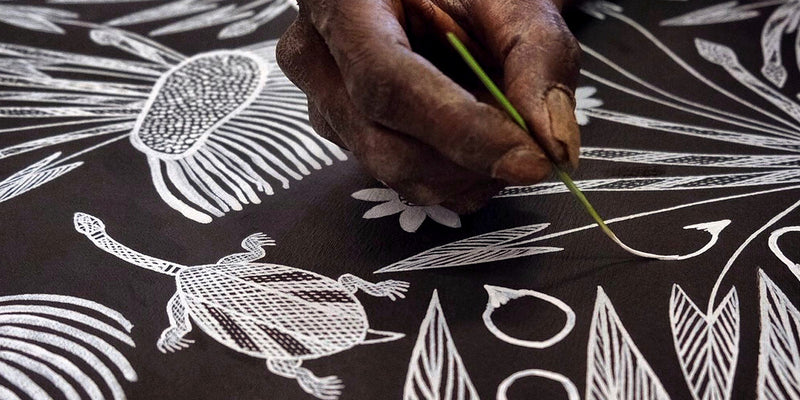
Maureen Ali, Mun-dirra (fish fence), 265cm
Original artwork certified by the community art centre.
Community Certified Artwork
This original artwork is sold on behalf of Maningrida Arts and Culture, a community-run art centre. It includes their Certificate of Authenticity.
– Original 1/1
- Details
- Artwork
- Artist
- Art Centre
- Aboriginal Artist - Maureen Ali
- Community - Maningrida
- Homeland - Yilan
- Aboriginal Art Centre - Maningrida Arts and Culture
- Catalogue number - 1343-25
- Materials - Pandanus with natural dyes
- Size(cm) - Total: H265 W124 (irregular)
- Postage - Posted rolled
This is a fish net fence called mun-dirra. A long time ago they would put the mun-dirra across rivers and creeks. In the middle they would place the an-gujechiya (fish trap). They also used small things like sticks, rocks, mud and grass to block the fish from going through. People would then catch fish like saltwater barramundi rajarra, freshwater barramundi (janambal), small black freshwater catfish (buliya), bonefish (an-guwirrpiya), and sand bass (dalakan) in these fish traps.
Maureen Ali learned to weave under the guidance of her sister Bonny Burarn.garra, a highly skilled fibre artist who has exhibited in commercial galleries around Australia since the 1990s. She also learned from her watching her mother, leading fibre artist Lorna Jin-gubarrangunyja, who won the Wandjuk Marika Award at the 20th Telstra National Aboriginal and Torres Strait Islander Art Award (NATSIAA) in 2013 with a colourful pandanus fish trap.
Maureen has been practicing since 2006. She is Burarra, one of the east-side language groups who specialise in the customary conical dilly bags, woven string bags and mats. She is particularly renowned for the use of mirlarl, (malaisia scandens), a type of vine that grows in the coastal jungle. The use of this vine to manufacture fish traps, barriers and large strong dillybags is unique to this region.
An art movement that is striking, political and enduring: this is what contemporary artists in Maningrida and the surrounding homelands have built, powered by their ancestral connections to country and djang.
Ways of learning and schools of art in Arnhem Land are based around a system of passing knowledge and information on to others. The art here has its genesis in body design, rock art and cultural practices, in concert with more than 50 years of collaborations, travel and political action to retain ownership of country. Values and law are expressed through language, imagery, manikay (song), bunggul (dance), doloppo bim (bark painting), sculptures, and kun-madj (weaving) – the arts.
The artists’ transformation of djang into contemporary artistic expression has intrigued people around the world: art curators and collectors, and stars including Yoko Ono, Jane Campion, David Attenborough and Elton John. Pablo Picasso said of Yirawala’s paintings, ‘This is what I’ve been trying to achieve all my life.’
Yirawala (c.1897–1976) was a legendary Kuninjku leader, artist, land-rights activist and teacher, and his artwork was the first of any Indigenous artist to be collected by the National Gallery of Australia as part of a policy to represent in depth the most significant figures in Australian art.
Maningrida Arts & Culture is based on Kunibídji country in Arnhem Land in Australia’s Northern Territory. The area where artists live encompasses 7,000 square kilometres of land and sea, and over 100 clan estates, where people speak more than 12 distinct languages. Aboriginal people in this region are still on country, surviving and resilient because their country is the centre of their epistemology, their belief system, culture – djang.
Artists’ works from the larger Maningrida region can be seen in collections and institutions around the world. We work with museums, contemporary galleries and high-end retailers both nationally and internationally on projects throughout the year.
Text courtesy: Maningrida Arts and Culture
"Beautifully presented and arrived quickly." - Tom, Aus – ART ARK Customer Review
Arnhem Land Art from the Maningrida Homelands
This artwork comes from Maningrida Arts & Culture, based on Kunibídji country in Arnhem Land. Artists live across homelands spanning more than 7,000 square kilometres of land and sea and over 100 clan estates where many distinct languages are spoken and people continue to live on Country.
— Image: Freda Ali Wayartja harvesting pandanus, Maningrida Arts & Culture