Life is better with art!
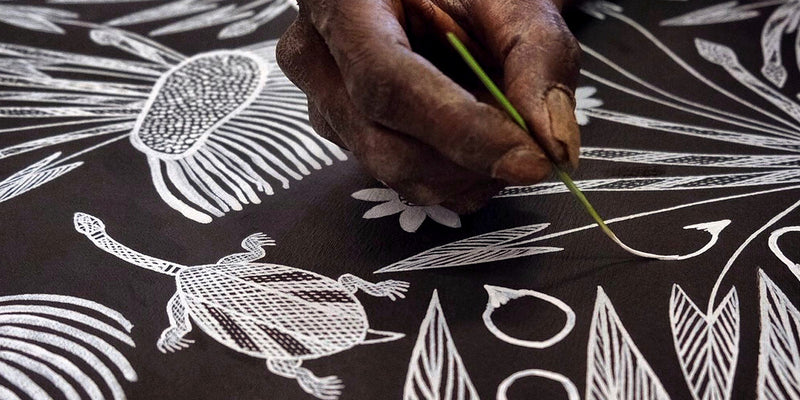
  • Aboriginal Artwork by May Mayiwalku (May Wokka) Chapman, Untitled, 61x46cm
  • Aboriginal Artwork by May Mayiwalku (May Wokka) Chapman, Untitled, 61x46cm
  • Aboriginal Artwork by May Mayiwalku (May Wokka) Chapman, Untitled, 61x46cm
  • Aboriginal Artwork by May Mayiwalku (May Wokka) Chapman, Untitled, 61x46cm

May Mayiwalku (May Wokka) Chapman, Untitled, 61x46cm

Martumili Artists Certificate of Authenticity

Community Certified Artwork

This original artwork is sold on behalf of Martumili Artists, a community-run art centre. It includes their Certificate of Authenticity.

  • Aboriginal Artists - May Mayiwalku (May Wokka) Chapman
  • Community - Warralong
  • Aboriginal Art Centre - Martumili Artists
  • Catalogue number - 23-992
  • Materials - Acrylic paint on canvas
  • Size(cm) - H46 W61 D2
  • Postage variants - Artwork posted un-stretched and rolled for safe shipping
  • Orientation - Painted from all sides and OK to hang as wished

This is Mayiwalku’s Country, her ngurra (home Country, camp). People identify with their ngurra in terms of specific rights and responsibilities, and the possession of intimate knowledge of the physical and cultural properties of one’s Country. Painting ngurra, and in so doing sharing the Jukurrpa (Dreaming) stories and physical characteristics of that place, has today become an important means of cultural maintenance.

Mayiwalku’s ngurra encompasses the Country that she and her family walked in the pujiman (traditional, desert-dwelling) era. Mayiwalku was born at Yirnangarri. She grew up, walked and hunted primarily around the Country extending across the Punmu, Kunawarritji (Canning Stock Route Well 33) and Karlamilyi (Rudall River) regions. Following the death of both their parents, Mayiwalku and her sisters travelled alone between Punmu and Kunawarritji, occasionally meeting with other family groups. They continued to live nomadically before eventually deciding to move to Jigalong Mission along with many other relatives following an extreme and prolonged drought in the 1960s.

Portrayed in this work are features of Mayiwalku’s ngurra, such as the dominant permanent red tali (sandhills), warta (trees, vegetation), and the individually named water sources she and her family camped at. These include Januwa, Jilankujarra, Karlajarntu, Kartungu, Kulari, Kumpupajanu, Kunalimpi, Kunarra, Marnakari, Pangkapirni, Wilunganinya, Wurur-wururna, Yilyara, and Yirrajarra. Rockholes, waterholes, soaks and springs were all extremely important sites for Martu people during the pujiman period, and are generally depicted with circular forms.

The encyclopaedic knowledge of the location, quality and seasonal availability of the hundreds of water bodies found in one’s Country sustained Martu as they travelled across their Country, hunting and gathering, visiting family, and fulfilling ceremonial obligations. They would traverse very large distances annually, visiting specific areas in the dry and wet season depending on the availability of water and the corresponding cycles of plant and animal life on which hunting and gathering bush tucker was reliant. As they travelled and hunted they would also burn areas of Country, generating a greater diversity of plant and animal life.

Mayiwalku May Chapman is the eldest sister of fellow Martumili Artists Nancy Nyanjilpayi (Ngarnjapayi) Chapman, Mulyangki Marney and Marjorie Yates (dec.). Her mother was Warnman and her father was Manyjilyjarra. Mayiwalku was born to the east, in Yirnangarri, “where the two footprints lie”. Her family’s Country extends across the Punmu, Kunawarritji (Canning Stock Route Well 33) and Karlamilyi (Rudall River) regions. Following the death of both their parents, Mayiwalku and her sisters travelled alone between Punmu and Kunawarritji, occasionally meeting with other family groups. They later walked south into Karlamilyi, where they first saw a plane flying overhead. Petrified, they hid under spinifex grass until the plane had passed.

Following the construction of the Canning Stock Route in 1910, the family increasingly came into contact with Europeans and Martu working as cattle drovers along the route. Gradually men from Mayiwalku’s family began to work seasonally at stations around Jigalong, but as a family group they remained living in the desert long after most Martu had moved to Jigalong Mission. Finally, in 1966, following a prolonged and severe drought, Mayiwalku and her sisters made the decision to walk to Balfour Downs, where they were collected by Jigalong Mission staff.

Mayiwalku lived for many years at Jigalong Mission before eventually relocating with her five children to Warralong, a community southeast of Port Hedland. She continues to live in Warralong today with her daughter and equally renowned artist, Doreen Chapman.

Mayiwalku was one of Martumili’s pioneering artists, and is highly regarded for her technically sophisticated works. Her paintings depict her ngurra (home Country, camp); the Country she walked as a young woman, its animals, plants, waterholes and associated Jukurrpa (Dreaming) narratives. Mayiwalku’s work has been exhibited widely across Australia and internationally, and acquired by the National Museum of Australia.

Martumili Artists was established in late 2006 and supports Martu artists in Kunawarritji, Punmu, Parnngurr, Jigalong, Warralong, Irrungadji (Nullagine), and Parnpajinya (Newman). Many Martu artists have close relationships with established artists amongst Yulparija, Kukatja, and other Western Desert peoples and are now gaining recognition in their own right for their diverse, energetic, and unmediated painting styles. Their works reflect the dramatic geography and scale of their homelands in the Great Sandy Desert and Rudall River regions of Western Australia. Martumili Artists represents speakers of Manyjilyjarra, Warnman, Kartujarra, Putijarra, and Martu Wangka languages, many of whom experienced first contact with Europeans in the 1960s. The artists include painters working in acrylics and oils, as well as weavers coiling baskets and sculptors working in wood, grass, and wool. Martu artists proudly maintain their creative practices whilst pursuing social and cultural obligations across the Martu.

Martu Art from the Western Desert

Martu Art from the Western Desert

This artwork comes from Martumili Artists, based in Newman in Western Australia and representing Martu artists living across remote desert communities. Martu Country covers more than 150,000 square kilometres of the Western Desert, including the Great Sandy, Little Sandy and Gibson Deserts, an expansive landscape punctuated by salt lakes and claypans.

— Image: Punu community on Nyayartakujarra (Lake Dora), Great Sandy Desert

"Gorgeous artwork and very professional." - Paula, Aus – ART ARK Customer Review


← Previous Page Arnhem Land Weaving Arnhem Land Art Dot Paintings Subscribers Stretched Paintings Desert Weavings Landscape Paintings


Remote Aboriginal artists share their culture through art

Supporting Aboriginal Artists

By sharing their culture, remote artists create opportunities for themselves. Buying Aboriginal art ethically supports these artists while bringing warmth and meaning into your home.


Aboriginal artwork displayed in a home

Original Art That Will Look Great at Your Place

Beautiful, original art that fits perfectly into your home. Your purchase supports Aboriginal artists and helps us continue our mission in celebrating and promoting ethical Aboriginal art.

We're confident you will love your artwork, but if it’s not right for any reason, return it within 120 days. Easy. Over 1,670 past customers have shared their experiences, and they love their artworks.

Reserving a Work

You're welcome to secure a work with a 20% deposit. Use code DEPOSIT20 at checkout and settle the balance within 30 days (we'll email you an invoice).

Deposits are non-refundable, but once paid in full your artwork ships as normal, covered by our 120-day returns.


Aboriginal painting in situ with the certificate of authenticity shown

Authenticity Certified by Community Art Centres

Only certificates from community-based Aboriginal art centres guarantee ethical sourcing, ensuring your purchase supports the artist and their community. Every ART ARK® piece includes this documentation, offering transparency and trust in its origin. Proof of provenance ensures authenticity and contributes to the artwork’s long-term value.

Learn more about Aboriginal Art Authenticity.


Aboriginal artwork being photographed and colour corrected

Colour Accuracy Guaranteed

We spend hours to ensure your artwork will arrive as shown. Carefully packed, colour-accurate, and ready to love.

Colours are matched as closely as possible, and with returns under 0.2%, our customers are consistently delighted with their artworks.


Example of an Aboriginal painting framed in a float frame

Framing Aboriginal Art

We keep pricing transparent by delivering artworks without added third-party costs, allowing us to offer free shipping and maintain pricing in accordance with each art centre. Canvas and linen pieces are sent rolled for safe delivery and easy re-stretching at your local framer.

Learn more about Framing Aboriginal Art.


Worldwide shipping from ART ARK

Fast, Free Post

From Tasmania to your doorstep, no matter where you are in the world. Orders ship within 1 business day and arrive in 1 to 3 days within Australia and 5 to 10 days internationally. Enjoy free domestic shipping on all orders. International shipping is free for orders over A$500, and a flat rate of A$30 applies for orders under that amount.

Customs & Duties: Original artworks (tariff codes 9701.91 for paintings and drawings, 9703.00 for sculptures) are duty and tax-free when arriving in the United States and Canada. The UK applies a reduced VAT of 5%, France 5.5%, and Germany 7%. Other countries may have different rates, so we recommend checking before purchase.

*Estimated delivery for international shipments is 5–10 business days, not including any customs processing time, which varies by country.

Learn more about Customs and Shipping.


arty emails? (they're good)