Life is better with art!
  • Aboriginal Artwork by Serena and Jeremiah Bonson, Warraburnburn Family (3), 172cm
  • Aboriginal Artwork by Serena and Jeremiah Bonson, Warraburnburn Family (3), 172cm
  • Aboriginal Artwork by Serena and Jeremiah Bonson, Warraburnburn Family (3), 172cm
  • Aboriginal Artwork by Serena and Jeremiah Bonson, Warraburnburn Family (3), 172cm

Serena and Jeremiah Bonson, Warraburnburn Family (3), 172cm

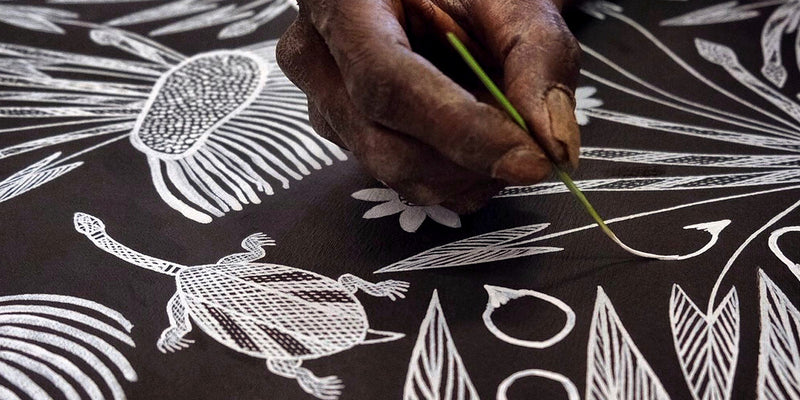
Warraburnburn ghost spirits, marked with white dots, represents spirit beings who move together across Warrawarra Country.
At your place?
Maningrida Arts and Culture Certificate of Authenticity

Community Certified Artwork

This original artwork is sold on behalf of Maningrida Arts and Culture, a community-run art centre. It includes their Certificate of Authenticity.

  • Aboriginal Artists - Serena Bonson, Jeremiah Bonson
  • Community - Gamurra Gu-yurra
  • Homeland - 
  • Aboriginal Art Centre - Maningrida Arts and Culture
  • Catalogue number - 822-25, 981-25, 2021-24
  • Materials - Cottonwood (Bombas Ceiba) with Ochre Pigment and PVA Fixative
  • Size(cm) - H172, H130, H95
  • Display - Basic bases (pictured) are included when shipping in Australia

In Burarra and Gun-nartpa languages the figure represented in this artwork is generally known as a wangarra ‘ghost spirit’. For the Warrawarra clan ghost spirits have their own particular characteristics and their own name – Warraburnburn.

The Warraburnburn and the closely related Galabarrbarr spirit (owned by the Balkarranga clan) are also manikay song topics.  The spirits are related to each other as maternal grandparent and grandchild, just as the people of Warrawarra and Balkarranga are. The dancing of the two ghost spirit figures forms the finale performance for funerals, and is the final goodbye to a deceased family member.

In many ways the Warraburnburn and Galabarrbarr ghost spirits are like people. They emerge from the patches of jungle on Warrawarra and Balkarranga country in the late afternoon and go hunting in family groups of men, women and children. They stay in contact with each other by calling out as the men hunt for fish and the women walk with their dillybags looking for vegetable food. 

The ghost spirits are associated closely with white ochre and artists commonly paint the bodies of carved figures in white. Different types of ghost spirit wear different patterns. Warraburnburn is decorated with uniform white dots while others are painted white all over. Some ghost spirits are shown with a design painted on their chest infilled with rarrk ‘cross-hatching’, the same designs that are painted onto japi an-guyinda ‘male initiations’. 

They also have supernatural characteristics including superhuman size (jarra anbaykarda ‘super tall’). They know the country intimately – some are malevolent towards humans and will lead people astray, taking them to unfamiliar and dangerous places. These malevolent spirits are likened to an-muburda ‘sorcerers’ and can conduct dangerous rituals that cause harm to people. Others are benign and will lead humans back to familiar paths and their own camps.

Jeremiah Bonson is a Djinaŋ/Marung artist. He was born in Darwin but raised at the outstation Gamurra-Gu-yurra, his mother Matilda Pascoe’s country. Jeremiah and his wife lived in Galiwinku but moved to Maningrida in 2021 with their small family. Jeremiah is a dancer, musician (he plays the yidaki or didgeridoo), painter and sculptor. Although an emerging artist, he was taught his traditional culture and traditional song line (bourgur) by his adoptive father Jimmy. His practice is informed by a culture thousands of years old.

Born in Miwirnbi, Serena Bonson lives and works in Manigrida community in the Northern Territory. Her heritage is of Djowinge moiety, the Djinang language group and she is part of the Murrungun clan. Bonson has quickly become known for her striking carvings in stringybark painted in black and white to depict the Wangarra spirits. The Wangarra play a key role in the stories of Bonson’s community relating to death, birth and the transition of the spirit into the afterlife, and in rebirth. They are considered indicative of ancestral beings and deeply connected to the waterholes that are central to the stories of the clan and their connections to land.

An art movement that is striking, political and enduring: this is what contemporary artists in Maningrida and the surrounding homelands have built, powered by their ancestral connections to country and djang.

Ways of learning and schools of art in Arnhem Land are based around a system of passing knowledge and information on to others. The art here has its genesis in body design, rock art and cultural practices, in concert with more than 50 years of collaborations, travel and political action to retain ownership of country. Values and law are expressed through language, imagery, manikay (song), bunggul (dance), doloppo bim (bark painting), sculptures, and kun-madj (weaving) – the arts.

The artists’ transformation of djang into contemporary artistic expression has intrigued people around the world: art curators and collectors, and stars including Yoko Ono, Jane Campion, David Attenborough and Elton John. Pablo Picasso said of Yirawala’s paintings, ‘This is what I’ve been trying to achieve all my life.’

Yirawala (c.1897–1976) was a legendary Kuninjku leader, artist, land-rights activist and teacher, and his artwork was the first of any Indigenous artist to be collected by the National Gallery of Australia as part of a policy to represent in depth the most significant figures in Australian art.

Maningrida Arts & Culture is based on Kunibídji country in Arnhem Land in Australia’s Northern Territory. The area where artists live encompasses 7,000 square kilometres of land and sea, and over 100 clan estates, where people speak more than 12 distinct languages. Aboriginal people in this region are still on country, surviving and resilient because their country is the centre of their epistemology, their belief system, culture – djang.

Artists’ works from the larger Maningrida region can be seen in collections and institutions around the world. We work with museums, contemporary galleries and high-end retailers both nationally and internationally on projects throughout the year.

Text courtesy: Maningrida Arts and Culture

Arnhem Land Art from the Maningrida Homelands

Arnhem Land Art from the Maningrida Homelands

This artwork comes from Maningrida Arts & Culture, based on Kunibídji country in Arnhem Land. Artists live across homelands spanning more than 7,000 square kilometres of land and sea and over 100 clan estates where many distinct languages are spoken and people continue to live on Country.

— Image: Freda Ali Wayartja harvesting pandanus, Maningrida Arts & Culture

"Beautifully presented and arrived quickly." - Tom, Aus – ART ARK Customer Review


← Previous Page Arnhem Land Weaving Arnhem Land Art Dot Paintings Subscribers Stretched Paintings Desert Weavings Landscape Paintings


Remote Aboriginal artists share their culture through art

Supporting Aboriginal Artists

By sharing their culture, remote artists create opportunities for themselves. Buying Aboriginal art ethically supports these artists while bringing warmth and meaning into your home.


Aboriginal artwork displayed in a home

Original Art That Will Look Great at Your Place

Beautiful, original art that fits perfectly into your home. Your purchase supports Aboriginal artists and helps us continue our mission in celebrating and promoting ethical Aboriginal art.

We're confident you will love your artwork, but if it’s not right for any reason, return it within 120 days. Easy. Over 1,670 past customers have shared their experiences, and they love their artworks.

Reserving a Work

You're welcome to secure a work with a 20% deposit. Use code DEPOSIT20 at checkout and settle the balance within 30 days (we'll email you an invoice).

Deposits are non-refundable, but once paid in full your artwork ships as normal, covered by our 120-day returns.


Aboriginal painting in situ with the certificate of authenticity shown

Authenticity Certified by Community Art Centres

Only certificates from community-based Aboriginal art centres guarantee ethical sourcing, ensuring your purchase supports the artist and their community. Every ART ARK® piece includes this documentation, offering transparency and trust in its origin. Proof of provenance ensures authenticity and contributes to the artwork’s long-term value.

Learn more about Aboriginal Art Authenticity.


Aboriginal artwork being photographed and colour corrected

Colour Accuracy Guaranteed

We spend hours to ensure your artwork will arrive as shown. Carefully packed, colour-accurate, and ready to love.

Colours are matched as closely as possible, and with returns under 0.2%, our customers are consistently delighted with their artworks.


Example of an Aboriginal painting framed in a float frame

Framing Aboriginal Art

We keep pricing transparent by delivering artworks without added third-party costs, allowing us to offer free shipping and maintain pricing in accordance with each art centre. Canvas and linen pieces are sent rolled for safe delivery and easy re-stretching at your local framer.

Learn more about Framing Aboriginal Art.


Worldwide shipping from ART ARK

Fast, Free Post

From Tasmania to your doorstep, no matter where you are in the world. Orders ship within 1 business day and arrive in 1 to 3 days within Australia and 5 to 10 days internationally. Enjoy free domestic shipping on all orders. International shipping is free for orders over A$500, and a flat rate of A$30 applies for orders under that amount.

Customs & Duties: Original artworks (tariff codes 9701.91 for paintings and drawings, 9703.00 for sculptures) are duty and tax-free when arriving in the United States and Canada. The UK applies a reduced VAT of 5%, France 5.5%, and Germany 7%. Other countries may have different rates, so we recommend checking before purchase.

*Estimated delivery for international shipments is 5–10 business days, not including any customs processing time, which varies by country.

Learn more about Customs and Shipping.


arty emails? (they're good)