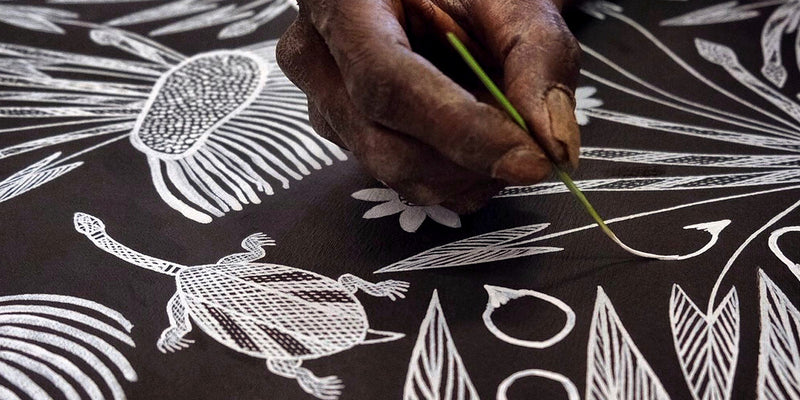
Life is better with art!
  • Aboriginal Artwork by Walter Jangala Brown, Tingari Cycle, 182x152cm
  • Aboriginal Artwork by Walter Jangala Brown, Tingari Cycle, 182x152cm
  • Aboriginal Artwork by Walter Jangala Brown, Tingari Cycle, 182x152cm
  • Aboriginal Artwork by Walter Jangala Brown, Tingari Cycle, 182x152cm
  • Aboriginal Artwork by Walter Jangala Brown, Tingari Cycle, 182x152cm
  • Aboriginal Artwork by Walter Jangala Brown, Tingari Cycle, 182x152cm

Walter Jangala Brown, Tingari Cycle, 182x152cm

..The Tingari cycle consists of three major Dreaming tracks...

Warlukurlangu Artists Certificate of Authenticity

Community Certified Artwork

This original artwork is sold on behalf of Warlukurlangu Artists, a community-run art centre. It includes their Certificate of Authenticity.

  • Aboriginal Artist - Walter Jangala Brown
  • Community - Nyirripi  
  • Aboriginal Art Centre - Warlukurlangu Artists Aboriginal Corporation
  • Catalogue number - 8000/22
  • Materials - Professional artist acrylic on Belgian linen
  • Size(cm) - H182 W152 D2
  • Postage variants - Artwork posted rolled for safe shipping
  • Orientation - Painted from all sides and OK to hang as wished

This painting depicts a portion of the Tingari cycle, a very important collection of Dreaming narratives from the Western Desert region. The country that this painting depicts is located far to the west of Yuendumu and spans a vast area of land across the Gibson and Great Sandy Deserts in Western Australia. Aboriginal groups that paint the Tingari cycle include the Pintupi, Kukatja, Ngarti, and Walmajarri peoples, among others.

The Tingari cycle consists of three major Dreaming tracks. One begins west of Jupiter Well and eventually runs due east, concluding south-east of Lake Mackay; another heads south-west from near Kintore for some 200 km, and then doubles back to end at Lake Macdonald; the third runs from south to north through Docker River and Kintore.

The cycle tells the story of a group of ancient creation ancestors, the Tingari, who travelled across the country. The Tingari took different forms, some human and some animal. Humans were typically initiated men accompanied by ‘punyunyu’ (novices, uninitiated men). The men were sometimes accompanied by extremely powerful initiated women (called variously the ‘Kungka Tjuta,’ ‘Minyma Tjuta,’ or ‘Kanaputa’). Like the initiated men, these initiated women were accompanied by uninitiated women to whom they provided a ritual education. Animals featured in the Tingari cycle include the dingo, emu, kingfisher, and western quoll, among others.

As the Tingari travelled over vast areas of the country, they held initiations and other ceremonies, caused or encountered raging bushfires, hunted game, found and cooked bush-tucker, fought and killed one another, disposed of the dead or brought them back to life, interacted with totemic ancestors, copulated illicitly, made and used sacred objects, flew through the air, and died in hailstorms. In the course of these adventures, they either created or became the physical features of the sites they visited, forming rocky outcrops, waterholes, trees, salt lakes, ochre deposits, and so on. These sites which are now regarded as sacred by their descendants, today’s custodians of these places. The Tingari also laid down social custom and law as it should be practised today. Their journeys form the basis of sacred and secret men’s and women’s laws. Public paintings of the Tingari cycle typically only show the unrestricted portions of these stories.

Traditional iconography is used to represent the Dreamings, associated sites, and other elements of the Tingari cycle. In many paintings of these narratives, concentric circles represent soakages, rockholes, ancient wells, and other water features. Lines indicate rainfall and grasses that provide edible seeds after the rain, or routes taken by the Tingari as they travelled. People are represented by semi-circles. Sets of circles can represent the body-designs of the older men who are painting the bodies of the younger men, often represented as smaller circles.

Walter Jangala Brown was born in 1977 in Yuendumu, a remote Aboriginal community 290 km north-west of Alice Springs in the NT of Australia. He comes from a long line of artists including Pintupi artist Ronnie Jampijinpa, a highly acclaimed painter and founder of the Papunya Tula Artists group. Walter went to Yirara College, an Aboriginal boarding college in Alice Springs. When he finished school, he worked for the Shire for 2 or 3 years. He now lives in Nyirripi and is married to Valerie. They have three children.

He began painting for Warlukurlangu Artists Aboriginal Corporation, an Aboriginal owned and governed art centre located in Yuendumu in 2007. He paints his father’s Ngapa Jukurrpa (Water Dreaming); Warna Jukurrpa (Snake Dreaming); and Yumari Jukurrpa (a collection of rocks located to the west of Kintore in the Gibson Desert). He also paints his grandfather’s Tingari Cycle. These dreamings relate directly to his land, its features and the plants and animals that inhabit it.

When Walter is not working or painting he plays football and goes hunting.

Warlpiri Art from the Tanami Desert

Warlpiri Art from the Tanami Desert

This artwork comes from Warlukurlangu Artists in Yuendumu. The art centre represents Warlpiri artists from Yuendumu and Nyirripi, located in the Tanami Desert northwest of Alice Springs. This remote region of red sand and open desert Country is central to the stories and knowledge shared through the paintings.

— Image: Nyirripi community in the Northern Territory of Australia

"Purchased this artwork as a gift and it exceeded expectations." - Kaitlyn, Aus – ART ARK Customer Review


← Previous Page Arnhem Land Weaving Arnhem Land Art Dot Paintings Subscribers Stretched Paintings Desert Weavings Landscape Paintings


Remote Aboriginal artists share their culture through art

Supporting Aboriginal Artists

By sharing their culture, remote artists create opportunities for themselves. Buying Aboriginal art ethically supports these artists while bringing warmth and meaning into your home.


Aboriginal artwork displayed in a home

Original Art That Will Look Great at Your Place

Beautiful, original art that fits perfectly into your home. Your purchase supports Aboriginal artists and helps us continue our mission in celebrating and promoting ethical Aboriginal art.

We're confident you will love your artwork, but if it’s not right for any reason, return it within 120 days. Easy. Over 1,670 past customers have shared their experiences, and they love their artworks.

Reserving a Work

You're welcome to secure a work with a 20% deposit. Use code DEPOSIT20 at checkout and settle the balance within 30 days (we'll email you an invoice).

Deposits are non-refundable, but once paid in full your artwork ships as normal, covered by our 120-day returns.


Aboriginal painting in situ with the certificate of authenticity shown

Authenticity Certified by Community Art Centres

Only certificates from community-based Aboriginal art centres guarantee ethical sourcing, ensuring your purchase supports the artist and their community. Every ART ARK® piece includes this documentation, offering transparency and trust in its origin. Proof of provenance ensures authenticity and contributes to the artwork’s long-term value.

Learn more about Aboriginal Art Authenticity.


Aboriginal artwork being photographed and colour corrected

Colour Accuracy Guaranteed

We spend hours to ensure your artwork will arrive as shown. Carefully packed, colour-accurate, and ready to love.

Colours are matched as closely as possible, and with returns under 0.2%, our customers are consistently delighted with their artworks.


Example of an Aboriginal painting framed in a float frame

Framing Aboriginal Art

We keep pricing transparent by delivering artworks without added third-party costs, allowing us to offer free shipping and maintain pricing in accordance with each art centre. Canvas and linen pieces are sent rolled for safe delivery and easy re-stretching at your local framer.

Learn more about Framing Aboriginal Art.


Worldwide shipping from ART ARK

Fast, Free Post

From Tasmania to your doorstep, no matter where you are in the world. Orders ship within 1 business day and arrive in 1 to 3 days within Australia and 5 to 10 days internationally. Enjoy free domestic shipping on all orders. International shipping is free for orders over A$500, and a flat rate of A$30 applies for orders under that amount.

Customs & Duties: Original artworks (tariff codes 9701.91 for paintings and drawings, 9703.00 for sculptures) are duty and tax-free when arriving in the United States and Canada. The UK applies a reduced VAT of 5%, France 5.5%, and Germany 7%. Other countries may have different rates, so we recommend checking before purchase.

*Estimated delivery for international shipments is 5–10 business days, not including any customs processing time, which varies by country.

Learn more about Customs and Shipping.


arty emails? (they're good)