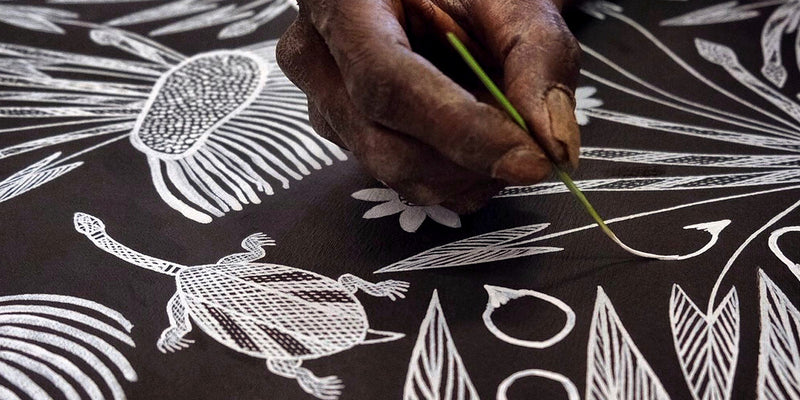
Lena Yarinkura, Duruk (dog), 68cm
Originalkunstwerk, zertifiziert vom Community Art Centre.
Gemeinschaftlich zertifiziertes Kunstwerk
Dieses originale Kunstwerk wird im Namen von Maningrida Arts and Culture, einem gemeinschaftlich geführten Kunstzentrum, verkauft. Es enthält ein Echtheitszertifikat.
– Unikat 1/1
- Details
- Artwork
- Artist
- Art Centre
- Aboriginal Artists - Lena Yarinkura
- Community - Maningrida
- Homeland - Buluhkarduru
- Aboriginal Art Centre - Maningrida Arts and Culture
- Catalogue number - 1227-25
- Materials - Pandanus, Natural dyes, Paperbark, Beach Hibiscus, Ochre
- Size(cm) - L68, H22, W19
- Postage - Legs and ears removable for safe delivery
Materials for these camp dogs come from the clan estate. Pandanus and grass are the twines used for the creature's bodies. Red, white and yellow ochres and black ashes are then carefully mixed and applied for colour. The use of local materials provides an integral link between the mythological nature of the creatures, which inhabit the country, and their physical form.
“No one taught me to use pandanus to make my animals. I have been teaching myself, I create new ways all the time. They are only my ideas…I pass my ideas on to my children and my grandchildren. It is important that I teach them, because one day I will be gone, and they will take my place.”
– Lena Yarinkura, 2012
Lena Yarinkura is renowned for her ambitious and highly distinctive pandanus and paperbark fibre sculptures. Yarinkura diverged from the more conventional fibre work of her contemporaries to become one of the first Arnhem Land women to work with fibre in a sculptural way.
Yarinkura has developed her method using pandanus in much the same process as a dilly bag or fish trap might be made: beginning by creating a closed end, much like the base of a dilly bag. When making her noted Yawkyawk spirit form, Yarinkura works up and out to gently expand the woven structure to fashion a bulbous torso before narrowing the weave at the torso’s base or hips to create a flat two layered section representing the tail fins. The ochre pigment applied to the textured weave of the pandanus fibre, suggest the scales of the water spirits and the shimmering quality to their skin.
An art movement that is striking, political and enduring: this is what contemporary artists in Maningrida and the surrounding homelands have built, powered by their ancestral connections to country and djang.
Ways of learning and schools of art in Arnhem Land are based around a system of passing knowledge and information on to others. The art here has its genesis in body design, rock art and cultural practices, in concert with more than 50 years of collaborations, travel and political action to retain ownership of country. Values and law are expressed through language, imagery, manikay (song), bunggul (dance), doloppo bim (bark painting), sculptures, and kun-madj (weaving) – the arts.
The artists’ transformation of djang into contemporary artistic expression has intrigued people around the world: art curators and collectors, and stars including Yoko Ono, Jane Campion, David Attenborough and Elton John. Pablo Picasso said of Yirawala’s paintings, ‘This is what I’ve been trying to achieve all my life.’
Yirawala (c.1897–1976) was a legendary Kuninjku leader, artist, land-rights activist and teacher, and his artwork was the first of any Indigenous artist to be collected by the National Gallery of Australia as part of a policy to represent in depth the most significant figures in Australian art.
Maningrida Arts & Culture is based on Kunibídji country in Arnhem Land in Australia’s Northern Territory. The area where artists live encompasses 7,000 square kilometres of land and sea, and over 100 clan estates, where people speak more than 12 distinct languages. Aboriginal people in this region are still on country, surviving and resilient because their country is the centre of their epistemology, their belief system, culture – djang.
Artists’ works from the larger Maningrida region can be seen in collections and institutions around the world. We work with museums, contemporary galleries and high-end retailers both nationally and internationally on projects throughout the year.
Text courtesy: Maningrida Arts and Culture
"Great experience. Love my painting." - Caitlin, Aus – ART ARK Customer Review
Kunst aus Arnhem Land aus den Homelands von Maningrida
Dieses Kunstwerk stammt von Maningrida Arts & Culture im Kunibídji-Land in Arnhem Land. Künstler leben in Homelands, die mehr als 7.000 km² Land und Meer sowie über 100 Clan-Gebiete umfassen, in denen viele unterschiedliche Sprachen gesprochen werden und Menschen weiterhin auf ihrem Country leben.
— Bild: Freda Ali Wayartja beim Sammeln von Pandanus, Maningrida Arts & Culture