Panier
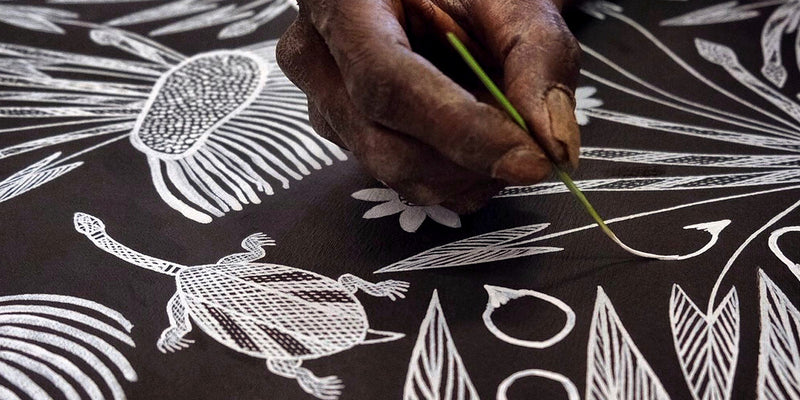
  • Marcus Cameron, 93x48cm Bark Painting
  • Marcus Cameron, 93x48cm Bark Painting
  • Marcus Cameron, 93x48cm Bark Painting

Marcus Cameron, 93x48cm Bark Painting

In northern Australia, paintings on bark shelters in the Kimberley and Arnhem Land were stylistically similar to rock shelter paintings.
  • Retours sous 120 jours
  • Envoi assuré gratuit
  • Expédié de Tasmanie sous 1 jour, transit 5 à 10 jours
  • TVA réduite à l'import sur l'art original
  • Images aux couleurs fidèles
Maningrida Arts and Culture Certificate of Authenticity

Œuvre certifiée par la communauté

Cette œuvre originale est vendue au nom de Maningrida Arts and Culture, un centre d’art communautaire. Elle comprend un certificat d’authenticité.

  • Aboriginal Artist - Marcus Cameron
  • Community - Maningrida
  • Homeland - Manmoyi
  • Aboriginal Art Centre - Maningrdia Arts
  • Catalogue number - 726-24
  • Materials - Earth pigments on fire-hardened stringybark
  • Size(cm) - H93 W48 D2 (irregular)
  • Orientation - As displayed
  • Postage variant - Delivered ready to hang with a metal mount on the reverse

Aboriginal bark paintings have a long cultural tradition, believed to extend back many thousands of years. In northern Australia, paintings on bark shelters in the Kimberley and Arnhem Land were stylistically similar to rock shelter paintings. The Aboriginal bark paintings were used to convey and illustrate stories which were told to the clan when holed up in the shelter for long periods in the wet season. In the Kimberley, the Aboriginal bark paintings by Lily Karadada resemble ancient rock art Wandjina paintings which are themselves many, many thousands of years old. Bark paintings with deep cultural and ritual significance still feature in the Aboriginal sacred ceremonies of northern Australia, and Arnhem Land artists, along with some coastal inhabitants, are the only Aboriginal people still making traditional bark paintings. The process of making a bark painting begins with choosing a suitable stringybark eucalyptus tree, preferably in the wet season when the sap is rising and the bark is fairly supple and easy to grip. After finding a section of bark that is devoid of knots and termite damage, cuts are made top and bottom and after some encouragement by tugging and prying, a hollow open cylinder of bark is removed. The bark sheet is trimmed and a fire made ready, over which the bark will be cured to drive out any moisture. The bark is then flattened to the ground with feet and then held down with heavy weights to ensure that it doesn't curl or warp. The Aboriginal bark painters of Arnhem Land adhere to four basic pigments: red, black, white and yellow. The reds and yellows come from ochres, crushed and powdered rocks. White comes from pipeclay and black generally comes from charcoal. Sometimes natural fixatives are mixed in to bind the pigments, including wax, egg yolk, resins and the sap of orchid plants. The paint can then be applied to the bark, perhaps as a rarrk design, using a wood comb, or with brushes made from human hair or even feathers.

Details are currently unavailable

An art movement that is striking, political and enduring: this is what contemporary artists in Maningrida and the surrounding homelands have built, powered by their ancestral connections to country and djang.

Ways of learning and schools of art in Arnhem Land are based around a system of passing knowledge and information on to others. The art here has its genesis in body design, rock art and cultural practices, in concert with more than 50 years of collaborations, travel and political action to retain ownership of country. Values and law are expressed through language, imagery, manikay (song), bunggul (dance), doloppo bim (bark painting), sculptures, and kun-madj (weaving) – the arts.

The artists’ transformation of djang into contemporary artistic expression has intrigued people around the world: art curators and collectors, and stars including Yoko Ono, Jane Campion, David Attenborough and Elton John. Pablo Picasso said of Yirawala’s paintings, ‘This is what I’ve been trying to achieve all my life.’

Yirawala (c.1897–1976) was a legendary Kuninjku leader, artist, land-rights activist and teacher, and his artwork was the first of any Indigenous artist to be collected by the National Gallery of Australia as part of a policy to represent in depth the most significant figures in Australian art.

Maningrida Arts & Culture is based on Kunibídji country in Arnhem Land in Australia’s Northern Territory. The area where artists live encompasses 7,000 square kilometres of land and sea, and over 100 clan estates, where people speak more than 12 distinct languages. Aboriginal people in this region are still on country, surviving and resilient because their country is the centre of their epistemology, their belief system, culture – djang.

Artists’ works from the larger Maningrida region can be seen in collections and institutions around the world. We work with museums, contemporary galleries and high-end retailers both nationally and internationally on projects throughout the year.

Text courtesy: Maningrida Arts and Culture

Art d’Arnhem Land des homelands de Maningrida

Art d’Arnhem Land des homelands de Maningrida

Cette œuvre provient de Maningrida Arts & Culture, basé sur le pays Kunibídji en Arnhem Land. Les artistes vivent dans des homelands couvrant plus de 7 000 km² de terre et de mer et plus de 100 domaines claniques, où de nombreuses langues distinctes sont parlées et où les communautés continuent de vivre sur leur Country.

— Image : Freda Ali Wayartja récoltant le pandanus, Maningrida Arts & Culture

"Experience was smooth, quick and friendly. Perfect for mum." - Erin, Aus – ART ARK Customer Review


← Page précédente Tissage de la Terre d'Arnhem Art de la Terre d'Arnhem Peintures aborigènes à points Abonnés Peintures tendues Tissage du désert Peintures de paysages


Remote Aboriginal artists share their culture through art

Soutien aux artistes aborigènes

En partageant leur culture, les artistes des régions éloignées créent des opportunités pour eux-mêmes. Acheter de l'art aborigène de manière éthique soutient ces artistes tout en apportant chaleur et sens à votre intérieur.


Aboriginal artwork displayed in a home

Des œuvres d'art originales qui embelliront votre intérieur

De belles œuvres d'art originales qui s'intègrent parfaitement à votre intérieur. Votre achat soutient les artistes aborigènes et nous aide à poursuivre notre mission de célébration et de promotion de l'art aborigène éthique.

Nous sommes convaincus que vous aimerez votre œuvre d'art, mais si, pour une raison quelconque, elle ne vous convient pas, retournez-la dans les 120 jours. Facile. Plus de 1 670 clients ont partagé leurs expériences, et ils adorent leurs œuvres d'art.

Réserver une œuvre

Vous pouvez sécuriser une œuvre avec un acompte de 20 %. Utilisez le code DEPOSIT20 lors du paiement et réglez le solde dans les 30 jours (nous vous enverrons une facture par e-mail).

Les acomptes ne sont pas remboursables, mais une fois le paiement intégral effectué, votre œuvre est expédiée normalement, couverte par notre politique de retour de 120 jours.


Aboriginal painting in situ with the certificate of authenticity shown

Authenticité certifiée par les centres d'art communautaires

Seuls les certificats des centres d'art aborigènes communautaires garantissent un approvisionnement éthique, assurant que votre achat soutient l'artiste et sa communauté. Chaque œuvre ART ARK® inclut cette documentation, offrant transparence et confiance quant à son origine. La preuve de provenance garantit l'authenticité et contribue à la valeur à long terme de l'œuvre.

En savoir plus sur l'authenticité de l'art aborigène.


Aboriginal artwork being photographed and colour corrected

Précision des couleurs garantie

Nous passons des heures pour garantir que votre œuvre d'art arrivera telle que présentée. Soigneusement emballée, aux couleurs exactes, et prête à être aimée.

Les couleurs sont assorties aussi fidèlement que possible, et avec moins de 0,2 % de retours, nos clients sont constamment ravis de leurs œuvres d'art.


Example of an Aboriginal painting framed in a float frame

Encadrer l'art aborigène

Nous maintenons une transparence des prix en livrant les œuvres sans frais tiers supplémentaires, ce qui nous permet d'offrir la livraison gratuite et de maintenir les prix en accord avec chaque centre d'art. Les toiles et les pièces en lin sont envoyées roulées pour une livraison sûre et un ré-étirage facile chez votre encadreur local.

En savoir plus sur l'encadrement de l'art aborigène.


Worldwide shipping from ART ARK

Expédition rapide et gratuite

De la Tasmanie à votre porte, où que vous soyez dans le monde. Les commandes sont expédiées sous 1 jour ouvrable et arrivent en 1 à 3 jours en Australie et en 5 à 10 jours à l'international. Profitez de la livraison domestique gratuite sur toutes les commandes. La livraison internationale est gratuite pour les commandes de plus de 500 $AUD, et un tarif fixe de 30 $AUD s'applique pour les commandes inférieures à ce montant.

Douanes et droits : Les œuvres d'art originales (codes tarifaires 9701.91 pour les peintures et dessins, 9703.00 pour les sculptures) sont exemptes de droits et taxes à l'arrivée aux États-Unis et au Canada. Le Royaume-Uni applique une TVA réduite de 5 %, la France 5,5 % et l'Allemagne 7 %. D'autres pays peuvent avoir des taux différents, nous vous recommandons donc de vérifier avant l'achat.

*Le délai de livraison estimé pour les expéditions internationales est de 5 à 10 jours ouvrables, sans compter le temps de traitement douanier, qui varie selon les pays.

En savoir plus sur les douanes et l'expédition.


arty emails? (they're good)