Merrkiyawuy #2 Munuŋgurr, Dhatam, 86x35cm
- Retours sous 120 jours
- Envoi assuré gratuit
- Expédié de Tasmanie sous 1 jour, transit 5 à 10 jours
- TVA réduite à l'import sur l'art original
- Images aux couleurs fidèles

Œuvre certifiée par la communauté
Cette œuvre originale est vendue au nom de Buku-Larrŋgay Mulka Centre, un centre d’art communautaire. Elle comprend un certificat d’authenticité.
- Détails
- Artwork
- Bark Process
- Artist
- Art Centre
- Aboriginal Artist - Merrkiyawuy #2 Munuŋgurr
- Community - Yirkala
- Homeland - Waṉḏaway
- Aboriginal Art Centre - Buku-Larrŋgay Mulka Centre
- Catalogue number - 1084-26
- Materials - Earth pigments on fire-hardened Stringybark
- Size(cm) - H86 W35 D1-2 (irregular shape)
- Postage variants - Artwork posted flat and ready to hang with a metal mount
- Orientation - OK to hang as wished. Strung to hang as pictured.
This imagery refers to perhaps the oldest continuous human religious iconographical practice: the story of the Rainbow Serpent. Estimates vary from 40,000-60,000 years on the depictions of the Rainbow Serpent in West Arnhem rock shelters.
Amongst the Dhatam, waterlillies, two ancestral figures travelled Gälpu clan lands and on further, during the days of early times called Waŋarr: Wititj, the all powerful rainbow serpent (olive python) and Djaykuŋ the Javanese filesnake that is a companion and possibly alternate incarnation of Wititj, living in amongst the Dhatam, or waterlillies, causing ripples and rainbows (Djari) on the surface of the water (one reference in the cross hatch).
The story of Wititj is of storm and monsoon, in the ancestral past. It has particular reference to the mating of Wititj during the beginning of the wet season when the Djarrwa (square shaped thundercloud) begin forming and the lightning starts striking.
The Galpu clan miny’tji (sacred clan design behind the lillies) represents Djari (rainbows) and the power of the lightning within them. It also refers to the power of the storm created by Wititj, the diagonal lines representing trees that have been knocked down as Wititj moves from place to place. The ribs of the snake also form the basis of the sacred design here.
The sun shining against the scales of the snake form a prism of light like a rainbow. The arc which a snake in motion travels through holds to a rainbow shape but causes the oily shimmer to refract the colours of the rainbow. The power of the lightning is made manifest when they strike their tongue. The thunder being the sound they make as they move along the ground. The morning after a major cyclone there are swathes of stringybark bent over in snake trails through the bush in just the same way a normal scale snake leaves bent over grass traceable by trained trackers. After Cyclone Monica there was a path cleared through the stringybark forest almost from Maningrida to Jabiru.
In mortuary ceremony for Gälpu, the slithering line of dancers take on the form of Wititj and coil in the sand searching for their place. As the spirit comes to rest it adopts the metaphor of a python settling its head into the fork in the tree, known as Galmak, the final resting place of Wititj. Other references are the bunches of leaves dancers hold in their hands wet and shining in the sun, perhaps like a rainbow. This pattern is the fury of the tempest seen through the relief of the emerging survivor as the storm moves on sucking the cloud with it, allowing the sun to shine.
In many ways, the harvesting and material production to create bark paintings is an art in itself. The bark is stripped from Eucalyptus stringybark. It is generally harvested from the tree during the wet season. Two horizontal slices and a single vertical slice are made into the tree, and the bark is carefully peeled off. The smooth inner bark is kept and placed in a fire. After firing, the bark is flattened and weighted to dry flat. Once dry, the bark becomes a rigid surface and is ready to paint upon.

Djawakan Marika, Yilpirr Wanambi, Wukun Wanambi and Nambatj Munu+ïgurr Harvesting stringybark for artists Photo credit: David Wickens

Wanapa Munu+ïgurr, Yilpirr Wanambi and Wukun Wanambi harvesting stringybark. Photo credit: David Wickens

Wanapa and Nambatj Munu+ïgurr firing a bark to start the flattening process. Photo credit: David Wickens
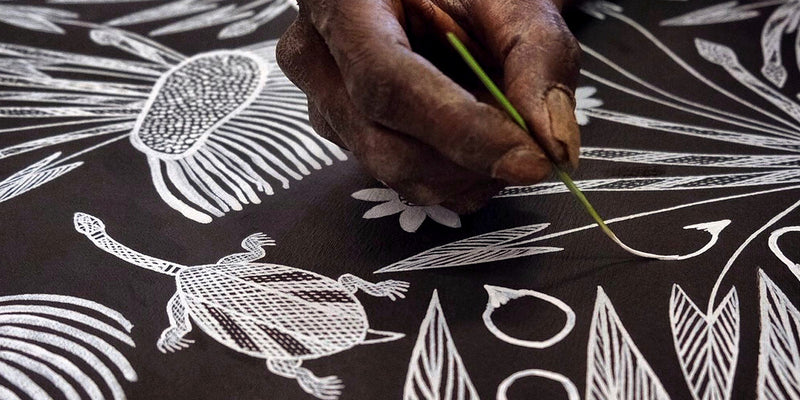
Arnhem Land paintings are characterised by the use of fine crosshatched patterns of clan designs that carry ancestral power: the crosshatched patterns, known as rarrk in the west and miny’tji in the east, produce an optical brilliance reflecting the presence of ancestral forces.
These patterns are composed of layers of fine lines, laid onto the surface of the bark using a short-handled brush of human hair, just as they are painted onto the body for ceremony.

Rerrkiwaŋa Munuŋgurr painting her husbands design Gumatj fire or Gurtha. Photo credit: Buku-Larrŋgay Mulka Centre
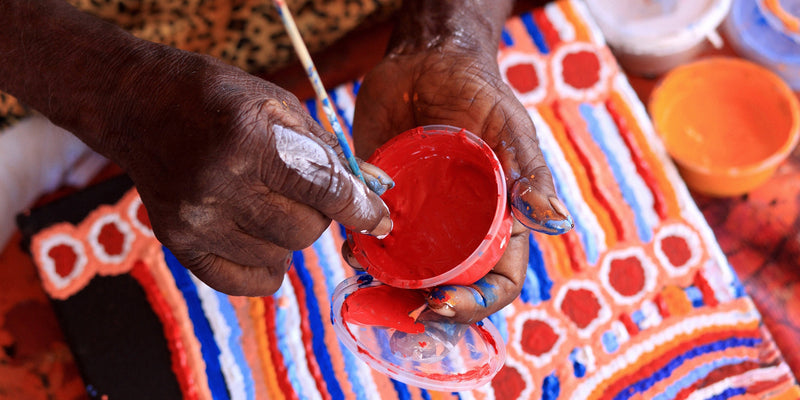
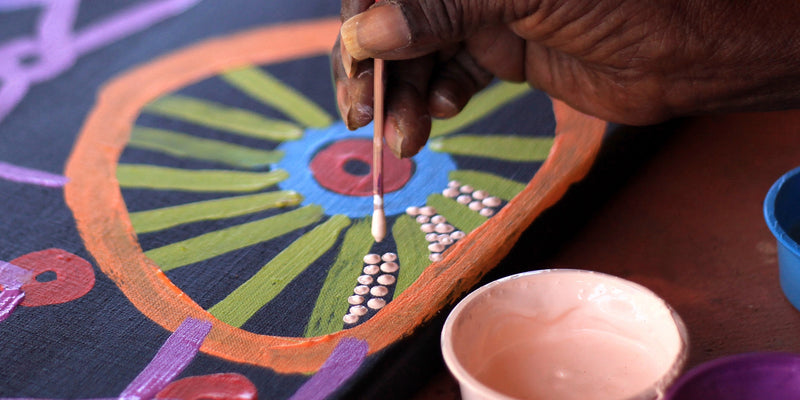
The artist’s palette consists of red and yellow ochres of varying intensity and hues, from flat to lustrous, as well as charcoal and white clay(pictured above). Pigments that were once mixed with natural binders such as egg yolk have, since the 1960s, been combined with water-soluble wood glues.

Naminapu Maymuru White collecting gapan white clay used for painting. Photo credit: Edwina Circuitt
Details currently unavailable
Buku-Larrŋgay Mulka Centre is the Indigenous community-controlled art centre of Northeast Arnhem Land. Located in Yirrkala, a small Aboriginal community on the north-eastern tip of the Top End of the Northern Territory, approximately 700km east of Darwin. Our primarily Yolŋu (Aboriginal) staff of around twenty services Yirrkala and the approximately twenty-five homeland centres in the radius of 200km.
In the 1960’s, Narritjin Maymuru set up his own beachfront gallery from which he sold art that now graces many major museums and private collections. He is counted among the art centre’s main inspirations and founders, and his picture hangs in the museum. His vision of Yolŋu-owned business to sell Yolŋu art that started with a shelter on a beach has now grown into a thriving business that exhibits and sells globally.
Buku-Larrŋgay – “the feeling on your face as it is struck by the first rays of the sun (i.e. facing East)
Mulka – “a sacred but public ceremony.”
In 1976, the Yolŋu artists established ‘Buku-Larrŋgay Arts’ in the old Mission health centre as an act of self-determination coinciding with the withdrawal of the Methodist Overseas Mission and the Land Rights and Homeland movements.
In 1988, a new museum was built with a Bicentenary grant and this houses a collection of works put together in the 1970s illustrating clan law and also the Message Sticks from 1935 and the Yirrkala Church Panels from 1963.
In 1996, a screen print workshop and extra gallery spaces was added to the space to provide a range of different mediums to explore. In 2007, The Mulka Project was added which houses and displays a collection of tens of thousands of historical images and films as well as creating new digital product.
Still on the same site but in a greatly expanded premises Buku-Larrŋgay Mulka Centre now consists of two divisions; the Yirrkala Art Centre which represents Yolŋu artists exhibiting and selling contemporary art and The Mulka Project which acts as a digital production studio and archiving centre incorporating the museum.
Text courtesy: Buku-Larrŋgay Mulka Centre

Art Yolŋu du nord-est d’Arnhem Land
Cette œuvre provient du Buku-Larrŋgay Mulka Centre à Yirrkala. Le centre représente des artistes Yolŋu des homelands du nord-est d’Arnhem Land où l’art reste étroitement lié au Country, aux cérémonies et à la transmission des savoirs culturels.
— Image : collecte d’écorce pour la peinture, Buku-Larrŋgay Mulka Centre
"It included fantastic supporting documentation with information about the artist, the piece and how the purchase supports the artist directly. My friend absolutely loves it!" - Soraya, Aus
– Read all 1,700+ ART ARK Customer Reviews