- Détails
- Œuvre d'art
- Procédé d'écorce
- Artiste
- Centre d'art
- Artiste aborigène - Munhala Dhamarrandji
- Communauté - Yirkala
- Terre d'origine - Yilpara
- Centre d'art aborigène - Buku-Larrŋgay Mulka Centre
- Numéro de catalogue - 1882-25
- Matériaux - Pigments terreux sur écorce de stringybark durcie au feu
- Taille(cm) - H53 L31 P1 (irrégulier)
- Options d'expédition - Œuvre expédiée à plat et prête à être accrochée avec un support métallique rigide
- Orientation - Telle qu'affichée
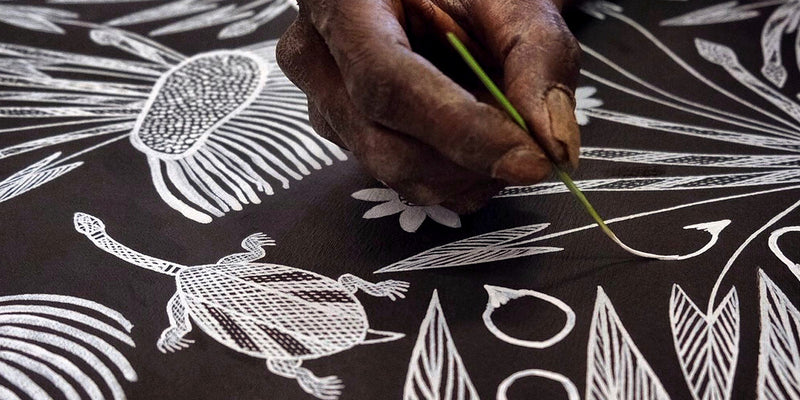
Cette peinture représente le miny'tji de Batjimurruŋu, un coquillage de la zone des mangroves qui grimpe le long des racines aériennes des mangroves à marée montante. Il est chanté par le clan Djambarrpuyngu avec les noms de famille Guyula / Dhamarrandji et se rapporte à la région de la baie de Buckingham de Gurula Dhulmuwandany. C'est un motif appris par l'artiste par l'intermédiaire du premier mari de sa mère et c'est son clan sœur classificatoire.
Ce lieu et ce motif, ces chants et le coquillage lui-même sont liés aux chants des sœurs Djaŋ'kawu de la moitié Dhuwa.
Batjimurruŋu est Cassidula angulifera ou la coquille d'oreille angulaire. Les synonymes sont miniminipi et mitjalaŋaniŋ.
À bien des égards, la récolte et la production des matériaux nécessaires à la création de peintures sur écorce sont un art en soi. L'écorce est prélevée sur l'eucalyptus stringybark. Elle est généralement récoltée sur l'arbre pendant la saison des pluies. Deux incisions horizontales et une incision verticale sont pratiquées dans l'arbre, et l'écorce est délicatement retirée. L'écorce intérieure lisse est conservée et placée dans un feu. Après avoir été chauffée, l'écorce est aplatie et lestée pour sécher à plat. Une fois sèche, l'écorce devient une surface rigide et est prête à être peinte.

Djawakan Marika, Yilpirr Wanambi, Wukun Wanambi et Nambatj Munu+ïgurr Récolte d'écorce de stringybark pour les artistes Crédit photo : David Wickens

Wanapa Munu+ïgurr, Yilpirr Wanambi et Wukun Wanambi récoltant de l'écorce de stringybark. Crédit photo : David Wickens

Wanapa et Nambatj Munu+ïgurr brûlant une écorce pour commencer le processus d'aplatissement. Crédit photo : David Wickens
Les peintures d'Arnhem Land se caractérisent par l'utilisation de fins motifs hachurés de dessins de clans qui portent un pouvoir ancestral : les motifs hachurés, connus sous le nom de rarrk à l'ouest et de miny'tji à l'est, produisent une brillance optique reflétant la présence de forces ancestrales.
Ces motifs sont composés de couches de fines lignes, appliquées sur la surface de l'écorce à l'aide d'une brosse à manche court en cheveux humains, de la même manière qu'elles sont peintes sur le corps pour les cérémonies.

Rerrkiwaŋa Munuŋgurr peignant le motif de son mari, le feu Gumatj ou Gurtha. Crédit photo : Buku-Larrŋgay Mulka Centre
La palette de l'artiste se compose d'ocres rouges et jaunes d'intensité et de teintes variables, du mat au lustré, ainsi que de charbon de bois et d'argile blanche (illustrés ci-dessus). Les pigments qui étaient autrefois mélangés à des liants naturels tels que le jaune d'œuf sont, depuis les années 1960, combinés à des colles à bois hydrosolubles.

Naminapu Maymuru White collectant l'argile blanche gapan utilisée pour la peinture. Crédit photo : Edwina Circuitt
Les détails sont actuellement indisponibles.
Le Buku-Larrŋgay Mulka Centre est le centre d'art contrôlé par la communauté indigène du nord-est d'Arnhem Land. Il est situé à Yirrkala, une petite communauté aborigène à la pointe nord-est du Top End du Territoire du Nord, à environ 700 km à l'est de Darwin. Notre personnel principalement Yolŋu (aborigène), composé d'une vingtaine de personnes, dessert Yirrkala et les environ vingt-cinq centres de patrie dans un rayon de 200 km.
Dans les années 1960, Narritjin Maymuru a créé sa propre galerie en bord de mer d'où il a vendu des œuvres d'art qui ornent aujourd'hui de nombreux grands musées et collections privées. Il est considéré comme l'une des principales inspirations et fondateurs du centre d'art, et son portrait est accroché dans le musée. Sa vision d'une entreprise appartenant aux Yolŋu pour vendre de l'art Yolŋu, qui a commencé par un abri sur une plage, est devenue une entreprise florissante qui expose et vend dans le monde entier.
Buku-Larrŋgay – « la sensation sur votre visage lorsque les premiers rayons du soleil vous frappent (c'est-à-dire en direction de l'est)
Mulka – « une cérémonie sacrée mais publique. »
En 1976, les artistes Yolŋu ont créé « Buku-Larrŋgay Arts » dans l'ancien centre de santé de la Mission, en signe d'autodétermination, coïncidant avec le retrait de la Mission méthodiste d'outre-mer et les mouvements pour les droits fonciers et les terres d'origine.
En 1988, un nouveau musée a été construit grâce à une subvention du bicentenaire. Il abrite une collection d'œuvres rassemblées dans les années 1970 illustrant le droit des clans, ainsi que les Message Sticks de 1935 et les Yirrkala Church Panels de 1963.
En 1996, un atelier de sérigraphie et des espaces de galerie supplémentaires ont été ajoutés pour offrir un éventail de médiums différents à explorer. En 2007, le projet Mulka a été ajouté, qui abrite et expose une collection de dizaines de milliers d'images et de films historiques, tout en créant de nouveaux produits numériques.
Toujours sur le même site mais dans des locaux considérablement agrandis, le Buku-Larrŋgay Mulka Centre se compose désormais de deux divisions : le Yirrkala Art Centre qui représente les artistes Yolŋu exposant et vendant de l'art contemporain, et le projet Mulka qui fait office de studio de production numérique et de centre d'archivage intégrant le musée.
Texte fourni par : Buku-Larrŋgay Mulka Centre
"This is our second purchase from Art Ark and we just could not be happier. We are also very happy with how this company works with artists and communities in ensuring that it does so fairly and ethically. Thrilled!!" - Milena, Aus
– Read all 1,680+ ART ARK Customer Reviews